i Short answer
A prime of prime broker sits between large tier-1 banks and smaller liquidity providers, and your smaller retail broker.
It provides aggregated liquidity access that indirectly affects your execution quality.
📋 ON THIS PAGE
- The liquidity chain explained from top to bottom
- Why smaller brokers can't access tier-1 liquidity directly
- How this affects your actual trading experience
- Does this chain affect your funds' safety
- Identifying your broker's position in this chain
- Why this matters more for some trading styles than others
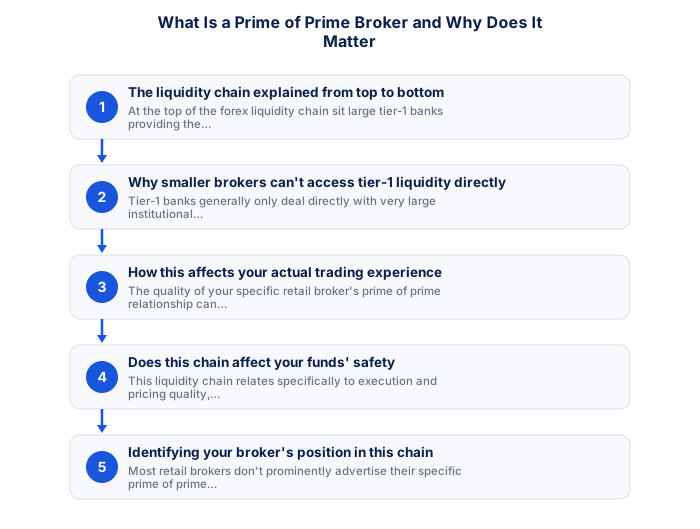
1. The liquidity chain explained from top to bottom
At the top of the forex liquidity chain sit large tier-1 banks providing the deepest, most direct market liquidity. Prime of prime brokers aggregate access to multiple tier-1 banks, then make this aggregated liquidity available to smaller retail brokers who couldn't otherwise meet tier-1 banks' typically very high minimum trading volume and capital requirements for direct access.
2. Why smaller brokers can't access tier-1 liquidity directly
Tier-1 banks generally only deal directly with very large institutional counterparties given their own minimum size and capital requirements, meaning the retail brokers's content typically cannot meet these thresholds independently. Prime of prime brokers specifically exist to bridge this gap, aggregating sufficient volume across many smaller broker clients to meet tier-1 access requirements collectively.
- Search FSP name or number at fsca.co.za
- Confirm licence is current and not suspended
- Check scope covers forex and CFD activity
- Confirm client funds in segregated accounts
- Read FSCA enforcement actions history
- Test customer support before depositing
- Client funds legally segregated
- FSCA complaints process available
- SA consumer protections apply
- ZAR account, no FX conversion costs
- Some offshore brokers offer wider instruments
- Regulatory overhead passed on in spreads
- Stricter position limits for retail clients
- FICA verification required before trading
- Client funds segregated
- Formal FSCA complaints process
- SA consumer protections apply
- ZAR account available
- Fund safety not guaranteed
- Overseas disputes only
- SA law does not apply
- Currency conversion costs
3. How this affects your actual trading experience
The quality of your specific retail broker's prime of prime relationship can affect the spreads, and execution reliability you experience as an end client, since this relationship ultimately determines the underlying liquidity pool your broker draws from when filling your orders. A broker with a strong, well-established prime of prime relationship generally can offer more competitive, reliable pricing than one with weaker liquidity access.
See also: My Broker Merges Brands: What Happens to My Account?
4. Does this chain affect your funds' safety
This liquidity chain relates specifically to execution and pricing quality, rather than directly to the fund segregation and regulatory protections, your relationship and regulatory protection remain with your own contracted retail broker, regardless of which prime of prime relationship that broker maintains behind the scenes.
| Protection | FSCA Regulated | Offshore Unregulated |
|---|---|---|
| Client fund segregation | ✓ Required | Varies by broker |
| SA complaints process | ✓ Available | ✗ Not available |
| SA consumer law applies | ✓ Yes | ✗ No |
| ZAR account available | ✓ Typically | Often USD/EUR only |
5. Identifying your broker's position in this chain
Most retail brokers don't prominently advertise their specific prime of prime relationships, though some more transparent brokers do disclose this information, sometimes within their execution policy documentation or marketing materials emphasising their liquidity quality as a competitive differentiator worth highlighting to prospective clients.
6. Why this matters more for some trading styles than others
Astrading, the quality of your broker's underlying liquidity chain matters considerably more for these execution-sensitive styles than for the lower-frequency swing or position trading styles, where minor execution quality differences matter proportionally less given these styles' longer holding periods and larger target price movements.
Before trusting any broker with real capital, it's worth directly verifying their FSP licence number on the FSCA's public register, since this single check confirms both that the licence is genuinely active and what specific activities it actually covers.
The FSCA regulatory framework provides South African retail traders with meaningful protection that includes segregated client funds, mandatory disclosure requirements, and a formal complaints process backed by regulatory enforcement. Traders considering offshore brokers outside the FSCA framework should evaluate whether the incremental instrument access or other benefits justify the loss of these domestic regulatory protections, particularly for higher deposit amounts where the downside of unregulated broker failure would be material.
Retail traders sit at the end of a multi-layer liquidity chain. Tier 1 banks supply prime of prime brokers, who supply your broker, who marks up the spread before it reaches you. This explains why spreads vary between brokers.
★ Why It Matters
Something worth asking your broker directly, even though many won't disclose details, which prime of prime relationships they maintain, brokers with stronger PoP relationships typically can offer deeper liquidity and tighter pricing, particularly noticeable during volatile market conditions.
✕ Common mistakes
- Assuming all retail brokers have equally strong prime of prime relationships. These relationships genuinely vary and affect liquidity depth and pricing quality.
- Treating this structural detail as irrelevant to your day-to-day trading. It affects spread quality and execution, particularly during volatile periods.
- Assuming bigger broker brand names automatically mean stronger PoP access. This isn't always reliably correlated with brand recognition.
When evaluating whether a broker is appropriate for South African retail trading, the FSCA public register provides the starting point, but the quality of regulatory compliance goes beyond simply holding a licence. Checking how long the broker has been licensed, whether there are any enforcement actions in their history, and what the FSCA inspection record shows, if available, provides a more complete picture than the licence alone. South African financial consumer bodies periodically publish guidance on broker evaluation that supplements the FSCA register as a due diligence resource.
South African traders choosing between locally-based and internationally-based brokers should weigh FSCA regulatory protection, rand deposit convenience, and ZAR account access against the potentially broader instrument range of some offshore providers. Most South African retail traders' needs are well served by FSCA-regulated brokers who maintain segregated client funds and provide ZAR accounts with EFT deposit and withdrawal support. For traders who specifically need instruments not available through FSCA-regulated providers, verifying the offshore broker's regulation through its home regulator's public register is the essential due diligence step before depositing.
Key Takeaways
- Prime of prime brokers provide liquidity access to smaller retail brokers, indirectly affecting your execution quality even though you trade with a different name.
- A prime of prime broker sits between large tier-1 banks and smaller liquidity providers, and your smaller retail broker.
- It provides aggregated liquidity access that indirectly affects your execution quality.
- The liquidity chain explained from top to bottom.
- Why smaller brokers can't access tier-1 liquidity directly.
See also: What Is a Broker's Client Categorisation Process?.
Frequently asked follow-up questions
Can I trade directly with a prime of prime broker myself?
Generally no for typical retail traders, given the minimum volume and capital requirements these relationships typically require, which are designed for institutional-scale, not individual retail, access.
Does a better prime of prime relationship always mean better spreads?
Generally a contributing factor, though your specific broker's own pricing markup and business model also affect the final spread you actually experience as a client.
Should I ask my broker about their specific liquidity providers?
This is a reasonable question for execution-sensitive traders specifically, though many retail traders don't need this level of detail for their particular trading style.
