i Short answer
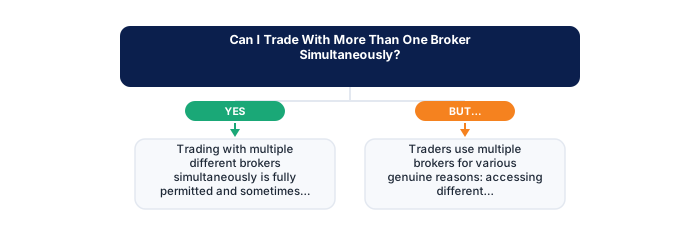
Yes. Trading with multiple different brokers simultaneously is fully permitted and sometimes genuinely useful for comparing execution quality or accessing different instrument ranges.
📋 ON THIS PAGE
- How this differs from multiple accounts with one broker
- Genuine reasons traders use multiple brokers
- Comparing execution quality directly across brokers
- The added administrative complexity this introduces
- Managing separate FICA verification for each broker
- A practical approach to multi-broker trading
1. How this differs from multiple accounts with one broker
Running multiple accounts with one broker means separate accounts sharing a single verified identity, one regulatory relationship, and one set of terms. Multiple brokers means genuinely separate firms: separate FICA verifications, separate capital held at separate institutions, separate regulatory relationships, and separate operational systems to manage.
This distinction is worth keeping clear because the practical implications differ meaningfully. Multiple accounts at one broker can often share the same deposit infrastructure, have a single login portal, and produce consolidated statements. Multiple brokers means truly independent account management across entirely separate platforms with no backend connection.
The benefits and costs of each arrangement are different. Multiple accounts at one broker primarily provide strategic and currency separation within an existing relationship. Multiple separate brokers primarily provide access to different instruments, different regulatory environments, or execution comparison, things that can't be achieved within a single broker relationship.
Clarifying which of those goals you're actually pursuing before deciding whether to add another broker helps determine whether a second account at your existing broker would serve the purpose equally well without the additional administrative complexity.
| Feature | Single Broker | Multiple Brokers |
|---|---|---|
| Administrative complexity | Lower | Higher |
| FICA verification | Once | Separately per broker |
| Execution quality comparison | Not possible | Direct, real-world comparison |
| Combined performance tracking | Simpler | Requires consolidated journal |
2. Genuine reasons traders use multiple brokers
People use multiple brokers for real, practical reasons: accessing instruments one broker doesn't offer, comparing actual execution quality rather than relying on marketing claims, maintaining capital diversification across separate regulated entities, or having access to a backup platform if their primary broker experiences technical issues.
It's worth being honest with yourself about which of these reasons genuinely applies to your situation before taking on the administrative overhead. 'More brokers seems like more sophisticated trading' isn't a functional reason. 'My primary broker doesn't offer the specific JSE instruments I want to trade alongside my international positions' is a functional reason.
- Search FSP name or number at fsca.co.za
- Confirm licence is current and not suspended
- Check scope covers forex and CFD activity
- Confirm client funds in segregated accounts
- Read FSCA enforcement actions history
- Test customer support before depositing
- Client funds legally segregated
- FSCA complaints process available
- SA consumer protections apply
- ZAR account, no FX conversion costs
- Some offshore brokers offer wider instruments
- Regulatory overhead passed on in spreads
- Stricter position limits for retail clients
- FICA verification required before trading
- Client funds segregated
- Formal complaints process
- FSCA dispute resolution
- SA consumer law applies
- ZAR account available
- Fund safety not guaranteed
- Disputes overseas only
- SA law does not apply
- Currency conversion costs
- Tax reporting more complex
Execution quality comparison is one of the more legitimate reasons that's also difficult to evaluate without a live comparison account. Marketing materials and review sites describe average or typical conditions; a small live account running alongside your primary account gives you real, live execution data on your specific instruments at your specific position sizes, information that's genuinely useful for evaluating whether to shift more activity to the better-executing broker.
Capital diversification across regulated entities has a specific logic for traders with meaningful account balances. Client funds at FSCA-regulated brokers must be segregated from the broker's own capital, but that doesn't eliminate the operational risk that comes with concentrating a significant trading balance at a single institution. Spreading capital across two well-regulated brokers reduces that concentration risk.
3. Comparing execution quality directly across brokers
Having accounts with more than one broker allows execution-sensitive traders to compare real, live performance directly, fill quality, slippage, requote frequency, spread during news events, rather than relying on advertised 'typical' figures that reflect best-case conditions. The comparison requires deliberately running similar trades across both brokers to get meaningful data rather than superficial side-by-side screenshots.
This kind of direct comparison is worth structuring deliberately: running comparable trade sizes on similar instruments across both brokers during the same market sessions, and tracking actual fill prices against the quoted price at the time of the order. The difference between brokers in this measure is often more significant than spread alone suggests, particularly during volatile periods when execution quality diverges from normal conditions.
The insight this comparison produces has clear value: it tells you whether the cost savings from a lower spread are genuine in practice or are offset by worse fills during the conditions where execution quality matters most. That's information you can't get from a broker's marketing materials or from any third-party review.
Once you have sufficient comparison data, the practical next step is usually consolidating to the better-executing broker rather than maintaining both indefinitely. The goal of the comparison account is to generate information, not to create a permanent multi-broker setup for its own sake.
4. The added administrative complexity this introduces
The cost of multiple brokers is administrative complexity: multiple separate logins, separate capital pools to manage, multiple sets of statements to consolidate for tax purposes, and staying on top of different account requirements, margin levels, and fee structures across genuinely separate systems.
This overhead is worth weighing honestly against the specific benefit you're seeking. Managing two broker accounts is roughly twice the administrative work of managing one, and the time this consumes is time not spent on improving your analysis, managing your primary positions, or doing anything else that contributes to trading performance.
| Protection | FSCA Regulated | Offshore Unregulated |
|---|---|---|
| Client fund segregation | ✓ Required | Varies by broker |
| SA complaints process | ✓ Available | ✗ Not available |
| SA consumer law applies | ✓ Yes | ✗ No |
| ZAR account available | ✓ Typically | Often USD/EUR only |
Tax reporting adds a specific complexity layer. SARS requires you to report all trading income across all brokers in your return for the relevant tax period. Combining statements from two different platforms, with different date formats, different currency conventions, and different trade reporting approaches, into a single accurate picture is more work than working from a single source. Building this process before it becomes urgent, at the time you open the second account, is substantially easier than assembling it retrospectively.
Monitoring margin requirements across two separate accounts independently also requires attention. A margin call developing at your secondary broker while you're focused on your primary account can escalate faster than you'd notice if you're not maintaining consistent oversight of both.
5. Managing separate FICA verification for each broker
Unlike additional accounts within a single broker relationship, each separate broker requires its own full FICA verification from scratch. Every broker must independently confirm your identity and meet their own compliance obligations, they can't rely on verification another institution has already conducted.
It's worth having your standard verification documents readily accessible in digital form rather than needing to locate and rescan physical documents each time you add a new broker. A current South African ID or passport, a recent proof of address, and your bank account details cover the core requirements for most FSCA-regulated brokers. Keeping clean digital copies of these in a secure, accessible location makes the verification process for any new broker relationship significantly faster.
The verification timeline at a new broker can vary from same-day to several days depending on their internal processes and the completeness of the documentation you provide. Planning this lead time into any decision about when to start using the new account prevents arriving at the new platform ready to trade and finding the account isn't yet verified.
Periodic KYC reviews at each broker operate independently, one broker refreshing your verification doesn't satisfy another broker's review requirement. If you're actively trading at multiple brokers, tracking the verification status and documentation currency at each institution separately is part of maintaining your accounts in good standing.
6. A practical approach to multi-broker trading
For most traders, the sensible balance is one primary broker for the bulk of activity, plus perhaps one more for a clear, specific purpose, access to a particular instrument, a comparison period, or genuine capital diversification. Beyond that, the administrative overhead typically exceeds the practical benefit for most retail trading operations.
FSCA regulation of retail CFD and forex brokers provides a baseline protection framework that applies regardless of which regulated broker you're dealing with. Checking each broker's FSCA registration status, their client fund segregation practices, and their specific terms is the due diligence that applies equally whether you're opening your first account or adding a second one.
An underused benefit of briefly running a comparison account alongside your main one: it gives you real, lived execution-quality data across both brokers, not from the broker's own marketing, not from third-party reviews, but from your own trading experience at your actual sizes during actual market conditions. That data has genuine decision-making value, and it often clarifies relatively quickly whether the second broker is better, worse, or equivalent to your primary one.
✕ Common mistakes
- Spreading capital too thin across too many brokers. Smaller balances per broker can limit practical position sizing.
- Not comparing execution quality with real, lived data. A small comparison account often reveals more than review sites can.
- Losing track of combined exposure across all accounts. Total risk should be assessed across brokers together, not in isolation.
- Forgetting login details or verification status for a rarely used account. Dormant secondary accounts can drift out of compliance unnoticed.
How long does verification take?
A day is typical when the paperwork is in order. An unclear address proof or a mismatch against the bank account adds days. Switching brokers covers it in full.
Key Takeaways
- Yes, trading with multiple brokers is permitted and sometimes useful for comparing execution or accessing different instrument ranges, though it adds complexity.
- Trading with multiple different brokers simultaneously is fully permitted and sometimes genuinely useful for comparing execution quality or accessing different instrument ranges.
- How this differs from multiple accounts with one broker.
- Genuine reasons traders use multiple brokers.
- Comparing execution quality directly across brokers.
Frequently asked follow-up questions
Does the FSCA restrict how many brokers I can use?
No, there's no regulatory limit on how many different FSCA-regulated brokers an individual client can use simultaneously.
Should I split my trading capital evenly across multiple brokers?
This depends on your specific reasons for using multiple brokers. An even split isn't necessarily optimal if your purpose is specific (like accessing a particular instrument) rather than general diversification.
Is it harder to track overall performance across multiple brokers?
Yes, this requires more deliberate record-keeping, to maintain a complete, accurate picture of your overall trading performance across separate broker relationships.
