i Short answer
A VPS runs your trading platform on a remote server with constant uptime and connectivity.
A dedicated personal laptop still depends entirely on your own local power and internet connection remaining available.
📋 ON THIS PAGE
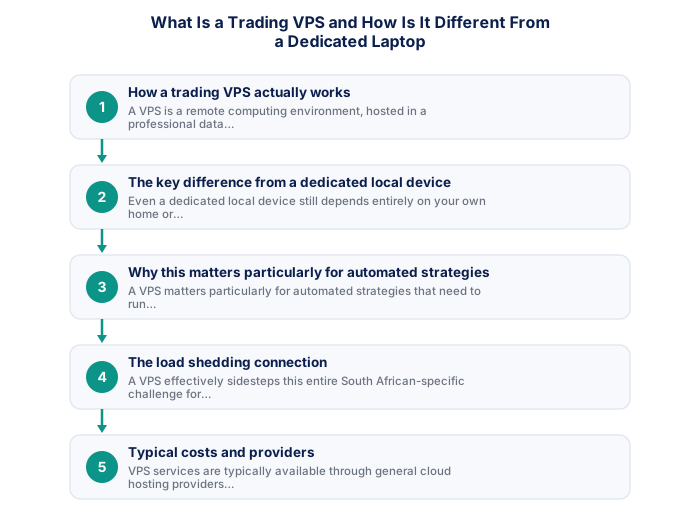
1. How a trading VPS actually works
A VPS is a remote computing environment, hosted in a professional data centre, that you access over the internet to run your trading platform continuously, with your actual trading software, including automated Expert Advisors, operating on this remote server rather than on your own local device.
It's worth thinking of this as essentially renting a computer that never sleeps, is never affected by your own local power or connectivity issues, and remains permanently connected to run your platform continuously, independent of what's happening on your own actual physical device.
2. The key difference from a dedicated local device
Even a dedicated local device still depends entirely on your own home or office's power and internet connection remaining available, a VPS, by contrast, runs in a professional data centre with redundant power and connectivity infrastructure specifically designed for continuous, reliable uptime independent of your own local conditions.
It's worth appreciating this distinction clearly against the dedicated trading laptop discussed elsewhere on this site, a dedicated laptop still depends entirely on your own local power and internet remaining stable, while a VPS operates from professional data centre infrastructure specifically designed for continuous uptime.
- FSCA-regulated broker verified at fsca.co.za
- Demo account tested for minimum 60 days
- Trading plan written: entry, exits, position sizing
- Risk per trade defined (1-2% of account)
- Backup internet connection tested for load shedding
- Tax implications understood
3. Why this matters particularly for automated strategies
A VPS matters particularly for automated strategies that need to run continuously without interruption, your own local power or connectivity failure would otherwise stop an automated strategy from functioning exactly when it might need to respond to market conditions.
It's worth understanding why this connects so directly to automated trading, discussed elsewhere on this site regarding trading bots, an Expert Advisor genuinely needs continuous, uninterrupted operation to function as intended, any connectivity gap on your own local device would interrupt exactly the automated execution the whole approach depends on.
4. The load shedding connection
A VPS effectively sidesteps this entire South African-specific challenge for your actual trading platform's uptime, since the platform itself runs on infrastructure unaffected by your own local power schedule, even though you'd still need your own connectivity to actually access and monitor the VPS itself.
It's worth appreciating this as one of the more compelling, South Africa-specific arguments for VPS usage, discussed elsewhere on this site regarding load shedding's effect on local trading, a VPS genuinely sidesteps this entire category of connectivity risk since it operates from infrastructure entirely outside your own local power grid.
| Item | Detail |
|---|---|
| Regulator | FSCA, fsca.co.za |
| Exchange control | SARB, resbank.co.za |
| Tax authority | SARS, sars.gov.za |
| JSE hours | 09:00-17:00 SAST Mon-Fri |
| Best forex session | 15:00-17:00 SAST |
| CGT annual exclusion | R50,000 (individuals) |
5. Typical costs and providers
VPS services are typically available through general cloud hosting providers or through providers specifically marketing toward traders, with costs varying based on the specific server specifications and provider, this represents an additional, ongoing monthly cost beyond your standard trading account, worth weighing against the genuine uptime benefit it provides.
It's worth checking whether your specific broker offers any VPS partnership or discount, some brokers provide subsidised or free VPS access to clients meeting certain trading volume thresholds, worth confirming this possibility before assuming you'll need to source and pay for a VPS entirely independently.
6. Who genuinely benefits most from using a VPS
Traders running automated strategies, those specifically engaged in execution-sensitive styles like scalping, or those in areas with particularly unreliable power or internet infrastructure are most likely to find a VPS's additional cost justified, compared to traders manually executing trades during deliberately scheduled sessions, where this continuous uptime matters less.
Platform reliability during high-volatility events is a more important consideration than the breadth of analytical features for most retail traders. South African traders have an additional reliability concern that traders in stable electricity markets do not face: load shedding requires a tested mobile platform backup for managing open positions during power outages. Testing the mobile backup specifically, the ability to view positions, modify stops, and close trades, before going live with real capital is a practical step that traders outside South Africa simply do not need to consider. The best platform is ultimately the one you can use confidently under adverse conditions, not the one with the most features under ideal conditions. Confirming that your broker's mobile app functions correctly on your specific mobile device and 4G connection takes five minutes and could prevent a significant connectivity-related loss.
A VPS runs automated strategies 24/7 from a remote data centre connection.
A dedicated laptop suits manual trading but goes offline when you do. A VPS runs automated strategies from a remote data centre 24/7, useful for EAs that need to monitor markets continuously.
★ Why It Matters
Something worth checking before committing to a VPS provider: their server's physical location relative to your broker's trade servers, latency between the two locations can meaningfully affect execution speed for strategies sensitive to timing, this is worth more attention than VPS price alone.
✕ Common mistakes
- Assuming a VPS is necessary without testing your actual uptime needs first. Tracking your own connection reliability for a week gives more relevant personal data.
- Not testing the VPS setup thoroughly before relying on it for live automation. A configuration issue discovered during live trading is costlier than one caught in testing.
- Treating VPS cost as negligible without weighing it against your actual need. For many manual traders, a dedicated laptop with backup power covers the need adequately.
Key Takeaways
- A VPS runs your trading platform on a remote server with constant uptime, distinct from a dedicated personal laptop that still depends on your own connectivity.
- A VPS runs your trading platform on a remote server with constant uptime and connectivity.
- A dedicated personal laptop still depends entirely on your own local power and internet connection remaining available.
- How a trading VPS actually works.
- The key difference from a dedicated local device.
Frequently asked follow-up questions
Do I still need my own internet to use a VPS?
Yes, you still need connectivity to access and monitor the VPS itself, though the platform's actual continuous operation doesn't depend on your own local connection remaining uninterrupted.
Is a VPS necessary for manual, non-automated trading?
Generally less necessary for traders manually executing trades during scheduled sessions, compared to those running continuous automated strategies.
Can I use a VPS specifically offered by my broker?
Some brokers offer this as a service, sometimes with conditions tied to trading volume; checking your specific broker's offerings clarifies whether this is available and on what terms.
