i Short answer
A dealing desk processes client orders internally, often taking the opposite side of client trades itself.
This is distinct from no-dealing-desk models that pass orders directly through to external liquidity providers.
📋 ON THIS PAGE
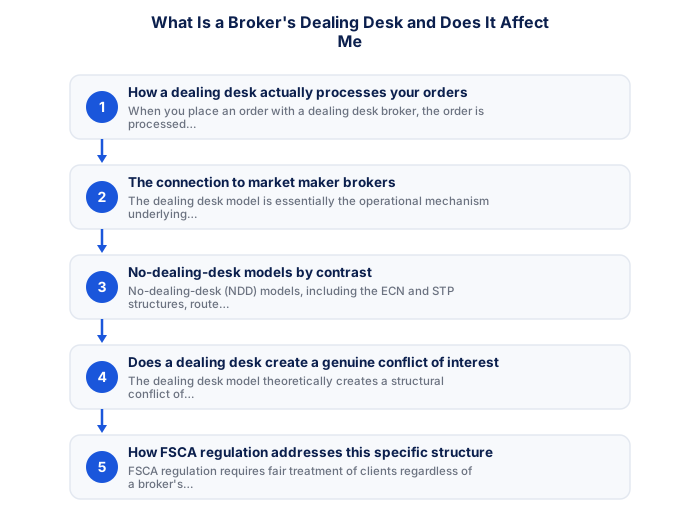
1. How a dealing desk actually processes your orders
When you place an order with a dealing desk broker, the order is processed internally rather than being immediately routed to an external market. The broker's own dealing desk decides how to handle the order, sometimes taking the opposite position itself (effectively becoming your counterparty) rather than passing the order through to external liquidity providers.
It's worth understanding that this internal processing happens essentially instantaneously from your perspective as a trader, the dealing desk's decision-making occurs within the broker's own systems in a fraction of a second, meaning the practical experience of placing an order feels identical regardless of whether it's ultimately handled internally or routed externally.
2. The connection to market maker brokers
The dealing desk model is essentially the operational mechanism underlying the market maker structure. The dealing desk is specifically what makes the internal pricing and counterparty function characteristic of market maker brokers actually work in practice.
Thinking of 'market maker' as describing the broker's overall business model and 'dealing desk' as describing the specific mechanism that implements it can help keep these related but distinct terms straight, they're often used somewhat interchangeably in casual discussion, but understanding the more precise relationship between them helps when reading a broker's own more technical documentation.
- Search FSP name or number at fsca.co.za
- Confirm licence is current and not suspended
- Check scope covers forex and CFD activity
- Confirm client funds in segregated accounts
- Read FSCA enforcement actions history
- Test customer support before depositing
- Client funds legally segregated
- FSCA complaints process available
- SA consumer protections apply
- ZAR account, no FX conversion costs
- Some offshore brokers offer wider instruments
- Regulatory overhead passed on in spreads
- Stricter position limits for retail clients
- FICA verification required before trading
- Client funds segregated
- Formal FSCA complaints process
- SA consumer protections apply
- ZAR account available
- Fund safety not guaranteed
- Overseas disputes only
- SA law does not apply
- Currency conversion costs
3. No-dealing-desk models by contrast
No-dealing-desk (NDD) models, including ECN and STP structures, route client orders directly to external liquidity providers without this internal dealing desk processing step, meaning the broker doesn't take the opposite side of your trade itself, instead earning revenue through commission or a markup on the externally-sourced spread.
note that that 'no dealing desk' doesn't mean no internal processing happens at all, brokers using this model still have systems routing and managing your order, it specifically means the broker isn't making an internal decision about whether to take the opposite side of your trade itself.
4. Does a dealing desk create a genuine conflict of interest
The dealing desk model theoretically creates a structural conflict of interest, since the broker profits when client positions lose, given its counterparty role. This is a genuine, often-discussed structural feature of this model, though it doesn't automatically mean any specific dealing-desk broker acts against client interests, particularly when operating under genuine FSCA regulation requiring fair treatment.
It's worth applying the same practical standard here that applies to evaluating any broker, rather than dismissing dealing desk brokers as a category based on this theoretical structural concern alone, checking a specific candidate broker's regulatory standing, complaint history, and independent reviews gives more concrete, useful information about how that particular broker actually behaves in practice.
| Protection | FSCA Regulated | Offshore Unregulated |
|---|---|---|
| Client fund segregation | ✓ Required | Varies by broker |
| SA complaints process | ✓ Available | ✗ Not available |
| SA consumer law applies | ✓ Yes | ✗ No |
| ZAR account available | ✓ Typically | Often USD/EUR only |
5. How FSCA regulation addresses this specific structure
FSCA regulation requires fair treatment of clients regardless of a broker's execution model, meaning dealing desk brokers operating under genuine FSCA licensing are still bound by this broader fair-treatment obligation, even though the underlying structural conflict of interest above remains a real, inherent feature of this particular model.
6. Practical implications for choosing a broker
For most retail traders, understanding whether a specific broker operates a dealing desk or no-dealing-desk model is one useful input among broader broker comparison factors. Neither model is universally superior, and a genuinely well-regulated, fairly-operating broker can exist under either structure, making this one consideration among several rather than an automatic disqualifying factor for either model.
Before funding an account, find out whether the broker absorbs a negative balance. negative balance protection should be in writing.
If this specific distinction matters to you personally, perhaps because you're a higher-frequency trader particularly sensitive to raw spread pricing, it's worth confirming a broker's specific model directly through their execution policy document, discussed elsewhere on this site, rather than relying on general marketing language that doesn't always precisely specify which underlying structure actually applies.
A no-dealing-desk broker passes your orders to external liquidity providers.
A dealing desk broker takes the other side of your trades internally, offering fixed spreads but with higher requote risk. A no-dealing-desk broker passes orders to external liquidity with typically faster execution.
★ Why It Matters
Worth checking: ask your broker directly whether they operate a dealing desk model for your specific account type, since some brokers run different execution models for different account tiers. The answer for a standard account isn't always the same as for a premium one.
✕ Common mistakes
- Not asking directly whether your specific account uses a dealing desk. This detail isn't always obvious from general marketing material.
- Treating dealing desk models as automatically worse for clients. The model itself doesn't determine fairness; broker conduct does.
- Ignoring this distinction entirely when comparing brokers. It's a genuine structural difference worth understanding.
Key Takeaways
- A dealing desk processes client orders internally rather than passing them directly to external liquidity, relevant to understanding market maker execution.
- A dealing desk processes client orders internally, often taking the opposite side of client trades itself.
- This is distinct from no-dealing-desk models that pass orders directly through to external liquidity providers.
- How a dealing desk actually processes your orders.
- The connection to market maker brokers.
Frequently asked follow-up questions
How do I know if my broker uses a dealing desk?
Checking your broker's terms and conditions or execution policy documentation typically clarifies their execution model directly.
Are dealing desk brokers less regulated than no-dealing-desk brokers?
Not inherently. Both models can operate under genuine FSCA regulation, making the broker's actual regulatory status the more important factor than the execution model itself.
Can a broker switch between these models over time?
Some brokers do offer different account types with different execution models, or may evolve their overall structure over time. Checking current, specific documentation confirms what currently applies.
