i Short answer
Market maker brokers set their own internal prices and may take the other side of your trade directly.
ECN brokers route orders to external liquidity providers, typically offering tighter spreads but charging a separate commission.
📋 ON THIS PAGE
1. How market maker execution actually works
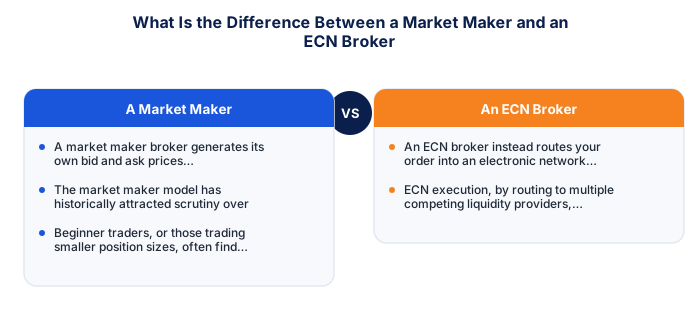
A market maker broker generates its own bid and ask prices internally, rather than directly sourcing prices from an external network of liquidity providers for every single trade. When you open a position with a market maker, the broker may take the opposite side of that trade directly onto its own book, meaning your profit is, in a direct sense, the broker's loss and vice versa for that specific transaction, at least until and unless the broker separately hedges its own resulting exposure in the broader market.
This structure allows market makers to offer fixed or relatively stable spreads regardless of underlying market liquidity conditions, and often supports smaller minimum position sizes suited to beginner traders, since the broker isn't directly dependent on external liquidity provider minimums for every trade size.
It's worth being precise about what 'taking the opposite side' actually means in practice: the broker isn't necessarily betting against you personally or deliberately, it's simply the mechanical consequence of internalising order flow rather than passing every trade through to an external market. Whether and how the broker subsequently manages that resulting exposure, through internal netting across many clients or external hedging, is a separate operational question from the basic mechanics of how your individual trade gets priced and filled.
2. How ECN execution actually works
An ECN broker instead routes your order into an electronic network connecting multiple liquidity providers, typically large banks and institutional market participants, who compete to fill your order at their best available price. This typically results in tighter raw spreads that more closely reflect genuine, real-time market liquidity and competition, since you're effectively accessing pricing from multiple competing sources rather than a single internal pricing engine.
Because the broker in this model is primarily facilitating access to this external network rather than taking the other side of your trade directly, ECN brokers typically charge a separate, explicit commission per trade as their primary revenue mechanism, layered on top of the (typically tighter) raw spread sourced from the liquidity network itself.
- Search FSP name or number at fsca.co.za
- Confirm licence is current and not suspended
- Check scope covers forex and CFD activity
- Confirm client funds in segregated accounts
- Read FSCA enforcement actions history
- Test customer support before depositing
- Client funds legally segregated
- FSCA complaints process available
- SA consumer protections apply
- ZAR account, no FX conversion costs
- Some offshore brokers offer wider instruments
- Regulatory overhead passed on in spreads
- Stricter position limits for retail clients
- FICA verification required before trading
- Client funds segregated
- Formal FSCA complaints process
- SA consumer protections apply
- ZAR account available
- Fund safety not guaranteed
- Overseas disputes only
- SA law does not apply
- Currency conversion costs
This commission-based model creates a genuinely different incentive structure worth understanding: an ECN broker generally profits from trading volume regardless of whether any individual client wins or loses, since their revenue comes from the commission charged per trade rather than from taking the other side of client positions directly.
3. Addressing the conflict-of-interest question directly
The market maker model has historically attracted scrutiny over a theoretical conflict of interest: if a broker profits directly when a client's trade loses, does this create an incentive for the broker to act against client interests (for example, through unfair pricing or deliberately poor execution)? This is a legitimate structural question worth understanding, though it's important to note that FSCA regulation specifically addresses this concern through conduct requirements mandating fair pricing and execution regardless of a broker's underlying execution model.
In practice, most established, regulated market maker brokers manage their own aggregate risk exposure through broader hedging strategies across their full client base, rather than relying on individual client losses as their primary or sole profit mechanism, and regulatory oversight aims to ensure pricing remains fair and execution remains honest regardless of which underlying model a broker uses, the existence of a theoretical conflict of interest doesn't automatically mean regulated market maker brokers are acting against client interests in practice.
It's worth applying the same practical test here that applies to broker selection generally, rather than dismissing an entire execution model based on a theoretical concern, checking a specific candidate broker's FSCA licence status, complaint history, and independent reviews gives more reliable, concrete information about how that particular broker actually behaves than the abstract structural question alone can answer.
4. Comparing the real cost structure between models
Comparing actual total trading costs between these models requires looking beyond the headline spread figure alone. A market maker's wider, all-inclusive spread might, in some cases, work out to a similar or even lower total cost compared to an ECN broker's combination of tighter raw spread plus separate commission, depending on the specific instrument, trade size, and the specific competitive pricing each individual broker offers within their respective model.
Rather than assuming one model is inherently and universally cheaper than the other, calculating the actual total cost (spread plus any commission) for your specific likely trade sizes and frequency across specific candidate brokers, regardless of which execution model each uses, gives a more accurate, useful basis for cost comparison than relying on generalised assumptions about which model is "better" in the abstract.
| Protection | FSCA Regulated | Offshore Unregulated |
|---|---|---|
| Client fund segregation | ✓ Required | Varies by broker |
| SA complaints process | ✓ Available | ✗ Not available |
| SA consumer law applies | ✓ Yes | ✗ No |
| ZAR account available | ✓ Typically | Often USD/EUR only |
Doing this calculation concretely, rather than relying on a general assumption about which model is cheaper, is worth the modest extra effort. Working out your total expected cost for a typical trade, spread plus commission where applicable, across two or three candidate brokers using your own realistic position sizes gives a genuinely comparable figure, rather than comparing headline spread numbers that don't reflect your actual total cost.
| Feature | Market Maker | ECN Broker |
|---|---|---|
| How your order fills | Broker takes the other side | Matched with real market liquidity |
| Spread type | Fixed spread (usually) | Variable spread, often tighter |
| Commission | None (spread is the fee) | Per-trade commission + raw spread |
| Conflict of interest | Exists in theory: broker profits when you lose | Minimal: broker earns on volume only |
| Execution speed | Fast, no requotes on most orders | Dependent on liquidity provider |
| Minimum deposit | Usually lower | Often higher |
| Best suited for | Smaller accounts, beginners | Active traders, tight-spread strategies |
| FSCA regulation applies | Yes, to licensed providers | Yes, to licensed providers |
5. Execution speed and slippage differences
ECN execution, by routing to multiple competing liquidity providers, can sometimes offer execution speed and pricing advantages during periods of high market volatility, since you're accessing a broader pool of available liquidity rather than relying on a single internal pricing engine that might widen spreads or pause pricing during extreme conditions. Market maker pricing, while often more stable and predictable during normal conditions, can sometimes behave differently during major news events or periods of extreme volatility, depending on the specific broker's internal risk management practices.
Neither model is universally superior on this dimension across all market conditions, the practical difference in execution quality during genuinely extreme market events is worth researching for any specific candidate broker (through reviews discussing their behaviour during past major volatility events) rather than assuming the execution model alone determines this outcome reliably.
6. Which model genuinely suits which type of trader
Beginner traders, or those trading smaller position sizes, often find market maker brokers more accessible given typically lower minimum position size requirements and the simplicity of an all-inclusive spread without needing to separately calculate and track commission costs. More experienced or high-frequency traders, particularly those whose strategies are sensitive to very tight pricing and who trade in larger, more consistent volumes, may find ECN execution's typically tighter raw spreads more cost-effective once commission costs are properly factored into larger-volume trading patterns.
Neither model is objectively "better" in all circumstances, the right choice depends on your specific trading style, typical position sizes, and trading frequency, making this a genuinely personal comparison point worth evaluating against your own specific trading plan rather than following generic, one-size-fits-all advice favouring either model universally.
A well-regulated broker will also keep client funds in segregated accounts, separate from the company's own operating capital, so your deposited funds aren't exposed if the broker itself runs into financial difficulty.
It's worth revisiting this choice periodically as your own trading develops, rather than treating your initial broker model selection as permanent. A trader who started with a market maker broker while learning the basics, and whose trading has since grown in frequency and volume, may find that switching to ECN execution now makes more sense than it did at the outset, worth reassessing rather than assuming your original choice remains optimal indefinitely.
An ECN broker matches you with external market participants.
A market maker takes the other side of your trade, creating an inherent conflict of interest. An ECN broker matches you with external market participants, reducing that conflict in exchange for a separate commission.
★ Why It Matters
Worth checking specifically rather than assuming based on the label alone: ask your broker directly whether they ever take the opposite side of client trades internally, the market maker versus ECN distinction in marketing material doesn't always perfectly match the broker's actual internal dealing practices.
✕ Common mistakes
- Choosing a broker based on this label alone without further verification. Marketing material doesn't always perfectly match actual internal dealing practices.
- Treating market maker brokers as inherently less trustworthy. The model itself doesn't determine fairness; specific broker conduct does.
- Not understanding how this distinction could affect your actual spread and execution. This affects practical trading experience in ways worth understanding directly.
Key Takeaways
- Market makers set their own prices and take the other side of your trade; ECN brokers route orders to a liquidity network. Learn what this means for you.
- Market maker brokers set their own internal prices and may take the other side of your trade directly.
- ECN brokers route orders to external liquidity providers, typically offering tighter spreads but charging a separate commission.
- How market maker execution actually works.
- How ECN execution actually works.
Frequently asked follow-up questions
Can a broker use both models depending on account type?
Yes, some brokers offer different account types using different execution models, allowing clients to choose based on their specific trading style and cost preferences.
Is ECN always more transparent than market maker execution?
ECN execution does provide visibility into the liquidity network pricing mechanism, but FSCA regulation requires fair conduct and pricing transparency from both models, so transparency isn't exclusively an ECN-only feature.
Does the execution model affect whether negative balance protection applies?
Not directly, negative balance protection is typically a broker-level policy decision independent of the specific execution model used, though it's worth confirming this separately for any specific broker regardless of their execution model.
