What this page covers
A card payment can sometimes be reversed; an EFT almost never can. Knowing which protection applies before you pay is more useful than finding out afterwards.
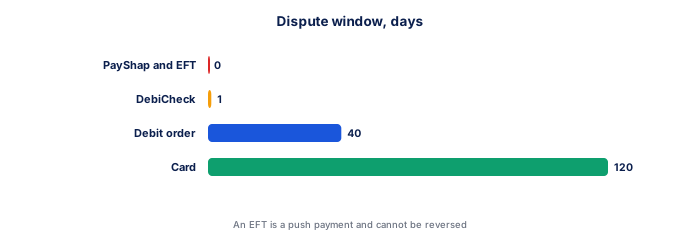
| Method | Reversible | Time limit | Decided by |
|---|---|---|---|
| Credit card | Yes, by chargeback | Usually 120 days | The card scheme |
| Debit card | Sometimes | Usually 120 days | The card scheme |
| EFT | No | None | Nobody, it is a push payment |
| Debit order | Yes, by dispute | 40 days, or 1 day for DebiCheck | Your bank |
| PayShap or RTC | No | None | Nobody |
| Crypto | No | None | Nobody |
| Ground | Example |
|---|---|
| Goods or services not received | Paid and nothing was delivered |
| Not as described | Materially different from what was offered |
| Unauthorised transaction | The card was used without your consent |
| Duplicate charge | Charged twice for one purchase |
| Cancelled recurring payment | Charged after cancellation |
| Credit not processed | A refund was agreed and never paid |
| Issue | Go to |
|---|---|
| A bank's handling of a dispute | National Financial Ombud |
| A licensed broker's conduct | FAIS Ombud |
| An unlicensed operator | FSCA, and the police |
| A card transaction | Your bank first, then the ombud |
| A credit agreement | National Credit Regulator |
How these figures work
The figures on this page come from the body that publishes them and change on a schedule rather than continuously, which is what makes them worth keeping in one place. An EFT is a push payment. Once it is made, no mechanism exists to pull it back, which is why paying an unknown party by EFT carries no protection at all.
A chargeback against a licensed broker for a losing trade will not succeed. Losing money on a position is not a failure to deliver a service.
★ What this means in practice
DebiCheck debit orders are authenticated by you at setup, which is what makes them harder to dispute afterwards and harder to abuse in the first place.
✕ Common mistakes
- An EFT is a push payment. An EFT is a push payment. Once it is made, no mechanism exists to pull it back, which is why paying an unknown party by EFT carries no protection at all.
- A chargeback against a licensed broker for a losing trade will not succe. A chargeback against a licensed broker for a losing trade will not succeed. Losing money on a position is not a failure to deliver a service.
- DebiCheck debit orders are authenticated by you at setup, which is what . DebiCheck debit orders are authenticated by you at setup, which is what makes them harder to dispute afterwards and harder to abuse in the first place.
- Taking a figure without its date. A number from a reference page is only as good as when it was last checked, which is why the date sits at the top of this one.
Notes on reading these figures
- An EFT is a push payment. Once it is made, no mechanism exists to pull it back, which is why paying an unknown party by EFT carries no protection at all.
- A chargeback against a licensed broker for a losing trade will not succeed. Losing money on a position is not a failure to deliver a service.
- DebiCheck debit orders are authenticated by you at setup, which is what makes them harder to dispute afterwards and harder to abuse in the first place.
To put this into practice, the South African Payment Methods runs the arithmetic on your own numbers; Ombudsman Schemes covers the same ground in ordinary language; Broker Deposits and Withdrawals goes into the detail this page only summarises; Common SA trading scams is the related figure worth reading beside it; and Card and Cross-Border Fees covers what this page leaves out.
Terms used on this page
Frequently asked questions
Can I reverse an EFT?
No. An EFT is a push payment and no mechanism exists to pull it back, which is why paying an unknown party that way carries no protection.
How long do I have to dispute a card payment?
Usually 120 days from the transaction, though the exact window depends on the ground and the scheme.
Can I charge back a losing trade?
No. Losing money on a position is not a failure to deliver a service, and a licensed broker will defend it successfully.
How long to dispute a debit order?
Forty days for an ordinary debit order, but only one day for a DebiCheck mandate you authenticated.
Where do I complain about my bank?
The National Financial Ombud, after giving the bank a reasonable chance to resolve it first.
What are valid chargeback grounds?
Goods not received, not as described, unauthorised use, duplicate charge, a charge after cancellation, or a refund never processed.
 Download this data