i Short answer
A realistic week for a part-time swing or position trader might include a longer weekend planning session, brief daily evening reviews of 20-30 minutes, and a Friday wrap-up.
This totals a modest, genuinely sustainable few hours overall, rather than day trading's demanding daily intensity.
📋 ON THIS PAGE
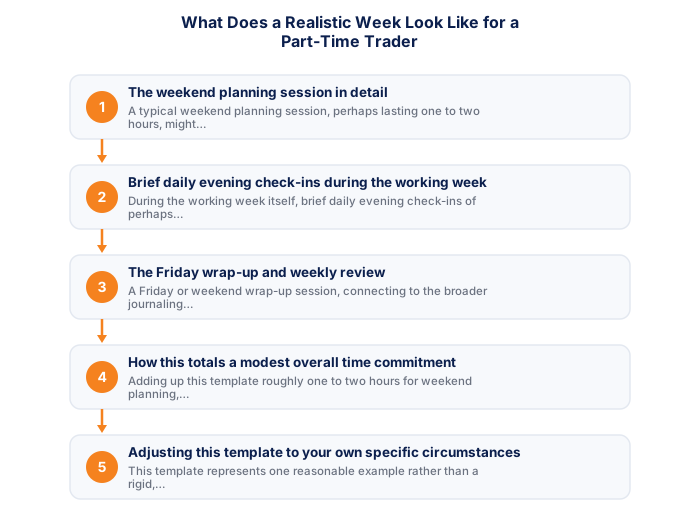
1. The weekend planning session in detail
A typical weekend planning session, perhaps lasting one to two hours, might involve reviewing the upcoming week's economic calendar, identifying any specific technical setups developing on your watched instruments, and setting any pending orders, that align with this analysis, effectively front-loading much of the week's analytical work into this single, focused session.
It's worth treating this session as genuinely non-negotiable, protecting it the same way you would an important appointment, since the quality of your entire week's trading tends to reflect how thoroughly this initial planning session was actually conducted.
2. Brief daily evening check-ins during the working week
During the working week itself, brief daily evening check-ins of perhaps 20-30 minutes might involve reviewing any open positions, checking whether any pending orders have triggered, and making any necessary adjustments based on how the week's analysis is playing out, without requiring the extended, continuous attention day trading would demand.
It's worth keeping these check-ins genuinely brief and focused, resisting the temptation to expand them into a longer session, the specific value of this template lies in its modest, sustainable time commitment, letting them creep longer undermines exactly what makes this approach realistic for a busy, working schedule.
- FSCA-regulated broker verified at fsca.co.za
- Demo account tested for minimum 60 days
- Trading plan written: entry, exits, position sizing
- Risk per trade defined (1-2% of account)
- Backup internet connection tested for load shedding
- Tax implications understood
3. The Friday wrap-up and weekly review
A Friday or weekend wrap-up session, connecting to the broader journaling discipline, involves reviewing the week's overall results, updating your trading journal with reflections on what went well or poorly, and beginning to think ahead toward the following week's planning session, creating a natural, recurring weekly cycle.
It's worth treating this weekly review with the same seriousness as your weekend planning session, since it's specifically this honest, reflective review that turns each week's trading into genuine learning, rather than simply a repeated cycle without accumulated improvement.
4. How this totals a genuinely modest overall time commitment
Adding up this template, roughly one to two hours for weekend planning, perhaps two to two-and-a-half hours across five brief daily check-ins, and a further hour for the Friday wrap-up, totals somewhere in the region of four to five hours weekly, a modest, sustainable commitment compared to the considerably more intensive day trading routines.
| Item | Detail |
|---|---|
| Regulator | FSCA, fsca.co.za |
| Exchange control | SARB, resbank.co.za |
| Tax authority | SARS, sars.gov.za |
| JSE hours | 09:00-17:00 SAST Mon-Fri |
| Best forex session | 15:00-17:00 SAST |
| CGT annual exclusion | R50,000 (individuals) |
5. Adjusting this template to your own specific circumstances
This template represents one reasonable example rather than a rigid, universal prescription, adjusting the specific timing and duration of each session to fit your own particular work schedule, family commitments, and personal preferences, while preserving the underlying structure of dedicated planning, periodic monitoring, and regular review, supports a genuinely personalised, sustainable routine.
It's worth actually testing your adjusted template for a few weeks before assuming it's the right fit, sometimes a schedule that looks reasonable on paper reveals genuine friction only once you've tried living with it in practice, worth remaining open to further adjustment based on real experience.
6. Why consistency matters more than total hours alone
As, maintaining this kind of regular, predictable weekly rhythm consistently over time matters considerably more than the precise total number of hours invested in any given week, a modest but genuinely consistent routine generally outperforms a more variable, inconsistent approach even if the inconsistent approach occasionally involves more total hours in any specific week.
In South African time (SAST, which is GMT+2 year-round), the London session typically opens around 09:00-10:00 and the New York session around 15:00-16:00, so the overlap between roughly 15:00 and 17:00 SAST tends to bring the highest liquidity and volatility for major forex pairs.
A realistic part-time trading week involves 30-45 minutes of pre-market preparation, 1-2 hours of active sessions, journal entry after each session, and a weekly chart review, totalling around 5-8 hours.
★ Why It Matters
Something worth scheduling explicitly rather than leaving open-ended: a fixed weekend block specifically for the coming week's planning, traders who treat this planning session as flexible ('I'll do it when I have time') tend to skip it most weeks once normal life gets busy.
✕ Common mistakes
- Leaving weekly planning unscheduled and informal. Treating it as flexible tends to mean it gets skipped during busy weeks.
- Underestimating the time needed for proper weekend preparation. Planning sessions often take longer than initially budgeted.
- Skipping the Friday wrap-up review when the week feels uneventful. Reviewing quiet weeks still builds useful pattern recognition.
- Assuming part-time trading requires day-trading-level daily intensity. Part-time swing or position approaches typically demand far less daily time.
How many trades per day should a day trader target?
Selective day traders typically place two to five high-quality trades per session. Placing more trades does not improve results - overtrading is a leading cause of day trader account drawdown.
Key Takeaways
- A realistic week includes a weekend planning session, brief daily evening reviews, and a Friday wrap-up, totalling a modest, sustainable few hours overall.
- A realistic week for a part-time swing or position trader might include a longer weekend planning session, brief daily evening reviews of 20-30 minutes, and a Friday wrap-up.
- This totals a modest, genuinely sustainable few hours overall, rather than day trading's demanding daily intensity.
- The weekend planning session in detail.
- Brief daily evening check-ins during the working week.
Frequently asked follow-up questions
Is four to five hours weekly really enough to trade successfully?
For swing and position trading styles, yes, this can be genuinely sufficient, since these styles don't require continuous, real-time monitoring the way day trading does.
Should I add more time as I gain experience?
Some traders do increase their analytical depth over time, though many maintain a similarly modest weekly time commitment even as their skill and results develop, since the structure itself remains efficient.
What if I miss a planned daily check-in occasionally?
This is generally not a serious problem given pending orders can handle execution even without your active daily presence, though consistent significant gaps warrant honest reflection on your routine.
