i Short answer
The London-New York overlap falls conveniently within South African afternoon and evening hours, offering strong global liquidity without very early morning starts.
📋 ON THIS PAGE
- Converting major global sessions to South African time
- Why the London-New York overlap particularly suits South African schedules
- The Asian session and its specific timing challenge for South Africans
- Daylight saving time considerations affecting these conversions
- Matching session choice to your own daily schedule
- Practical steps for confirming current session times
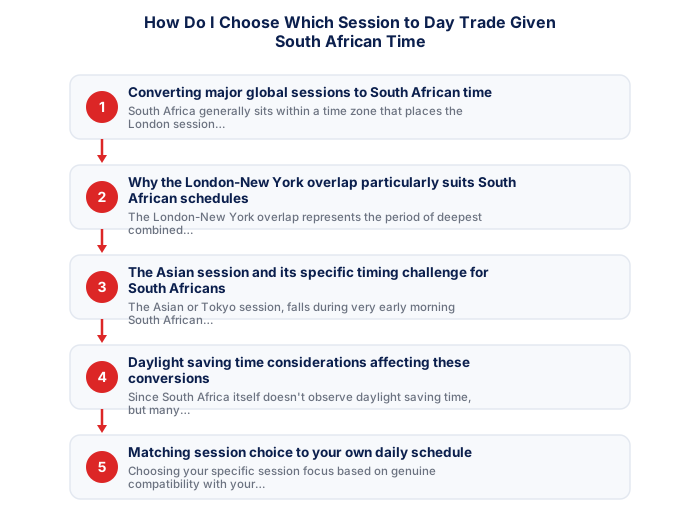
1. Converting major global sessions to South African time
South Africa generally sits within a time zone that places the London session comfortably within local daytime hours, while the New York session extends into the South African evening, and the Asian/Tokyo session falls during the very early morning South African hours, requiring some deliberate consideration of which specific session genuinely fits your own schedule.
It's worth writing your own personal reference table for these conversions and keeping it somewhere easily visible, rather than mentally recalculating each time, since a quick, saved reference removes any risk of miscalculating during the actual planning of your trading day.
| Session | Approximate SAST Hours | Notes |
|---|---|---|
| Asian Session | 02:00 - 11:00 | Early morning, lower volatility for most pairs |
| London Session | 09:00 - 18:00 | High liquidity begins |
| New York Session | 14:00 - 23:00 | Overlaps with London |
| London-New York Overlap | 14:00 - 18:00 | Highest liquidity window, suits SA daytime schedules |
2. Why the London-New York overlap particularly suits South African schedules
The London-New York overlap represents the period of deepest combined liquidity globally, and this overlap conveniently falls within South African afternoon and early evening hours, making it genuinely practical for South African traders to access this most liquid trading window without requiring unusual sleep schedule disruption.
It's worth building your core trading routine around this specific window deliberately if liquidity and reasonable scheduling both matter to you, since relatively few global trading hubs offer South African traders this particular combination of genuinely convenient local timing and genuinely strong market liquidity simultaneously.
- SARB economic calendar checked for the week
- Next Eskom load shedding schedule reviewed
- GNU stability news reviewed
- Stats SA data releases noted
- Credit agency review dates checked
- US/global events that move EM risk noted
3. The Asian session and its specific timing challenge for South Africans
The Asian or Tokyo session, falls during very early morning South African hours, presenting a genuine scheduling challenge for South African traders specifically interested in this session, since it would require either an unusually early start or staying awake through the night to actively participate.
Traders interested in Asian-session-relevant instruments, like certain Yen-based pairs, need to weigh this genuine timing challenge against the specific analytical interest this session might offer, recognising that this particular trade-off differs meaningfully from the more conveniently-timed London-New York overlap.
| Event | Frequency | ZAR impact | Source |
|---|---|---|---|
| SARB MPC | 6x per year | High | resbank.co.za |
| Budget Speech | Annual (February) | Very high | treasury.gov.za |
| Credit reviews | Annual each agency | Very high | Agency sites |
| Stats SA CPI | Monthly | Medium | statssa.gov.za |
| Eskom stage | As needed | Low-medium | eskomsepush.com |
- SA context provides genuine informational edge
- ZAR pairs accessible via FSCA brokers in ZAR accounts
- Rand volatility creates larger intraday ranges
- 6 SARB meetings/year create regular macro setups
- Higher geopolitical risk than G10 pairs
- Load shedding creates unique operational disruptions
- SA rand liquidity thinner than major G10 pairs
- SA-specific news requires constant local monitoring
It's worth being honest with yourself about whether this specific session genuinely offers something the more conveniently-timed sessions don't, before committing to the disruption an early start or late night involves, for many traders, the specific analytical interest doesn't outweigh the genuine cost to sleep and sustainability discussed elsewhere on this site.
4. Daylight saving time considerations affecting these conversions
Since South Africa itself doesn't observe daylight saving time, but many major financial centres including the US and UK do shift their clocks seasonally, the precise time conversion between South African time and these major sessions actually shifts by an hour at certain points during the year, meaning a session timing that applies during one part of the year may need slight adjustment during another.
Staying aware of when major financial centres shift their own clocks, and adjusting your own session timing expectations accordingly, avoids the kind of timing confusion that could otherwise lead to missing your intended trading window by an hour during these specific seasonal transition periods.
It's worth marking these seasonal shift dates on your own calendar in advance, rather than discovering the change only once your usual session timing suddenly feels off, a brief, proactive check twice a year prevents this recurring, entirely avoidable source of scheduling confusion.
5. Matching session choice to your own daily schedule
Choosing your specific session focus based on genuine compatibility with your own daily schedule, rather than purely theoretical liquidity considerations, supports the kind of sustainable, realistic trading routine as more important than chasing theoretically optimal but practically unsustainable timing.
It's worth revisiting this choice honestly if your daily schedule changes significantly, a session that fit well around a previous job or life stage may no longer align as cleanly with new circumstances, worth reassessing rather than continuing to force an outdated session choice into a schedule that no longer genuinely accommodates it.
6. Practical steps for confirming current session times
Given the daylight saving complexity discussed above, checking a current, reliable forex session timing tool or economic calendar, specifically for the current period's accurate South African time conversion, rather than relying on a fixed conversion that might become outdated as international daylight saving schedules shift, ensures your session timing planning remains genuinely accurate.
The Asian session falls during very early morning South African time.
The London-New York overlap offers the deepest combined liquidity and falls comfortably within South African afternoon and evening hours, unlike the Asian session's very early morning timing.
★ Why It Matters
Worth testing rather than assuming: log a week of results during your chosen session , some traders perform better in the comparatively calmer Asian session despite its lower volatility, simply because lower volatility suits their particular strategy and temperament.
✕ Common mistakes
- Choosing a session purely for convenience rather than testing it. Logging actual results during your chosen session matters more than assumption.
- Ignoring how session choice affects your sleep and energy levels. A poorly timed session can quietly degrade decision quality.
- Switching sessions frequently without giving any one enough of a trial. Comparing sessions fairly requires a meaningful sample in each.
What is the best market session for trading from South Africa?
The London-New York overlap (15:00 to 17:00 SAST) provides the highest liquidity for major forex pairs. The JSE regular session (09:00 to 17:00 SAST) is best for SA shares and the JSE Top 40 index.
How many of these should I take?
As many as the market offers and no more. A quota turns a method into activity. Trade frequency covers the cost.
Key Takeaways
- The London-New York overlap falls conveniently within South African afternoon and evening hours, offering strong liquidity without requiring very early starts.
- The London-New York overlap falls conveniently within South African afternoon and evening hours, offering strong global liquidity without very early morning starts.
- Converting major global sessions to South African time.
- Why the London-New York overlap particularly suits South African schedules.
- The Asian session and its specific timing challenge for South Africans.
Frequently asked follow-up questions
Does South Africa observe its own daylight saving time?
No, South Africa does not currently observe daylight saving time, though the countries hosting major sessions like London and New York do, affecting the relative time conversion at different points in the year.
Is the Asian session worth trading for South Africans despite the early hours?
This depends on personal schedule flexibility and specific interest in Asian-session-relevant instruments; many South African traders find the more conveniently-timed London-New York overlap sufficient for their needs.
Can I trade successfully outside the London-New York overlap?
Yes, though this may involve somewhat reduced liquidity depending on the specific period, making awareness of current conditions important regardless of which session you choose.
