What this page covers
Quick answer: The forex market runs continuously from Monday morning in Sydney to Friday evening in New York. Key figures: continuous trading 24/5; overlap begins 15:00; South Africa does not shift No DST; daily rollover 00:00. Figures current at 27 September 2026, from Bank for International Settlements, triennial survey.
The forex market runs continuously from Monday morning in Sydney to Friday evening in New York. South Africa sits two hours ahead of London in winter and one in summer, which puts the most active window in the late afternoon.
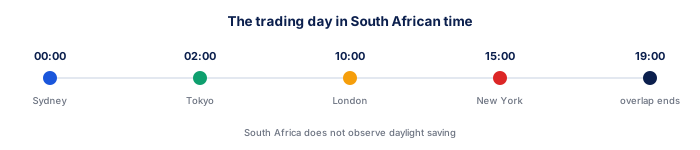
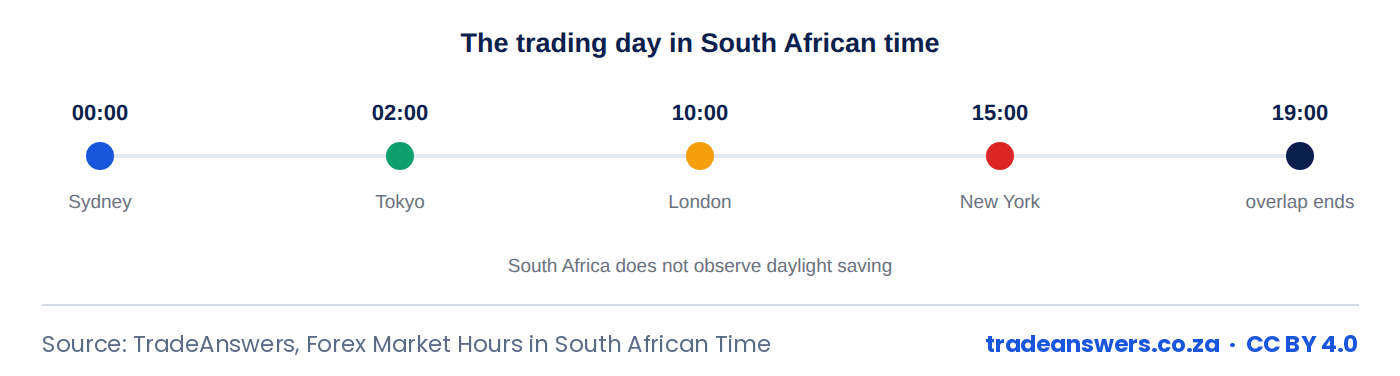
⬇ Download this chart (PNG) · Free to reuse with the credit “Source: TradeAnswers, Forex Market Hours in South African Time” (CC BY 4.0).
| Session | Opens | Closes | Character |
|---|---|---|---|
| Sydney | 00:00 or 01:00 | 09:00 or 10:00 | Thin, AUD and NZD pairs |
| Tokyo | 02:00 or 03:00 | 11:00 or 12:00 | JPY pairs, moderate |
| London | 10:00 or 11:00 | 19:00 or 20:00 | Deepest liquidity of the day |
| New York | 15:00 or 16:00 | 00:00 or 01:00 | High volume, US data |
| London and New York overlap | 15:00 or 16:00 | 19:00 or 20:00 | Tightest spreads, largest moves |
Source: TradeAnswers, Forex Market Hours in South African Time. Free to reuse with attribution (CC BY 4.0).
| Pair | Most active window |
|---|---|
| USD/ZAR | 10:00 to 19:00, peaking in the overlap |
| EUR/USD | 10:00 to 19:00 |
| GBP/USD | 10:00 to 19:00 |
| USD/JPY | 02:00 to 11:00 and again in the overlap |
| AUD/USD | 00:00 to 09:00 |
| Gold | 15:00 to 20:00 |
TradeAnswers · CC BY 4.0
| Time | What happens |
|---|---|
| Sunday about 23:00 | Sydney opens, the week begins |
| Monday to Thursday | Continuous trading |
| Friday about 23:00 | New York closes, the week ends |
| Weekend | No trading; gaps at the open are common |
| Daily rollover, about 00:00 | Swap charged or credited, spreads widen briefly |
TradeAnswers · CC BY 4.0
How these figures work
The figures on this page come from published sources and change on a schedule rather than continuously, which is what makes them worth recording in one place. South Africa does not observe daylight saving, so the sessions shift around you twice a year rather than the other way round. Times above show winter first, then summer.
The overlap is where the tightest spreads and the largest moves are, and it falls conveniently in the late afternoon for a South African working a normal day.
★ A worked example
Reading the tables together is where the value is. Spreads widen sharply at the daily rollover and in the first minutes after the Sunday open. Holding a stop close to the market through either is how it gets filled badly.
✕ Common mistakes
- South Africa does not observe daylight saving, so the sessions shift around you twice a year rather than the other way round. Times above show winter first, then summer.
- The overlap is where the tightest spreads and the largest moves are, and it falls conveniently in the late afternoon for a South African working a normal day.
- Spreads widen sharply at the daily rollover and in the first minutes after the Sunday open. Holding a stop close to the market through either is how it gets filled badly.
- Taking a figure without its date. A number from a reference page is only as good as when it was last checked, which is why the date sits at the top of this one.
Notes on reading these figures
- South Africa does not observe daylight saving, so the sessions shift around you twice a year rather than the other way round. Times above show winter first, then summer.
- The overlap is where the tightest spreads and the largest moves are, and it falls conveniently in the late afternoon for a South African working a normal day.
- Spreads widen sharply at the daily rollover and in the first minutes after the Sunday open. Holding a stop close to the market through either is how it gets filled badly.
To put these figures to work, the Forex hours in South African time runs the arithmetic on your own numbers. JSE Trading Hours and Holidays goes into the detail this table only summarises. The Bid-Ask Spread Cost Calculator covers the part this table leaves out.
Terms used on this page
See also: What Are the Forex Trading Sessions and Hours in South African Time? and Can I Make a Living Trading Forex Full-Time? and Trust Taxation Reference and PAYE, UIF and SDL Reference.
Spotted an outdated figure? If a figure or rate on this page no longer matches its source, email us the page and the source. A material correction is dated on the Updates Log.
How these figures are compiled, checked and corrected: our data methodology.
Cite this page
Barosso, G. (2026, September 27). Forex Market Hours in South African Time. TradeAnswers. https://www.tradeanswers.co.za/forex-market-hours-sast.htmlBarosso, G (2026) Forex Market Hours in South African Time, TradeAnswers, figures current at 27 September 2026, https://www.tradeanswers.co.za/forex-market-hours-sast.htmlThe tables and the CSV on this page are free to reuse under a CC BY 4.0 licence: attribution with a link to this page. See the Press & Data Licence page.
Frequently asked questions
When is the best time to trade from South Africa?
The London and New York overlap, roughly 15:00 to 19:00 South African time, where spreads are tightest and volume is highest.
Does South Africa observe daylight saving?
No. The sessions shift around you twice a year rather than the other way round, which is why times are quoted as two options.
When does the trading week start?
Around 23:00 on Sunday, South African time, when Sydney opens. It ends when New York closes on Friday.
What happens at the daily rollover?
Swap is charged or credited and spreads widen briefly. A stop close to the market can be filled badly in that window.
Why do prices gap at the Sunday open?
The market is closed over the weekend but news is not. The first price on Sunday reflects everything that happened while it was shut.
When is USD/ZAR most liquid?
During the London session and into the New York overlap, which is also when local data and MPC announcements land.
 Download this data