What this page covers
Crypto moves value across a border in minutes for a few dollars, which is why people use it for that. What it does not do is step outside exchange control or outside SARS.
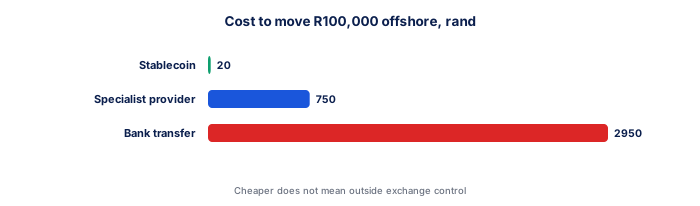
| Route | Typical cost | Typical speed | Reversible |
|---|---|---|---|
| Bank SWIFT transfer | 1.5% to 3% plus fees | 2 to 5 days | No |
| Specialist forex provider | 0.3% to 1% | 1 to 2 days | No |
| Stablecoin on a low-fee network | Under USD 1 | Minutes | No |
| Bitcoin | Network dependent | 10 to 60 minutes | No |
| Exchange withdrawal fee | Varies by asset and network | Minutes | No |
| Question | Position |
|---|---|
| Is crypto a financial product | Yes, under FAIS since October 2022 |
| Does exchange control apply | The Reserve Bank treats crypto transfers as subject to it |
| Does it use my allowance | Taking value offshore counts against the allowances |
| Is a platform licensed | A South African platform needs a CASP licence |
| Does SARS see it | Yes, and CARF extends that to offshore platforms |
| Item | Note |
|---|---|
| Exchange spread on buying | Often wider than a forex spread |
| Network fee | Varies enormously between networks |
| Exchange withdrawal fee | Flat per asset, can exceed the network fee |
| Spread on selling at the other end | The second conversion |
| Tax on each disposal | Every conversion is a disposal to SARS |
How these figures work
The figures on this page come from the body that publishes them and change on a schedule rather than continuously, which is what makes them worth keeping in one place. Every conversion is a disposal for tax, including crypto to crypto and crypto to stablecoin. A route with four conversions has four taxable events, whatever the net result was.
Using crypto to move value offshore does not avoid exchange control. The Reserve Bank's position is that the allowances apply to value, not only to currency.
★ What this means in practice
The arbitrage between local and offshore crypto prices exists because of exchange control, not despite it. It needs allowance capacity to execute, which is what limits it.
✕ Common mistakes
- Every conversion is a disposal for tax, including crypto to crypto and c. Every conversion is a disposal for tax, including crypto to crypto and crypto to stablecoin. A route with four conversions has four taxable events, whatever the net result was.
- Using crypto to move value offshore does not avoid exchange control. Using crypto to move value offshore does not avoid exchange control. The Reserve Bank's position is that the allowances apply to value, not only to currency.
- The arbitrage between local and offshore crypto prices exists because of. The arbitrage between local and offshore crypto prices exists because of exchange control, not despite it. It needs allowance capacity to execute, which is what limits it.
- Taking a figure without its date. A number from a reference page is only as good as when it was last checked, which is why the date sits at the top of this one.
Notes on reading these figures
- Every conversion is a disposal for tax, including crypto to crypto and crypto to stablecoin. A route with four conversions has four taxable events, whatever the net result was.
- Using crypto to move value offshore does not avoid exchange control. The Reserve Bank's position is that the allowances apply to value, not only to currency.
- The arbitrage between local and offshore crypto prices exists because of exchange control, not despite it. It needs allowance capacity to execute, which is what limits it.
To put this into practice, the Crypto Asset Regulation runs the arithmetic on your own numbers; Exchange Control Allowances covers the same ground in ordinary language; How SARS taxes crypto gains goes into the detail this page only summarises; Forex Transfer Costs is the related figure worth reading beside it; and What CARF changes covers what this page leaves out.
Terms used on this page
Frequently asked questions
Is crypto cheaper for moving money offshore?
Far cheaper on the transfer itself, but the spreads on both conversions and the tax on each disposal usually close most of the gap.
Does exchange control apply to crypto?
Yes. The Reserve Bank's position is that the allowances apply to value moved offshore, not only to currency.
Is every conversion taxed?
Yes. Crypto to crypto and crypto to stablecoin are both disposals, so a route with four conversions has four taxable events.
Why does the arbitrage exist?
Because exchange control limits how much capital can chase it. It needs allowance capacity to execute, which is what caps it.
Does SARS see offshore platforms?
Increasingly yes. CARF exchanges platform data between participating jurisdictions automatically.
Do I need a licence to use crypto?
No. The licence applies to platforms and intermediaries, not to someone transacting for their own account.
 Download this data