i Short answer
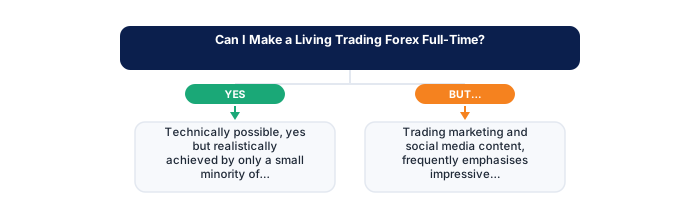
Technically possible, yes, but realistically achieved by only a small minority of traders, and it requires substantially more starting capital than most beginners assume.
📋 ON THIS PAGE
- The honest math behind this question
- Why impressive percentage returns can be misleading
- Realistic capital requirements for full-time income
- The survivorship bias and marketing problem in this space
- Alternative paths worth considering instead
- A more realistic way to frame this goal
- Working backwards from the income you need
1. The honest math behind this question
Take a trader hitting a genuinely strong, consistent 5% monthly return, already an ambitious target that very few sustain over multiple years. To generate R30,000 per month at that return rate requires R600,000 of trading capital deployed consistently. To generate R60,000 per month requires R1.2 million. Those figures assume the 5% is sustained every single month, which compounds the challenge rather than simplifying it.
It's worth running this calculation with your own actual numbers rather than illustrative figures. What monthly income would genuinely cover your essential expenses? What return percentage have you actually demonstrated over the last twelve months? What's the gap between those two figures in terms of capital required?
Most people who attempt this calculation for the first time are surprised by how large the required capital is relative to where they currently stand. The path from current capital to the capital level that makes full-time trading income viable is often years-long, not months-long, and it's best understood clearly rather than obscured by optimistic projections.
The calculation also needs to account for the months where any strategy underperforms or draws down, which means your monthly income requirements can't be met by simply withdrawing every month's return. A realistic full-time trader needs to maintain a reserve buffer on top of the core capital to sustain living costs through drawdown periods, which means the actual capital requirement is higher than the simple calculation suggests.
2. Why impressive percentage returns can be misleading
Trading marketing loves a big percentage figure, but a percentage return means nothing without the capital behind it. A 200% gain on R10,000 produces R20,000 of profit. The same 200% on R500,000 produces R1 million. The percentage is identical; the actual financial outcome is an entirely different conversation.
The real question isn't what return percentage you can achieve, it's whether that return, applied to your actual available capital, produces income that covers your actual financial life. Most traders who answer this question honestly find that the gap between those two numbers is large enough to make full-time trading a distant target rather than an immediate option.
| Lot type | Size | USD/ZAR pip value | Min recommended account |
|---|---|---|---|
| Standard | 100,000 units | ~R1.00 | R100,000+ |
| Mini | 10,000 units | ~R0.10 | R10,000+ |
| Micro | 1,000 units | ~R0.01 | R1,000+ |
| Nano | 100 units | ~R0.001 | R100+ |
- V = Pip value in account currency
- E = Current exchange rate of quote vs account currency
- L = Lot size (100,000 standard / 10,000 mini / 1,000 micro)
- USD/ZAR example = 1 pip = R1 per standard lot
- Leveraged instrument
- Long and short positions both available
- Overnight financing charges apply
- No underlying asset ownership
- No leverage (typically)
- Physical currency received
- No daily financing charges
- Actual currency ownership
This distinction is worth keeping in mind when evaluating trading courses, signal services, or social media accounts that lead with percentage return claims. Percentage returns are maximally flexible as marketing because they can be technically accurate while being practically irrelevant to anyone who doesn't have the capital base they imply. The relevant question is always what absolute return those percentages produce on your specific capital.
The capital requirement problem is compounded by the need to maintain a drawdown buffer. A trader withdrawing the entirety of each month's return as income has no reserve when an inevitable losing month arrives. Sustaining the buffer while drawing income means either deploying significantly more capital or withdrawing only a fraction of the return, both of which raise the required capital level further.
3. Realistic capital requirements for full-time income
Working backward from a realistic income target gives a clearer picture than projecting from return percentages. At a genuinely excellent 5% monthly return, covering living costs of R25,000 to R50,000 per month in South Africa requires between R500,000 and R800,000 of trading capital, before accounting for the drawdown reserve that responsible full-time traders maintain on top of their core deployed capital.
It's worth sitting with how large this capital requirement genuinely is relative to where most retail traders actually begin. The journey from a R20,000 account to R700,000, even at strong, consistent returns, compounded without withdrawals, takes years rather than months. Most traders who attempt to make this transition prematurely do so not because they lack skill but because they're working with capital that's structurally too small for the income they need.
There's also an income volatility dimension that matters practically. Even consistently profitable traders have months where their approach produces below-average returns or drawdown. Building a living-cost reserve separate from trading capital, the equivalent of three to six months of expenses held outside the trading account, is the foundation that makes full-time trading financially sustainable rather than perpetually precarious.
South African traders face a further consideration around SARB exchange control rules. Capital deployed offshore through a broker is subject to limits on how much can be sent under the single discretionary allowance or the foreign investment allowance. Traders whose full-time income strategy involves significant offshore deployment need to plan their capital allocation within these regulatory constraints.
4. The survivorship bias and marketing problem in this space
The trading education and signal-service industry has a structural incentive to make full-time trading sound achievable and common. The people who successfully went full-time are visible and vocal; the significantly larger group who attempted it, ran out of capital, and returned to employment are not. This survivorship bias makes the transition look more typical than it is.
Independent data on retail trading outcomes is consistent across providers and jurisdictions: the majority of retail CFD and forex traders lose money over time. Brokers regulated in jurisdictions that require disclosure of this figure typically publish it. Reading those disclosures as data rather than fine print provides a more accurate baseline for probability assessment than any collection of success stories.
It's worth actively seeking out the counter-narrative, since the more encouraging version is dramatically easier to find. The traders who didn't make it don't sell courses, don't have active social media accounts celebrating their results, and don't appear in broker testimonials. Their outcomes are statistically more representative and considerably harder to locate.
This isn't an argument that full-time trading is impossible, it clearly isn't, and some proportion of traders do make this transition successfully. It's an argument for accurate probability assessment before making a significant financial commitment to a path that carries higher failure rates than its marketing suggests.
5. Alternative paths worth considering instead
Given the capital requirements and the realistic distribution of outcomes, most traders find more sustainable success treating trading as a serious secondary activity rather than a primary income source, at least until the capital base that makes full-time trading viable has been genuinely accumulated. This isn't a compromise, it's the path that tends to produce better outcomes over time.
Keeping a primary income source also removes a specific psychological pressure that reliably undermines trading performance. When you need your trading account to produce income this month, risk-sizing decisions and exit timing are both influenced by income pressure rather than purely by the strategy's signals. The quality of decisions made under financial pressure is consistently lower than decisions made from security.
The alternative path, developing skill alongside a primary income, compounding returns without withdrawals, building capital systematically, tends to produce the traders who eventually transition to full-time from a position of genuine readiness rather than necessity. That trajectory often takes three to seven years, which is worth knowing plainly rather than discovering mid-transition.
South African traders have additional adjacent options worth considering: trading-related careers in financial services, analysis, proprietary trading firms, or fintech that provide income with significant market exposure. These paths aren't the same as independent trading, but for many people they offer a more realistic route to a market-connected professional life.
6. A more realistic way to frame this goal
A more useful question than whether you can make a living trading right now is what genuine skill development and capital growth would need to look like over a defined period to make that transition viable. Setting specific milestones, capital level, return track record over a meaningful period, drawdown reserve built, turns an aspiration into a plannable progression.
Some traders do make this transition successfully. It tends to happen on realistic timelines, after a period of sustained profitability across different market conditions, with capital that genuinely supports the income required. The transition made from that position is qualitatively different from a transition made from pressure or impatience.
The number that tends to surprise people in this conversation isn't the return percentage required, it's the realistic drawdown that accompanies any sustainable trading approach. A strategy that produces 5% monthly returns might produce those returns alongside 20–30% drawdown periods. Living through that drawdown while paying bills from the same account is a different experience from managing it with a primary income intact.
Setting a specific reassessment date, rather than an open-ended aspiration, also tends to produce clearer thinking. Asking yourself in three years, with documented performance and accumulated capital, whether the transition is genuinely viable at that point, is a more structured way to approach this goal than treating it as an indefinite future possibility.
✕ Common mistakes
- Underestimating the capital required for meaningful income. Percentage returns translate into modest Rand amounts on small accounts.
- Ignoring the drawdowns that accompany ambitious return targets. A 5% monthly target often comes paired with painful drawdown periods.
- Quitting a stable income before proving consistency over many months. A few good months isn't the same as a validated trading edge.
- Comparing yourself to curated highlight-reel results online. Publicly shared wins rarely show the losing months around them.
7. Working backwards from the income you need
The honest version of this calculation runs in the opposite direction from how it is usually framed. Instead of asking what returns are possible, start from the income you need and derive the capital. At a sustained 3% a month, which is a strong result rather than a starting expectation, R30,000 of monthly income requires roughly R1 million in trading capital. R10,000 a month requires around R330,000.
Two adjustments make those figures larger in practice. Trading income is taxed, usually as revenue at your marginal rate for active trading, so the gross figure is not what reaches your account. And returns arrive unevenly: a strategy averaging 3% a month delivers 8%, then minus 4%, then 1%, which means living expenses must be covered separately for the flat and losing stretches. What forex traders actually earn sets out the distribution, and how passive income works locally covers the yield-on-capital alternative.
Key Takeaways
- Technically possible but realistically rare and requires substantial capital. Learn the honest math behind full-time trading income expectations.
- Technically possible, yes, but realistically achieved by only a small minority of traders, and it requires substantially more starting capital than most beginners assume.
- The honest math behind this question.
- Why impressive percentage returns can be misleading.
- Realistic capital requirements for full-time income.
Frequently asked follow-up questions
What percentage return is realistic for an experienced trader to sustain?
This varies considerably, but sustained monthly returns in the low single digits over long periods are generally considered a strong, realistic achievement, well below some of the more aggressive figures sometimes marketed.
Should I quit my job to trade full-time once I'm consistently profitable on a small account?
This is generally not advisable given the capital requirements involved. Consistent profitability on a small account demonstrates skill but not necessarily the capital base needed to replace full-time income reliably.
Are there success stories of people genuinely making a living trading?
Yes, some traders do achieve this, typically after years of skill development and gradual capital accumulation, though they represent a minority relative to the total number of people who attempt full-time trading.
How much capital is generally considered necessary to realistically replace a full income through trading?
This varies enormously by your target income and realistic expected returns, but it typically requires a considerably larger capital base than most beginners initially assume, given how modest sustainable percentage returns tend to be.
Is it better to transition gradually rather than going full-time immediately?
Many successful full-time traders did transition gradually, building a track record and supplementary income alongside other work before fully relying on trading, rather than making an abrupt, all-or-nothing switch.
