What this page covers
Funding a trading account is usually easy. Getting money out is where the rules appear, and most of them exist because of anti-money-laundering obligations rather than broker preference.
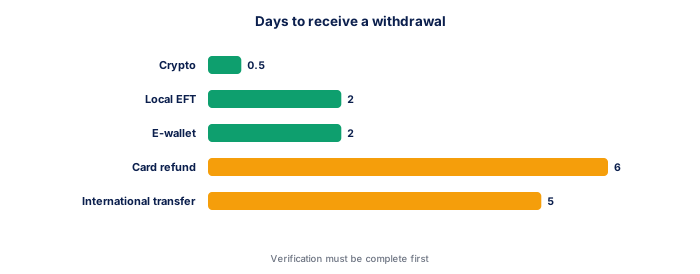
| Method | Deposit speed | Withdrawal speed | Typical cost |
|---|---|---|---|
| Local EFT to a local broker | Same day | 1 to 3 business days | Free to R50 |
| Instant EFT | Minutes | Not used for withdrawals | Free to the client |
| Debit or credit card | Immediate | 3 to 10 business days | Free, or 1% to 3% |
| International bank transfer | 2 to 5 business days | 3 to 7 business days | R300 to R600 plus margin |
| E-wallet | Minutes | 1 to 3 business days | 0% to 2% |
| Crypto | Minutes to an hour | Minutes to an hour | Network fee |
| Rule | Why it exists |
|---|---|
| Withdrawals return to the funding method first | Anti-money-laundering, stops layering |
| Payment only to an account in your own name | FICA, the client must be the beneficiary |
| A card refund cannot exceed what was deposited | Card scheme rules; profit goes by bank transfer |
| Verification must be complete before the first withdrawal | FICA verification obligation |
| A source of funds question on a large deposit | Enhanced due diligence |
| Check | Why |
|---|---|
| Which entity will hold the funds | A local FSP may book you offshore |
| Is the account segregated | It decides what happens if the broker fails |
| What the withdrawal fee is | Some charge per withdrawal, some monthly |
| The minimum withdrawal | Can strand a small balance |
| Base currency | A rand account avoids conversion both ways |
How these figures work
The figures on this page come from the body that publishes them and change on a schedule rather than continuously, which is what makes them worth keeping in one place. Fund from your own bank account in your own name. Using a spouse's or a parent's account is the single most common reason a withdrawal gets stuck.
The rule that profit must leave by bank transfer rather than card refund is a card scheme rule, not the broker being awkward. A refund cannot exceed the original charge.
★ What this means in practice
Verification delays cost days at the worst moment. Complete it when you open the account, not when you want the money out.
✕ Common mistakes
- Fund from your own bank account in your own name. Fund from your own bank account in your own name. Using a spouse's or a parent's account is the single most common reason a withdrawal gets stuck.
- The rule that profit must leave by bank transfer rather than card refund. The rule that profit must leave by bank transfer rather than card refund is a card scheme rule, not the broker being awkward. A refund cannot exceed the original charge.
- Verification delays cost days at the worst moment. Verification delays cost days at the worst moment. Complete it when you open the account, not when you want the money out.
- Taking a figure without its date. A number from a reference page is only as good as when it was last checked, which is why the date sits at the top of this one.
Notes on reading these figures
- Fund from your own bank account in your own name. Using a spouse's or a parent's account is the single most common reason a withdrawal gets stuck.
- The rule that profit must leave by bank transfer rather than card refund is a card scheme rule, not the broker being awkward. A refund cannot exceed the original charge.
- Verification delays cost days at the worst moment. Complete it when you open the account, not when you want the money out.
To put this into practice, the South African Payment Methods runs the arithmetic on your own numbers; FICA Requirements covers the same ground in ordinary language; Segregated client accounts goes into the detail this page only summarises; Broker Account Types is the related figure worth reading beside it; and Forex Transfer Costs covers what this page leaves out.
Terms used on this page
Frequently asked questions
Why must I withdraw to the same method?
Anti-money-laundering rules. Returning funds by the route they arrived stops an account being used to move money between sources.
Can I withdraw to a different person's account?
No. FICA requires the client to be the beneficiary, and a broker that pays a third party is in breach.
Why does profit come by bank transfer rather than card?
A card refund cannot exceed the original charge. That is a card scheme rule, so profit must leave another way.
How long does a withdrawal take?
One to three business days to a local account, three to seven for an international transfer. Verification must already be complete.
What should I check before funding?
Which entity holds the funds, whether the account is segregated, the withdrawal fee and the minimum withdrawal amount.
Why am I asked about source of funds?
Enhanced due diligence on a larger deposit. It is a FICA obligation on the broker, not suspicion of you.
 Download this data