i Short answer
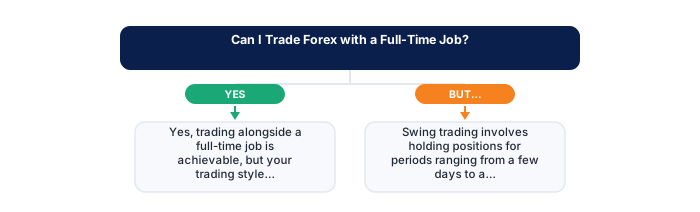
Yes, trading alongside a full-time job is genuinely achievable, but your trading style needs to match your actual schedule.
Scalping doesn't fit a 9-to-5, while swing or position trading fits far more naturally.
📋 ON THIS PAGE
1. Matching trading style to your actual schedule
The question isn't whether trading takes time in some abstract sense, it's whether your chosen style's specific attention requirements fit into the genuine gaps in your working week. Those gaps look different for different jobs: some roles have a predictable 9-to-5 with genuine evenings free; others have irregular hours, travel, or client demands that make any routine difficult to protect.
Styles that demand continuous, real-time attention to price, day trading, scalping, simply don't fit around the typical full-time job without meaningfully hurting either your job performance or your trading quality. Recognising that incompatibility early avoids the expensive lesson of discovering it through a string of inattentive trading decisions.
It's worth actually mapping out your genuine, realistic weekly availability on paper before choosing a trading style, rather than reasoning from aspirations about what you'd like your schedule to be. A style chosen for its appeal that doesn't fit your actual schedule produces worse outcomes than a less exciting style chosen precisely because it fits.
See also: Can I Change My Account's Base Currency Later?
The South African trading schedule has some useful characteristics for working traders: the London session opens at approximately 09:00-10:00 SAST and the New York session begins at approximately 15:00 SAST, with the overlap running until approximately 17:00 SAST. An end-of-day review after work coincides with late New York session activity, and pre-work preparation can capture the London open context, giving working traders two natural daily windows that align with genuine market activity.
2. Swing trading: the most job-compatible approach
Swing trading holds positions for days to weeks, based on broader trends rather than minute-by-minute noise. The monitoring requirement is typically once or twice a day, checking whether a stop or target has been hit, reviewing whether the thesis still holds, perhaps adjusting an order. That check takes minutes, not hours, and it fits naturally into an evening routine or a brief morning review.
That's exactly why swing trading gets recommended so often for people balancing trading with a job: the natural holding period and the analysis timeframe both align with the schedule of someone who has regular work commitments but can find a predictable daily window for focused review.
| Lot type | Size | USD/ZAR pip value | Min recommended account |
|---|---|---|---|
| Standard | 100,000 units | ~R1.00 | R100,000+ |
| Mini | 10,000 units | ~R0.10 | R10,000+ |
| Micro | 1,000 units | ~R0.01 | R1,000+ |
| Nano | 100 units | ~R0.001 | R100+ |
- V = Pip value in account currency
- E = Current exchange rate of quote vs account currency
- L = Lot size (100,000 standard / 10,000 mini / 1,000 micro)
- USD/ZAR example = 1 pip = R1 per standard lot
- Leveraged instrument
- Long and short positions both available
- Overnight financing charges apply
- No underlying asset ownership
- No leverage (typically)
- Physical currency received
- No daily financing charges
- Actual currency ownership
This lower monitoring frequency has a second, less obvious benefit beyond simple schedule compatibility: it also reduces the number of decisions you make per unit time. Fewer decisions means fewer opportunities to make impulsive or emotionally driven mistakes. Many developing traders actually improve their performance when they're forced by circumstance to slow down their decision frequency.
The end-of-day review routine that swing trading requires also tends to produce better analytical quality than decisions made during the trading day. Reviewing a daily candle's complete data, where price opened, how high and low it reached, where it closed, provides a cleaner signal than trying to read the same session while it's still unfolding in real time.
3. Position trading: an even lower-maintenance option
Position trading extends the holding period further still, sometimes weeks to months, built on broader fundamental or technical analysis of multi-week or monthly charts. Monitoring needs drop to a weekly or bi-weekly check-in for most position traders. This makes it the most compatible style with genuinely unpredictable or demanding work schedules.
The trade-off is a heavier analytical requirement up front. Position trading leans harder on your ability to form well-grounded views about longer-term trends, since you won't be watching closely enough to manage the trade tactically as it develops. The analysis that goes into opening a position needs to be thorough enough to stand on its own for weeks without requiring revision.
This style is worth considering seriously if your job involves genuinely unpredictable demands, client emergencies, irregular hours, travel, that make protecting even a daily review window unreliable. A position that you've set up with clear levels and a thesis that works on a weekly chart doesn't require daily attention to remain properly managed.
South African position traders often focus on macro factors that evolve slowly: SARB monetary policy direction, the rand's trajectory against major currencies, JSE sector performance relative to emerging market benchmarks, and commodity cycle trends that affect South Africa's resource-heavy economy. These drivers tend to have multi-week duration, making them natural candidates for a lower-frequency, higher-conviction trading approach.
4. End-of-day analysis and its specific value for South Africans
A common effective routine among South African working traders: review charts and market developments after work, when the New York session is winding down and the daily candle is near its close. This timing provides the benefit of near-complete daily data, you're not making decisions based on a candle that's still forming, while fitting naturally into an evening routine.
A focused 15 to 30 minutes after work, reviewing charts and placing any orders for the next session, gives a structured and bounded routine that avoids the unmanaged, open-ended time investment that trading without a defined routine tends to produce. Most of the decision-making work for swing traders happens in this window, with the rest of the day spent simply monitoring that nothing unexpected has triggered a review.
Treating this window as a genuine, protected appointment, rather than something to fit in only when the day allows, is what makes the routine sustainable over months and years rather than collapsing the first time work gets busy. The traders who sustain this combination longest are typically those who treat their trading review time with the same seriousness as a work commitment.
Pre-work preparation is also worth considering: a brief 10-minute check before the working day begins captures any overnight moves, reconfirms your open positions are as expected, and flags any data releases scheduled for the day that might affect your positions. Combining this with the end-of-day review creates a full, manageable daily routine that requires under an hour total.
5. What genuinely doesn't work part-time
Day trading and scalping don't fit around a full-time job regardless of discipline. These styles need sustained, continuous attention to price movement, you need to be watching, thinking, and ready to act for hours at a time, not checking in every hour or two. The work-trading conflict isn't about effort or commitment; it's a structural incompatibility.
It's far cheaper to recognise this incompatibility upfront than to discover it through a string of costly trades made during attention-divided work hours. Every trader who has tried to day trade during stolen minutes at work describes the same experience: missed entries, delayed exits, positions held too long because they couldn't close them at the right moment, and compounding pressure from managing both simultaneously.
It's worth being honest with yourself if this limitation feels frustrating, since the appeal of faster-paced trading styles is real and the restrictions of a working schedule can feel like an obstacle to a goal you're genuinely motivated by. The reframe that helps most: a well-executed swing trading programme can produce meaningful long-term results without requiring you to give up your income to pursue it. Day trading requires that choice; swing trading doesn't.
There's also a cognitive spillover cost worth acknowledging. Trying to day trade during work hours doesn't just produce poor trading results, it typically reduces work quality as well. The mental effort of managing open positions, monitoring price alerts, and waiting for setups is not fully contained in the moments you're actively looking at a chart. It occupies background cognitive bandwidth throughout the day.
6. Setting realistic expectations about pace of progress
Trading part-time naturally means building experience and refining a strategy more slowly than someone with far more daily hours dedicated to it. That's the reality of combining trading with a full-time job, and accepting it honestly produces more sustainable outcomes than trying to accelerate beyond what your schedule genuinely allows.
Accepting the slower pace, rather than trying to force faster progress through greater frequency or reduced discipline, is the approach that actually produces skill development over time. Many of the traders who go full-time successfully describe years of part-time development before the transition, not a shortcut that bypassed that phase.
The traders who sustain this combination longest tend to pick a single, narrow review window and protect it consistently rather than trying to fit trading into multiple fragmented sessions throughout the day. One good, focused session per day produces better outcomes than four distracted ones, and is far more compatible with also doing a full-time job well.
✕ Common mistakes
- Choosing a trading style that doesn't match your actual schedule. Scalping rarely fits around a standard working day.
- Treating review time as flexible rather than protected. An 'whenever I have time' approach usually means no consistent review at all.
- Checking charts compulsively throughout the workday. This affects both job performance and trading discipline.
- Underestimating fatigue's effect on evening trading decisions. Decision quality can decline noticeably after a full workday.
Does this apply to JSE shares too?
The larger JSE shares are available as CFDs through local brokers, without the shareholder rights that come with owning the share. Trading JSE shares through a forex broker covers it in full.
Key Takeaways
- Yes, if your trading style matches your schedule. Learn which approaches fit around a 9-to-5 job and which ones genuinely don't.
- Yes, trading alongside a full-time job is genuinely achievable, but your trading style needs to match your actual schedule.
- Scalping doesn't fit a 9-to-5, while swing or position trading fits far more naturally.
- Matching trading style to your actual schedule.
- Swing trading: the most job-compatible approach.
Frequently asked follow-up questions
Can I check trading charts during work hours without it affecting my job?
Frequent chart-checking during work hours can affect both job performance and trading decision quality due to divided, rushed attention; a structured before/after-work routine is generally more sustainable than checking intermittently throughout the day.
Is it better to trade fewer instruments if I have limited time?
Yes, many part-time traders find focusing on one or two specific instruments allows for more thorough, consistent analysis within limited available time, compared to spreading attention thin across many different markets.
Should I use automated tools to help with part-time trading?
Some traders use alerts or automated order types (like pending orders and stop-losses set in advance) specifically to manage positions without needing constant manual monitoring, which can help bridge the gap between limited available time and the need for timely position management.
