What this page covers
Quick answer: A tax-free savings account removes income tax, dividends tax and capital gains tax on everything inside it (SARS, tax-free investments) (SARS, dividends tax). Key figures: annual limit R46,000; lifetime limit R500,000; penalty on excess 40%; tax inside the wrapper 0%. Figures current at 19 November 2026, from South African Revenue Service, tax-free investments.
A tax-free savings account removes income tax, dividends tax and capital gains tax on everything inside it. The trade-off is a hard contribution ceiling, and exceeding it is penalised at a rate that wipes out the benefit.
Key findings
- South Africans can contribute R46,000 (from 1 March 2026) a year and R500,000 over a lifetime to tax-free savings accounts.
- Interest, dividends and capital gains inside the account are not taxed.
- Contributions above either limit attract a 40% penalty, even if money was withdrawn in between.
What changed in 2026
The annual limit rose from R36,000 to R46,000 from 1 March 2026; the R500,000 lifetime limit did not change. Earlier annual limits were R30,000 from the launch in March 2015, R33,000 from 1 March 2017 and R36,000 from 1 March 2020 (SARS, tax-free investments).
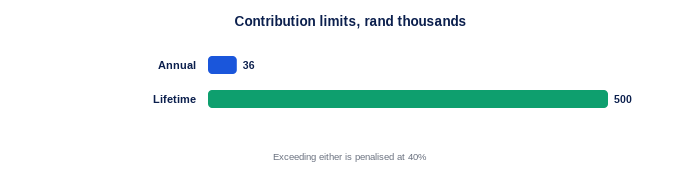
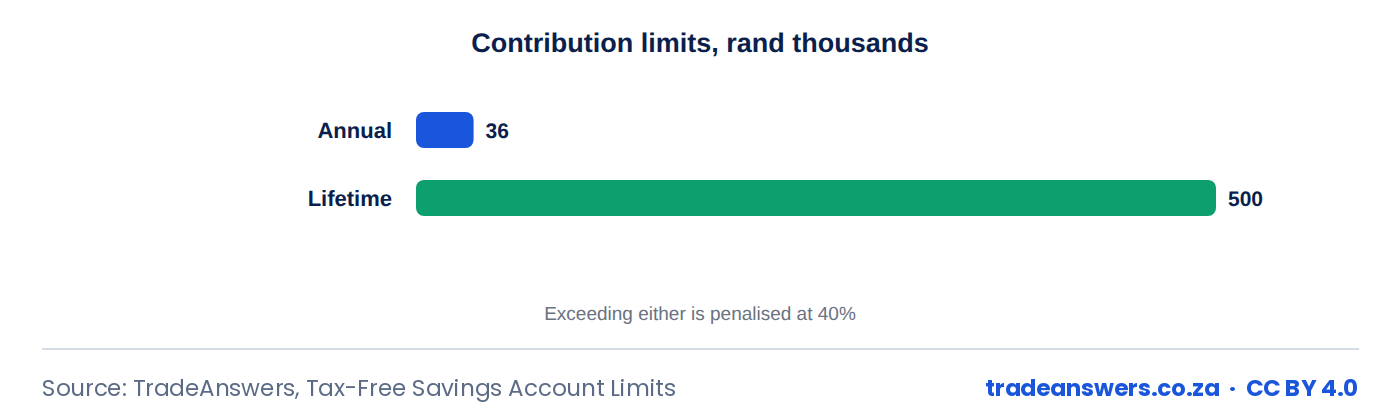
⬇ Download this chart (PNG) · Free to reuse with the credit “Source: TradeAnswers, Tax-Free Savings Account Limits” (CC BY 4.0).
| Limit | Amount | Applies to |
|---|---|---|
| Annual contribution | R46,000 | Each tax year, 1 March to end February |
| Lifetime contribution | R500,000 | Across all accounts, for life |
| Penalty on excess | 40% | Of the amount contributed above either limit |
| Number of accounts | No limit | But the limits apply across all of them combined |
| Minimum age | None | A parent may open one for a minor, against the child's limits |
Source: TradeAnswers, Tax-Free Savings Account Limits. Free to reuse with attribution (CC BY 4.0).
| Tax | Outside a TFSA | Inside |
|---|---|---|
| Interest | Taxed at your marginal rate above the exemption | Exempt |
| South African dividends | 20% withheld | Exempt |
| Capital gains | 40% included at your marginal rate | Exempt |
| Foreign dividends | Taxed with a partial exemption | Foreign withholding still applies |
| REIT distributions | Taxed as income | Exempt |
TradeAnswers · CC BY 4.0
| Instrument | Allowed |
|---|---|
| JSE-listed ETFs | Yes, if the fund is approved for TFSA use |
| Unit trusts | Yes, most |
| Fixed deposits and bank products | Yes |
| Retail savings bonds | Yes |
| Individual JSE shares | No |
| Derivatives and CFDs | No |
TradeAnswers · CC BY 4.0
📋 ON THIS PAGE
How these figures work
The wrapper is simple: nothing inside it is taxed, and the price of that is a ceiling on what you may put in. Both limits run at once, so a year in which you contribute R46,000 uses a year of annual room and R46,000 of the lifetime R500,000.
The penalty is what makes the limits bind. SARS raises 40% on any excess, which is more than the top marginal rate, so over-contributing is worse than not using the account at all (SARS, rates of tax for individuals).
★ A worked example
Hypothetical example using the figures on this page. Someone contributes R3,833 a month, reaching R45,996 by February. In year eleven the cumulative total passes R500,000.
The amount above R500,000 is an excess contribution, so SARS raises a penalty of 40% on it, and it still counts against the lifetime limit. Stopping at R500,000 exactly, part way through year eleven, avoids the penalty entirely.
Contributions count, withdrawals do not give room back
Worked example (hypothetical, 2026/27 tax year): you deposit R36,000 in March, withdraw R20,000 in June and deposit R20,000 in November. Your balance changed by R36,000, but your contributions for the year are R56,000, because the withdrawal does not reduce what you have contributed. That is R10,000 over the R46,000 annual limit, and SARS charges a 40% penalty on the excess: R4,000. All R56,000 also counts towards the R500,000 lifetime limit. If you need access to money, keep it outside the tax-free account.
What this means for you
- Using the full allowance: R3,833 a month comes to R45,996 a year, just inside the R46,000 limit; at that pace the R500,000 lifetime limit is reached in about 11 years.
- Over the annual limit: contributing R50,000 in one tax year puts R4,000 over the limit, and the 40% penalty is R1,600, more than the tax the account would save on that R4,000 for years.
- Taking money out: withdrawing R20,000 does not free up R20,000 of allowance; putting it back later uses new allowance and counts towards the lifetime limit again.
- Several accounts: the limits apply per person across all your tax-free accounts, not per account, so two accounts of R30,000 each in a year are R14,000 over.
✕ Common mistakes
- Assuming a withdrawal restores room. It does not. Taking R50,000 out and replacing it costs R50,000 of the lifetime R500,000.
- Holding cash in it. The exemption is worth most on the highest-growth assets. Cash in a TFSA wastes the wrapper.
- Opening several accounts without tracking the total. The limits apply across all of them combined, and each provider only sees its own.
- Expecting foreign dividends to be exempt. Foreign withholding tax still applies. Only the South African taxes fall away.
Notes on reading these figures
- A withdrawal does not restore the contribution room it used. Taking R50,000 out and putting it back costs R50,000 of lifetime allowance, which is the single most expensive misunderstanding about these accounts.
- The 40% penalty is on the excess contribution, not on the growth. SARS raises it on assessment, and it is payable whether or not you noticed.
- Transferring between providers does not count as a contribution, provided the transfer is done directly between them rather than by withdrawing and redepositing.
To work these figures through with your own numbers, use the Tax-Free Savings Account Calculator. For more detail, see Capital Gains Tax Rates and Exclusions, Can I trade in a TFSA? and Retirement Fund Contribution Limits. The Which ETF should a beginner buy? covers the part this table leaves out.
Terms used on this page
Recent changes to this page
- : Worked examples added to four tax reference pages
Every change is recorded on the Updates Log.
Spotted an outdated figure? If a figure or rate on this page no longer matches its source, email us the page and the source. A material correction is dated on the Updates Log; how figures are compiled and checked is set out in our data methodology.
Cite this page
Barosso, G. (2026, September 27). Tax-Free Savings Account Limits. TradeAnswers. https://www.tradeanswers.co.za/tax-free-savings-account-limits.htmlBarosso, G (2026) Tax-Free Savings Account Limits, TradeAnswers, figures current at 19 November 2026, https://www.tradeanswers.co.za/tax-free-savings-account-limits.htmlThe tables and the CSV on this page are free to reuse under a CC BY 4.0 licence: attribution with a link to this page. See the Press & Data Licence page.
Frequently asked questions
Can I have more than one TFSA?
Yes, with different providers. The annual and lifetime limits apply to all of them added together, and no provider sees the others.
What happens if I go over the limit?
SARS raises a 40% penalty on the excess. The contribution still counts against the lifetime limit, so the room is gone as well.
Does a withdrawal free up room?
No. Contribution room is used when you contribute, and a withdrawal does not return it.
Can I hold individual shares?
No. The permitted list covers approved ETFs, unit trusts, bank products and retail savings bonds, not single shares.
Should I use a TFSA or a retirement annuity first?
They do different things. A retirement annuity gives a deduction now and locks the money; a TFSA gives no deduction but is accessible and exempt on the way out.
Is the R500,000 limit adjusted for inflation?
It has not been since the accounts were introduced, which means it falls in real terms each year.
 Download this data