i Short answer
The Rand has shown a long-term depreciating trend against major currencies like the US Dollar over recent decades, reflecting structural emerging-market characteristics and persistent inflation differentials.
📋 ON THIS PAGE
- The general long-term trend pattern observed
- The inflation differential explanation for this pattern
- Why emerging-market currencies broadly share this tendency
- Significant historical episodes worth understanding for context
- Does this historical trend reliably predict future movement
- What this means for traders rather than long-term currency holders
1. The general long-term trend pattern observed
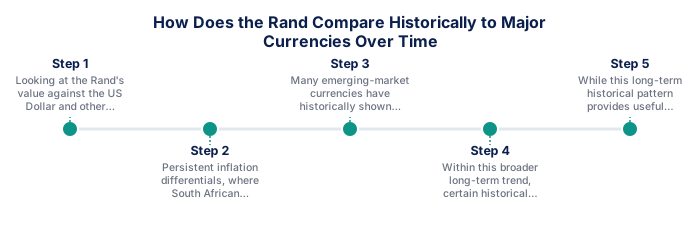
Looking at the Rand's value against the US Dollar and other major currencies over several decades reveals a general, long-term depreciating trend, with the Rand requiring progressively more units to equal one US Dollar over this extended historical period, though this trend has included significant periods of both relative stability and more pronounced depreciation.
It's worth looking at an actual long-term USD/ZAR chart yourself rather than only reading about this trend descriptively, seeing the genuine multi-decade pattern visually gives you a more intuitive, lasting understanding of this historical context than a purely written description can provide.
2. The inflation differential explanation for this pattern
Persistent inflation differentials, where South African inflation has historically tended to run higher than in major developed economies like the United States, provide one significant structural explanation for this long-term depreciating tendency. Higher relative inflation generally erodes a currency's purchasing power and value over time relative to lower-inflation currencies. See interest rates and currency prices for more on this mechanism.
It's worth understanding this through the concept of purchasing power parity, a foundational economic principle suggesting that persistent inflation differences between countries should, over the long run, be reflected in corresponding exchange rate adjustments, worth researching further if this underlying economic logic genuinely interests you.
See also: How Does SA Unemployment Relate to Currency Markets?
- SARB economic calendar checked for the week
- Next Eskom load shedding schedule reviewed
- GNU stability news reviewed
- Stats SA data releases noted
- Credit agency review dates checked
- US/global events that move EM risk noted
4. Significant historical episodes worth understanding for context
Within this broader long-term trend, certain historical periods have seen more pronounced, sometimes rapid Rand depreciation, often connected to specific combinations of domestic political or economic developments and broader global risk-aversion episodes, showing how various fundamental factors can compound during particular periods.
It's worth researching these specific historical episodes individually if you want genuine depth in your South African market fundamental understanding, knowing the specific triggers and context behind past significant Rand moves builds a more informed foundation for interpreting current events through a similar lens.
5. Does this historical trend reliably predict future movement
While this long-term historical pattern gives useful broader context, it doesn't reliably predict near-term or even medium-term currency movement for trading purposes. The day-to-day and week-to-week fluctuations relevant to most retail trading strategies are driven by more immediate fundamental and technical factors, not this broader, multi-decade historical trend directly.
It's worth being genuinely cautious about extrapolating this long-term trend into short-term trading decisions, a multi-decade historical pattern says very little about what USD/ZAR will do over your next specific trade's timeframe, worth keeping this distinction clear rather than treating historical trend as a reliable near-term signal.
6. What this means for traders rather than long-term currency holders
For active traders, this long-term historical context is more useful as background understanding than as a direct trading signal. Position sizing, risk management, and technical and fundamental analysis remain the more directly relevant tools for actual trading decisions, rather than relying on this broader historical trend alone.
This connects directly to the SARB's Monetary Policy Committee (MPC), which meets several times a year to set the repo rate, decisions that ripple through borrowing costs, the Rand, and market sentiment well beyond the immediate announcement.
The Rand's long-run depreciation trend, reflecting the inflation differential, is a genuinely different question from any specific short-term trading signal.
★ Why It Matters
Worth knowing: the Rand's long-term depreciation trend against the Dollar broadly tracks the inflation differential between South Africa and the US over the same period, a pattern consistent with purchasing power parity playing out over long timeframes, even when it fails to predict short-term moves.
✕ Common mistakes
- Assuming long-term depreciation predicts near-term price direction. Long-run trends and short-term trading signals are very different things.
- Ignoring the inflation differential underlying the long-term trend. This is the structural driver behind the Rand's historical depreciation pattern.
- Treating historical averages as a meaningful trading benchmark. Long-term averages have limited relevance to any individual trade decision.
- Not adjusting comparisons for the specific time period selected. Different historical windows can tell quite different stories.
How does load shedding affect this?
What it removes is your ability to manage a trade, not the trade. That is a reason to size and stop accordingly before the schedule hits. Trading through load shedding covers it in full.
Key Takeaways
- The Rand has shown a long-term depreciating trend against major currencies, reflecting structural emerging-market and inflation differential factors over decades.
- The Rand has shown a long-term depreciating trend against major currencies like the US Dollar over recent decades, reflecting structural emerging-market characteristics and persistent inflation differentials.
- The general long-term trend pattern observed.
- The inflation differential explanation for this pattern.
- Why emerging-market currencies broadly share this tendency.
See also: Why Is August Historically the Rand's Worst Month?.
Frequently asked follow-up questions
Has the Rand ever shown sustained periods of strengthening?
Yes, periods of relative Rand strength have happened at various points, often connected to favourable global risk sentiment or specific positive domestic developments, though the longer-term trend has generally been depreciating.
Is this historical pattern unique to the Rand specifically?
No, many other emerging-market currencies show broadly similar long-term patterns relative to major developed-market currencies.
Should this historical trend affect my position sizing as a trader?
Not directly. Standard risk management principles apply regardless of this broader historical context, which is more useful for general understanding than for specific trading decisions.
