What this page covers
Paying a foreign merchant by card carries two costs that do not appear as fees: the scheme conversion rate and, if you accept it, dynamic currency conversion at the terminal.
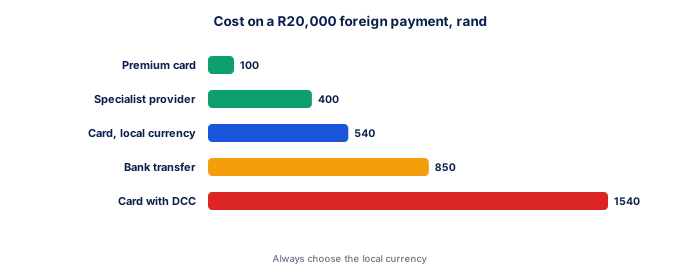
| Component | Typical level | Charged by |
|---|---|---|
| Scheme conversion | Mid-market plus 0% to 1% | Visa or Mastercard |
| International transaction fee | 2% to 3% | Your bank |
| Dynamic currency conversion | 3% to 7% on top | The merchant's acquirer, if you accept |
| Cash withdrawal abroad | 2% to 3% plus a flat fee | Your bank |
| Premium card waiver | 0% international fee | Some premium accounts |
| Item | Detail |
|---|---|
| What it is | The terminal offers to charge you in rand instead of the local currency |
| What it costs | A margin of 3% to 7% over the scheme rate |
| Why it is offered | The margin is shared with the merchant |
| What to do | Always choose the local currency |
| Where it appears | Card terminals, ATMs and some websites |
| Route | Approximate cost | Speed |
|---|---|---|
| Card, local currency chosen | R440 to R640 | Immediate |
| Card, dynamic conversion accepted | R1,040 to R2,040 | Immediate |
| Bank transfer | R750 to R950 | 2 to 5 days |
| Specialist provider | R350 to R450 | 1 to 2 days |
| Premium card, fee waived | R0 to R200 | Immediate |
How these figures work
The figures on this page come from the body that publishes them and change on a schedule rather than continuously, which is what makes them worth keeping in one place. Always choose to be charged in the local currency. Accepting rand at a foreign terminal is the most expensive routine decision a South African traveller or trader makes.
On small payments a card is usually cheapest because the fixed transfer fees dominate. The crossover is somewhere around R10,000 to R20,000.
★ What this means in practice
A card payment to a broker is a payment to a merchant, so the same international transaction fee applies as to any foreign purchase.
✕ Common mistakes
- Always choose to be charged in the local currency. Always choose to be charged in the local currency. Accepting rand at a foreign terminal is the most expensive routine decision a South African traveller or trader makes.
- On small payments a card is usually cheapest because the fixed transfer . On small payments a card is usually cheapest because the fixed transfer fees dominate. The crossover is somewhere around R10,000 to R20,000.
- A card payment to a broker is a payment to a merchant, so the same inter. A card payment to a broker is a payment to a merchant, so the same international transaction fee applies as to any foreign purchase.
- Taking a figure without its date. A number from a reference page is only as good as when it was last checked, which is why the date sits at the top of this one.
Notes on reading these figures
- Always choose to be charged in the local currency. Accepting rand at a foreign terminal is the most expensive routine decision a South African traveller or trader makes.
- On small payments a card is usually cheapest because the fixed transfer fees dominate. The crossover is somewhere around R10,000 to R20,000.
- A card payment to a broker is a payment to a merchant, so the same international transaction fee applies as to any foreign purchase.
To put this into practice, the Currency Converter runs the arithmetic on your own numbers; Forex Transfer Costs covers the same ground in ordinary language; Broker Deposits and Withdrawals goes into the detail this page only summarises; South African Bank Charges is the related figure worth reading beside it; and Exchange Control Allowances covers what this page leaves out.
Terms used on this page
Frequently asked questions
What is dynamic currency conversion?
The terminal offering to charge you in rand instead of the local currency, at a margin of 3% to 7% over the scheme rate.
Should I ever accept it?
No. Always choose the local currency and let your own bank do the conversion.
What does a foreign card transaction cost?
Typically 2% to 3% as an international transaction fee, plus the scheme conversion of up to 1%.
Is a card cheaper than a transfer?
On small amounts usually, because fixed transfer fees dominate. The crossover is around R10,000 to R20,000.
Do premium accounts waive the fee?
Some do. If you transact abroad regularly it is worth checking what your account includes.
Does the same fee apply to paying a broker?
Yes. A payment to a foreign broker is a foreign-currency transaction like any other.
 Download this data