What this page covers
Quick answer: Contributions to a pension fund, provident fund or retirement annuity are deductible, up to a percentage of income and a rand ceiling. Key figures: of income, deductible 27.5%; annual cap R430,000 (from 1 March 2026); offshore under Reg 28 45%; equity under Reg 28 75%. Figures current at 19 November 2026, from South African Revenue Service, retirement fund contributions.
Contributions to a pension fund, provident fund or retirement annuity are deductible, up to a percentage of income and a rand ceiling. Anything above the ceiling is not lost, but it is carried forward rather than deducted now.
Key findings
- Retirement contributions are deductible up to 27.5% of the greater of remuneration or taxable income.
- The annual deduction is capped at R430,000 across all pension, provident and retirement annuity funds.
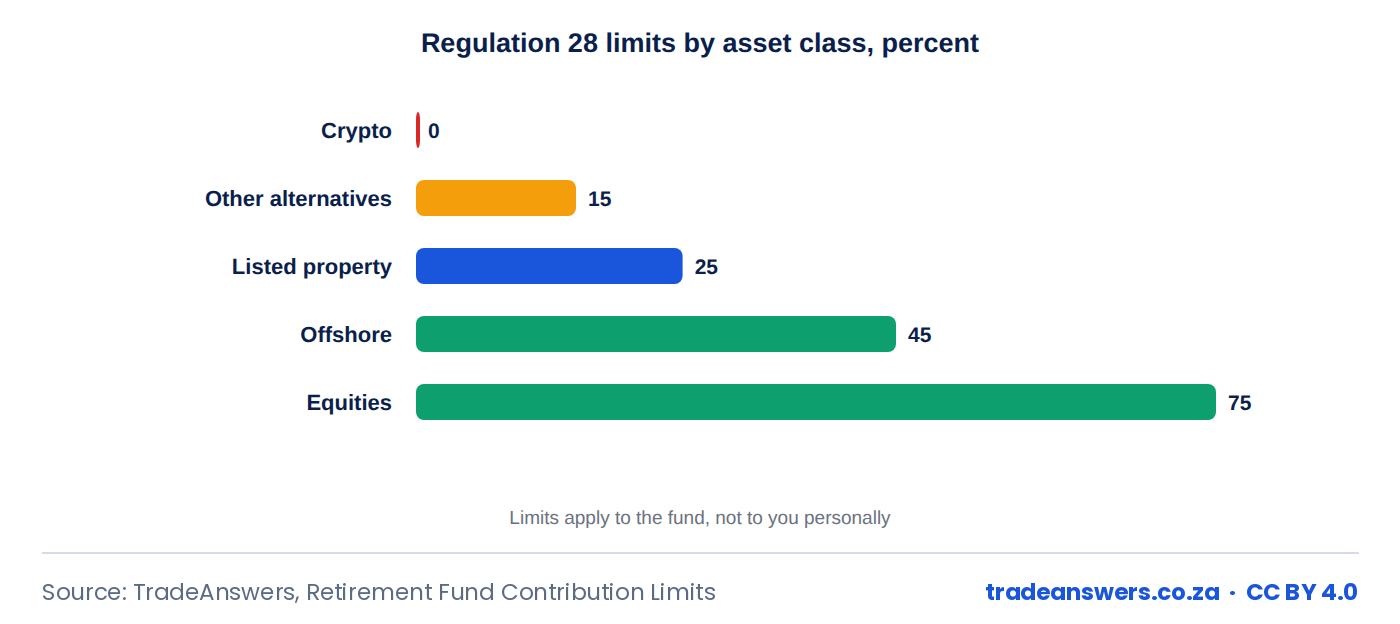
- Regulation 28 limits offshore assets to 45% and equities to 75% of a retirement fund.
What changed in 2026
The annual cap rose from R350,000 to R430,000 from 1 March 2026; the 27.5% limit did not change.
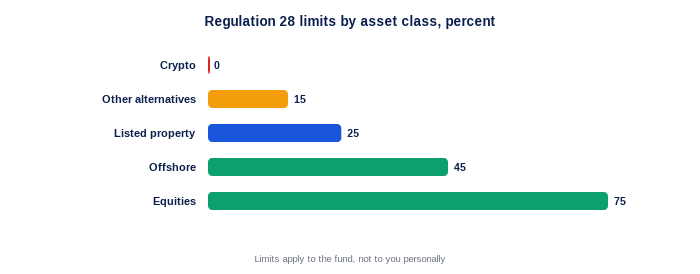
⬇ Download this chart (PNG) · Free to reuse with the credit “Source: TradeAnswers, Retirement Fund Contribution Limits” (CC BY 4.0).
| Item | Rule |
|---|---|
| Percentage limit | 27.5% of the greater of remuneration or taxable income |
| Annual rand cap | R430,000 |
| Funds covered | Pension, provident and retirement annuity combined |
| Employer contributions | Treated as a fringe benefit, then deductible under the same limit |
| Excess above the limit | Carried forward to the next year, or set against a lump sum at retirement |
Source: TradeAnswers, Retirement Fund Contribution Limits. Free to reuse with attribution (CC BY 4.0).
| Asset class | Maximum |
|---|---|
| Equities | 75% |
| Offshore | 45% |
| Listed property | 25% |
| Hedge funds, private equity and other | 15% combined |
| Crypto assets | 0% |
| African markets outside South Africa | 10% of the offshore allowance |
TradeAnswers · CC BY 4.0
| Taxable income | 27.5% of income | Deductible this year |
|---|---|---|
| R400,000 | R110,000 | R110,000 |
| R800,000 | R220,000 | R220,000 |
| R1,200,000 | R330,000 | R330,000 |
| R1,600,000 | R440,000 | R430,000, capped |
| R2,000,000 | R550,000 | R430,000, capped |
TradeAnswers · CC BY 4.0
📋 ON THIS PAGE
How these figures work
The deduction is the lower of two numbers: 27.5% of income and R430,000. Below roughly R1.56 million of income the percentage binds; above it the rand cap does.
Contributions above the limit are not wasted. They carry forward, and at retirement they reduce the taxable portion of the lump sum, which is why over-contributing deliberately is a recognised strategy rather than a mistake.
★ A worked example
Hypothetical example using the figures on this page. Someone with taxable income of R900,000 contributes R300,000 to a retirement annuity.
27.5% of R900,000 is R247,500, which is below the R430,000 cap, so the deductible amount is R247,500. At a 41% marginal rate that saves R101,475 in tax.
The remaining R52,500 is carried forward to next year, or set against the lump sum at retirement. Nothing is lost, but the benefit is deferred.
✕ Common mistakes
- Assuming the cap applies at every income. It binds only above about R1.56 million. Below that the 27.5% is the effective limit.
- Forgetting employer contributions count. They are added to your income as a fringe benefit, then deducted under the same limit, so they use your room.
- Treating excess contributions as lost. They carry forward and reduce the taxable lump sum at retirement.
- Expecting Regulation 28 to apply outside the fund. It constrains the fund only. Money held personally has no such limits.
Notes on reading these figures
- The cap binds only above roughly R1.56 million of income, where 27.5% first exceeds R430,000. Below that the percentage is the effective limit.
- Trading profit that SARS treats as revenue counts toward taxable income, so it raises the amount you may contribute deductibly.
- Regulation 28 applies to the fund, not to you. Money outside a retirement fund is unconstrained, which is why offshore exposure is usually built there rather than inside the fund.
To work these figures through with your own numbers, use the Marginal Tax Rate Calculator. For more detail, see Retirement annuity vs TFSA, What Regulation 28 limits and Tax-Free Savings Account Limits. The SARS Income Tax Tables covers the part this table leaves out.
Terms used on this page
Spotted an outdated figure? If a figure or rate on this page no longer matches its source, email us the page and the source. A material correction is dated on the Updates Log; how figures are compiled and checked is set out in our data methodology.
Cite this page
Barosso, G. (2026, September 27). Retirement Fund Contribution Limits. TradeAnswers. https://www.tradeanswers.co.za/retirement-fund-contribution-limits.htmlBarosso, G (2026) Retirement Fund Contribution Limits, TradeAnswers, figures current at 19 November 2026, https://www.tradeanswers.co.za/retirement-fund-contribution-limits.htmlThe tables and the CSV on this page are free to reuse under a CC BY 4.0 licence: attribution with a link to this page. See the Press & Data Licence page.
Frequently asked questions
What is the actual limit?
27.5% of the greater of remuneration or taxable income, capped at R430,000 a year across all retirement funds combined.
Do employer contributions use my limit?
Yes. They are treated as a fringe benefit added to your income, then deducted under the same limit.
What happens to contributions above the cap?
They carry forward to later years, and at retirement they reduce the taxable portion of the lump sum.
Does trading profit raise my limit?
Where SARS treats it as revenue, yes. It increases taxable income, which raises 27.5% of that figure.
What is Regulation 28?
The limits on what a retirement fund may hold: 75% equities, 45% offshore, 25% listed property, and no crypto.
Can I contribute to more than one fund?
Yes, but the limit applies to the total across a pension fund, provident fund and retirement annuity combined.
 Download this data