i Short answer
Most South African retail traders trade gold through a CFD, tracking the live price without ever owning, storing, or insuring physical metal.
You profit or lose based purely on price movement between opening and closing your position, using the same leveraged mechanics as forex. Gold's price movements can also meaningfully affect the Rand itself, given South Africa's status as a major gold producer.
📋 ON THIS PAGE
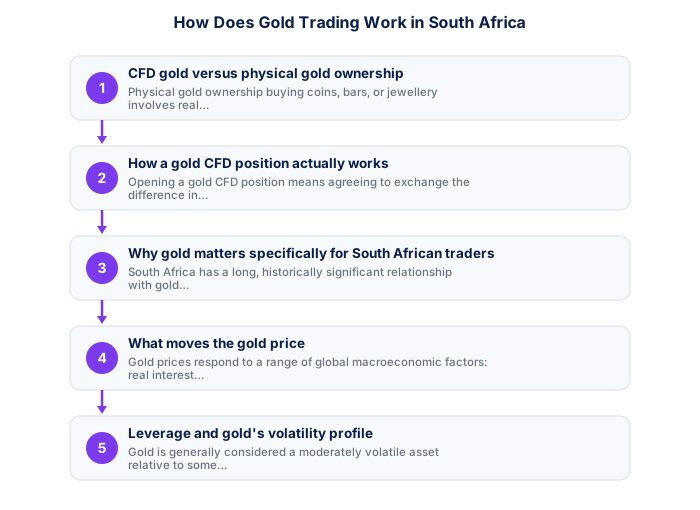
1. CFD gold versus physical gold ownership
Physical gold ownership, coins, bars, or jewellery, comes with real costs and friction that a CFD removes entirely: secure storage (a safe, or a bank's safety deposit box), insurance against theft or loss, and typically a wide spread between buy and sell prices at most physical dealers, reflecting what it costs them to hold and secure inventory. Selling physical gold quickly at a fair price is also rarely as simple as closing an electronic CFD position in a few clicks.
A gold CFD sidesteps all of that. You never take physical delivery, there's nothing to store or insure, and positions open and close almost instantly during market hours, priced against the live, globally-traded gold spot price rather than one dealer's own buy-sell quote. That makes CFDs the practical default for most retail traders whose interest in gold is about speculating on or hedging price movement, not holding the physical asset for its own sake.
It's worth being honest about what you give up in exchange for this convenience: a CFD gives you exposure to gold's price movement, not a tangible asset you can physically hold, transfer informally, or fall back on entirely outside the financial system. For traders whose interest is genuinely speculative or hedging-focused, that trade-off is usually a clear win; for those specifically drawn to gold's appeal as a physical store of value independent of any broker or platform, it isn't.
| Feature | Gold CFD | Physical Gold |
|---|---|---|
| Leverage available | Yes | No |
| Storage required | No | Yes |
| Can go short | Yes | No |
| Liquidity | High | Depends on dealer |
| Ownership of the metal | No | Yes |
2. How a gold CFD position actually works
Opening a gold CFD position means agreeing to exchange the difference in gold's price between your entry and exit points, using margin (a fraction of the total position value) and leverage to control more notional exposure than your deposited capital alone would allow. If gold rises after you open a long (buy) position, you profit by the price difference multiplied by your position size position size; if it falls, you take a loss of the same size.
You can also open a short position, profiting if gold falls rather than rises, a flexibility physical ownership doesn't easily offer. Profiting from a falling gold price while holding it physically would mean already owning gold to sell, then buying it back cheaper later, far more cumbersome than opening a short CFD position with a click.
- SARB economic calendar checked for the week
- Next Eskom load shedding schedule reviewed
- GNU stability news reviewed
- Stats SA data releases noted
- Credit agency review dates checked
- US/global events that move EM risk noted
Because leverage is involved, it's worth applying the identical position sizing discipline to gold that you would to any forex pair, calculating position size from your predetermined risk percentage and stop-loss distance, rather than treating gold as inherently safer simply because of its reputation as a stable, traditional asset. The leverage mechanics don't care what the underlying instrument's popular reputation happens to be.
3. Why gold matters specifically for South African traders
South Africa has a long, historically significant relationship with gold mining, and even though the country's share of global gold output has fallen well below its historical peak, gold remains economically relevant here beyond pure commodity speculation. The Rand has, at various points, shown sensitivity to gold price swings, a legacy of how much mining export revenue once mattered to the broader economy.
Some South African traders use gold positions to express a broader view on global risk sentiment, since gold has historically drawn increased demand during economic uncertainty, geopolitical stress, or worries about currency debasement, functioning as a traditional "safe haven" asset in market commentary, though that relationship isn't perfectly consistent across every period of market stress.
| Event | Frequency | ZAR impact | Source |
|---|---|---|---|
| SARB MPC | 6x per year | High | resbank.co.za |
| Budget Speech | Annual (February) | Very high | treasury.gov.za |
| Credit reviews | Annual each agency | Very high | Agency sites |
| Stats SA CPI | Monthly | Medium | statssa.gov.za |
| Eskom stage | As needed | Low-medium | eskomsepush.com |
- SA context provides genuine informational edge
- ZAR pairs accessible via FSCA brokers in ZAR accounts
- Rand volatility creates larger intraday ranges
- 6 SARB meetings/year create regular macro setups
- Higher geopolitical risk than G10 pairs
- Load shedding creates unique operational disruptions
- SA rand liquidity thinner than major G10 pairs
- SA-specific news requires constant local monitoring
This historical relevance is worth treating as useful context rather than a reliable, tradeable rule. The correlation between gold prices and Rand strength has weakened considerably as mining's share of the South African economy has declined, and relying on this relationship as a primary trading signal without independently verifying it against current data is a common way this kind of background knowledge gets misapplied.
4. What moves the gold price
Gold responds to a handful of global macro factors: real interest rates (since gold pays no yield, higher real rates on alternatives like bonds tend to reduce its appeal, and vice versa), US Dollar strength (gold is priced globally in USD, so a stronger or weaker Dollar mechanically shifts gold's price in other currencies), central bank buying and reserve policy, and broader risk sentiment during geopolitical or financial stress.
Because these are global, macro-level drivers rather than anything specific to South Africa's domestic economy, gold's price moves are generally less tied to local news than, say, USD/ZAR is. That said, trading gold through a ZAR-denominated account still layers Rand exchange rate movement on top of the underlying global gold price.
This is worth keeping specifically in mind if you're used to trading USD/ZAR or other Rand-linked pairs, where local South African news and SARB decisions are often the dominant driver. Gold requires a different information diet, US real interest rate expectations and Federal Reserve commentary matter more here than domestic South African developments, which can take some deliberate adjustment for traders more accustomed to following local news.
5. Leverage and gold's volatility profile
Gold is generally a moderately volatile asset relative to some other commodities, but it can move sharply around major macro announcements, central bank rate decisions, significant geopolitical developments, or shifting expectations on inflation and monetary policy. Trading gold CFDs with leverage amplifies those moves relative to your deposited margin, in exactly the same way leverage amplifies outcomes on any other instrument.
That means the standard risk management principles for leveraged CFD trading, sensible position sizing, defined stop-losses, awareness of upcoming high-impact announcements, apply just as fully to gold as to anything else, whatever its reputation in popular commentary as a "safe" or "stable" asset class.
Gold's 'safe haven' reputation in financial media can create a subtle, misleading impression that it's somehow lower-risk to trade than other instruments. That reputation describes how gold sometimes behaves relative to other assets during specific periods of market stress, it says nothing about the leveraged volatility risk of an individual gold CFD position, which behaves according to the same margin and leverage mechanics as any other leveraged instrument.
6. Alternatives to gold CFDs worth knowing about
Beyond CFDs, South African investors wanting gold exposure without the leverage and short-term orientation of CFDs have other options, though these sit closer to long-term investing than active trading. They include gold-backed exchange-traded funds (ETFs) that track the gold price through a standard JSE-linked brokerage account, and buying physical gold directly through reputable bullion dealers for anyone who specifically wants tangible ownership.
Each carries a different risk, cost, and liquidity profile than gold CFDs. ETFs typically don't involve leverage and suit longer-term holding rather than active trading, while physical gold carries the storage and insurance considerations covered earlier. Seeing these alternatives side by side makes clear that gold CFDs are the tool suited to active, leveraged, short-to-medium-term trading, not long-term gold exposure within a broader portfolio.
Trading gold on a ZAR account involves two factors: gold's own price move in USD, and the USD/ZAR exchange rate movement, a second, often overlooked layer of risk.
★ Why It Matters
Worth keeping separate in your head: a gold CFD's price move reflects the US Dollar gold price, but your Rand-denominated profit or loss also depends on USD/ZAR at the same time. A gold price that's flat in Dollar terms can still show a profit or loss on a ZAR account purely from currency movement.
✕ Common mistakes
- Assuming gold CFD trading requires the same considerations as physical gold. There's no storage, insurance, or delivery involved in a CFD position.
- Not checking margin requirements specific to gold versus forex. Margin and volatility characteristics differ between asset classes.
- Treating gold as risk-free simply because it's a traditional safe haven. Leveraged CFD exposure carries real risk regardless of the underlying asset's reputation.
Key Takeaways
- Most South African traders trade gold via CFDs rather than physical gold. Learn how it works, why CFDs are preferred, and the risks involved.
- Most South African retail traders trade gold through a CFD, tracking the live price without ever owning, storing, or insuring physical metal.
- You profit or lose based purely on price movement between opening and closing your position, using the same leveraged mechanics as forex.
- CFD gold versus physical gold ownership.
- How a gold CFD position actually works.
Frequently asked follow-up questions
Can I take physical delivery of gold through a CFD position?
No. CFDs are cash-settled contracts based on price difference, they don't involve or allow physical delivery of the underlying gold.
Does gold trading require more capital than forex trading?
Not inherently. Minimum position sizes and margin requirements depend on your broker and the leverage offered, much like any other CFD instrument, rather than gold specifically demanding more capital.
Is gold less risky than forex trading?
Not when it's traded as a leveraged CFD. Leverage amplifies gains and losses the same way regardless of the underlying instrument's reputation as a "stable" asset class.
