i Short answer
Correlation risk means multiple open positions can move together due to shared underlying drivers, concentrating your overall account risk.
This can happen even when the specific instruments appear superficially diversified. Our Portfolio Heat Calculator gives a quick combined risk total across all open positions as a related sanity check. Try our free Portfolio Risk Calculator to work through the numbers yourself.
📋 ON THIS PAGE
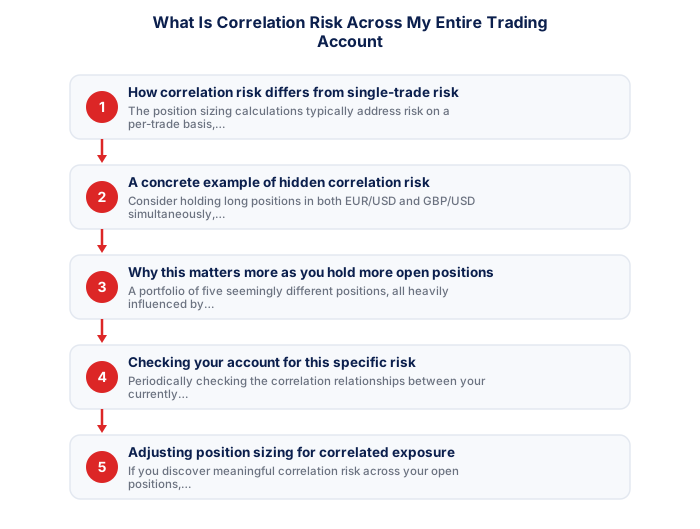
1. How correlation risk differs from single-trade risk
Position sizing calculations typically address risk on a per-trade basis, but correlation risk operates at the account level, considering how multiple simultaneously open positions might move together rather than independently. Even if each individual position is sized appropriately on its own terms, a portfolio of several correlated positions can produce a combined account-level loss considerably larger than any single position's individual risk percentage might suggest.
It's worth calculating this combined figure explicitly before adding any new position while others remain open, discussed elsewhere on this site regarding managing multiple open positions, individually reasonable risk percentages can combine into genuinely uncomfortable total account exposure when the underlying positions are correlated.
3. Why this matters more as you hold more open positions
This correlation risk compounds as you hold more simultaneous positions, particularly if several share similar underlying drivers without you necessarily realising this shared exposure. A portfolio of five seemingly different positions, all heavily influenced by the same broad Dollar or risk-sentiment factor, carries considerably more concentrated risk than five genuinely independent positions would.
It's worth being especially vigilant about this risk specifically as your trading activity and account complexity grow, a beginner holding a single position doesn't face this specific risk at all, making it a consideration that becomes genuinely relevant as your trading matures.
- Position size calculated before every entry
- Stop-loss defined from chart structure before entry
- Total open risk below 5% of account at any time
- No adding to losing positions under any circumstances
- Trading paused if monthly drawdown reaches 10%
- Stops never moved further away once position is open
4. Checking your account for this specific risk
Periodically checking the correlation relationships between your currently open positions, using a correlation matrix tool if available, helps reveal whether your account carries this kind of hidden, concentrated correlation risk, even when your individual position sizing appears disciplined and appropriate on a trade-by-trade basis.
It's worth building this check into your standard pre-trade routine, discussed elsewhere on this site regarding correlation matrix tools, rather than only reviewing it occasionally, a consistent habit catches developing correlation risk before it accumulates into something genuinely significant.
| Drawdown | Recovery needed | At 20%/yr | At 10%/yr |
|---|---|---|---|
| 10% | 11.1% | 7 months | 14 months |
| 25% | 33.3% | 19 months | 38 months |
| 50% | 100.0% | 4+ years | 7+ years |
| 75% | 300.0% | Never at 10%/yr | Never at 10%/yr |
6. The connection to overall account drawdown risk
Unrecognised correlation risk directly contributes to the kind of severe, unexpected drawdown that can undo months of careful risk management. A portfolio that appears diversified on paper but is actually heavily correlated can experience a considerably larger combined decline than the individual position sizing would suggest, precisely because multiple positions move adversely together during a single underlying adverse event rather than independently.
Recognising and managing correlation risk specifically is therefore not simply an abstract diversification consideration, but a direct, practical contributor to keeping your overall account drawdown within the bounds your broader risk management framework is actually designed to maintain.
Trading multiple correlated pairs in the same direction multiplies effective account-level risk beyond what each individual position suggests. Checking correlations before adding new positions prevents unintentional over-exposure.
★ Why It Matters
Worth calculating: your total exposure if your three most correlated open positions all moved against you by the same amount simultaneously. Many traders are surprised at how much larger this combined figure is than any single position's risk taken in isolation.
✕ Common mistakes
- Assuming superficially different instruments are genuinely uncorrelated. Shared underlying drivers can connect instruments that look unrelated on the surface.
- Not recalculating correlation periodically as market conditions shift. Relationships between instruments can change, sometimes significantly, over time.
- Adding a new position without checking its correlation to existing ones. This check should happen before adding exposure, not after.
Key Takeaways
- Correlation risk means multiple open positions move together due to shared underlying drivers, concentrating risk even when positions appear diversified.
- Correlation risk means multiple open positions can move together due to shared underlying drivers, concentrating your overall account risk.
- This can happen even when the specific instruments appear superficially diversified.
- How correlation risk differs from single-trade risk.
- A concrete example of hidden correlation risk.
Frequently asked follow-up questions
Does correlation risk only apply to currency pairs?
No, this concept applies across any combination of instruments, including correlations between currencies, commodities, and indices together.
How can I quickly check for this risk across my account?
A correlation matrix tool lets you check relationships across all your currently held instruments simultaneously, rather than checking pairs individually.
Should I avoid ever holding correlated positions?
Not necessarily avoid entirely, but understanding and accounting for this correlation in your overall risk assessment supports more accurate account-level risk management.
