i Short answer
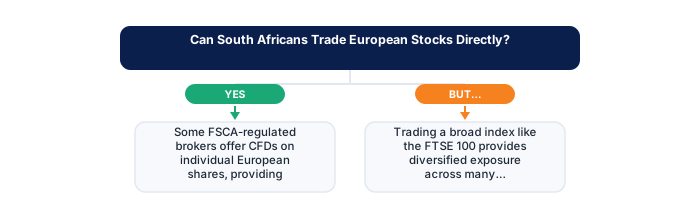
Some FSCA-regulated brokers offer CFDs on individual European shares, providing exposure to companies listed on exchanges like the London Stock Exchange or Euronext.
📋 ON THIS PAGE
| Exchange | Country | Currency |
|---|---|---|
| London Stock Exchange | United Kingdom | GBP |
| Deutsche Börse (Xetra) | Germany | EUR |
| Euronext Paris | France | EUR |
| Euronext Amsterdam | Netherlands | EUR |
2. Which European exchanges are typically covered
Depending on your specific broker, available European share CFDs might cover companies listed on the London Stock Exchange, Euronext Paris, Euronext Amsterdam, Frankfurt Stock Exchange, and occasionally the Swiss Exchange or other smaller European markets. The coverage breadth varies significantly between brokers, some offer hundreds of European shares across multiple exchanges; others limit selection to the most liquid names from the largest exchanges.
It's worth researching a specific company's primary listing exchange before assuming your broker offers access to it. A company that operates primarily in France but has a secondary listing elsewhere may only be available through one of its listings on your broker's platform, and understanding which listing your broker quotes, and in which currency, is important for interpreting prices correctly.
- SARB economic calendar checked for the week
- Next Eskom load shedding schedule reviewed
- GNU stability news reviewed
- Stats SA data releases noted
- Credit agency review dates checked
- US/global events that move EM risk noted
The availability of less commonly traded European shares, smaller cap companies, less prominent national markets, tends to be more broker-dependent than for the largest index constituents. If specific small or mid-cap European companies are your primary interest, verifying their availability before choosing a broker is more important than for a trader focused primarily on the large-cap FTSE 100 and CAC 40 components.
4. Trading hours for European markets
European market hours generally align reasonably well with South African daytime hours. The London market session runs from approximately 10:00-18:30 SAST and continental European exchanges from approximately 10:00-18:30 SAST as well. This creates a substantial window during the South African business day when European share markets are fully active.
This more convenient timing is worth appreciating as a practical advantage if you're also balancing trading around a full-time job or other South African-daytime commitments. The afternoon overlap between South African hours and European market activity, particularly the London-New York overlap from approximately 15:00 SAST, provides good liquidity and price action during accessible working hours.
European share markets also observe local public holidays, meaning there can be trading day differences between the UK (which observes UK bank holidays), continental European countries (which observe local national holidays), and South African markets. Checking whether a specific exchange is open on a given day is worth doing when public holiday calendars diverge.
Pre-market and post-market trading on European shares is less developed than the extended-hours US market. Most European share price movement occurs during the regular session, which means the important price action for position management happens during the core European hours rather than being spread across a longer extended session.
5. How this compares to European indices
Trading a broad index like the FTSE 100 gives diversified exposure across many companies simultaneously with a single position, a simpler way to express a view on the UK market generally, without needing a specific view on individual companies. Trading an individual European share concentrates exposure on a single company's specific dynamics: its earnings, its management, its sector, and its competitive position.
It's worth being deliberate about which approach fits your current analytical capacity. Individual share analysis requires understanding company-specific factors, reading earnings reports, following sector developments, tracking competitors, that a broad index position doesn't require. The potential reward of individual share selection, outperforming the broad index through specific company picks, comes with the cost of needing to do and maintain that company-level research.
Many South African traders who are initially attracted to individual European shares find in practice that broad European index CFDs suit their available research time and attention better. The index provides European equity exposure without requiring ongoing monitoring of individual company news. Individual shares become more appropriate as the trader develops specific expertise in a particular sector or company.
6. Checking availability with your specific broker
Not every broker offers the full range of individual European shares, so checking your broker's available instrument list directly, or contacting support to confirm specific company availability, is worth doing before building a European individual stock strategy around names that may not be accessible.
One nuance worth checking per share rather than broker-wide: individual European share CFD availability and liquidity can vary based on the underlying share's own trading volume. Less liquid European shares, even when technically available on a broker's platform, may have wider spreads and less reliable execution than the most actively traded names. Reviewing the spread on a specific European share during your likely trading hours, not just at the broker's headline spread, gives a more accurate cost picture.
✕ Common mistakes
- Assuming liquidity is uniform across all European share CFDs. It varies considerably by individual company, not just by exchange.
- Overlooking currency exposure on non-Dollar European shares. Euro or Pound-denominated instruments add a layer of currency risk.
- Trading outside the relevant exchange's actual operating hours. Spreads widen noticeably outside a share's home market session.
- Assuming every broker offers the same selection of shares. Availability differs meaningfully between providers.
Can I reach JSE shares this way?
Through CFDs rather than ownership. Settlement, dividends and rights all work differently from buying on the JSE. JSE shares through a forex broker covers it in full.
Key Takeaways
- Some brokers offer CFDs on individual European shares, providing exposure to companies listed on exchanges like the London Stock Exchange or Euronext.
- Some FSCA-regulated brokers offer CFDs on individual European shares, providing exposure to companies listed on exchanges like the London Stock Exchange or Euronext.
- How European share CFDs work mechanically.
- Which European exchanges are typically covered.
- Currency considerations for European shares specifically.
Frequently asked follow-up questions
Are European shares more volatile than US shares?
This varies by specific company and sector rather than being a general rule across the entire market. Individual company analysis matters more than broad regional generalisation.
Do I need a different account to trade European versus US shares?
Generally no. Most brokers offering both typically provide access through the same standard CFD trading account.
Can I find European shares through the same broker offering JSE Top 40 access?
Many brokers do offer a broad range of global instruments together, though checking your broker's exact coverage confirms this for your situation.
