i Short answer
South African traders typically trade oil through a CFD tracking Brent Crude, rather than dealing in physical barrels.
You speculate on price direction using the same leveraged CFD mechanics as gold and forex, with no physical delivery involved.
📋 ON THIS PAGE
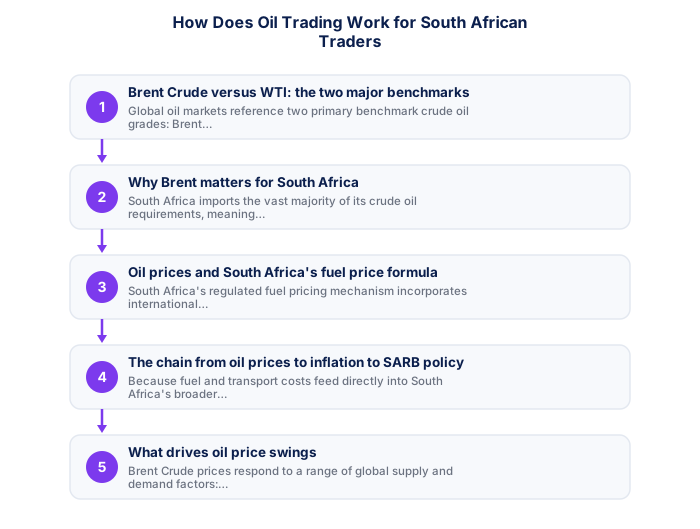
1. Brent Crude versus WTI: the two major benchmarks
Global oil markets reference two primary benchmark crude oil grades: Brent Crude, originally sourced from North Sea production and now functioning as the dominant international pricing reference for crude oil traded outside the Americas, and West Texas Intermediate (WTI), the primary US domestic benchmark. While both track the same broad global oil market and tend to move in a generally correlated fashion, their prices aren't identical and can diverge meaningfully at times due to differing regional supply, demand, and transportation logistics specific to each benchmark's reference points.
For South African and broader international pricing purposes, Brent Crude is generally the more directly relevant benchmark, since it more closely reflects the pricing dynamics of crude oil actually relevant to South Africa's import-dependent fuel supply chain, compared to WTI's more US-domestic-market-specific pricing dynamics.
It's worth checking which specific benchmark your broker actually offers before assuming, since some platforms may only provide one of the two, or price their oil CFD product with reference to a particular benchmark that's worth confirming directly rather than assuming based on general industry convention.
| Feature | Brent Crude | WTI |
|---|---|---|
| Primary source region | North Sea | United States |
| Relevance to SA fuel prices | Direct benchmark used | Less directly relevant |
| Typical global usage | International benchmark | US domestic benchmark |
2. Why Brent specifically matters for South Africa
South Africa imports the vast majority of its crude oil requirements, meaning the country is fundamentally a price-taker on global oil markets rather than having significant domestic production that would insulate the local economy from global price movements. This makes Brent Crude pricing directly and immediately relevant to a meaningful component of South Africa's import costs and broader trade balance, in a way that's structurally different from how oil price movements might affect a major oil-producing and exporting economy.
This direct import dependence is precisely why Brent Crude movements get closely watched by South African economic commentators and policymakers specifically, it's not simply an abstract global commodity price but a direct, mechanical input into the cost structure facing South African consumers and businesses through the fuel supply chain.
- SARB economic calendar checked for the week
- Next Eskom load shedding schedule reviewed
- GNU stability news reviewed
- Stats SA data releases noted
- Credit agency review dates checked
- US/global events that move EM risk noted
It's worth appreciating what this price-taker status actually means practically: South Africa has essentially no ability to influence global oil prices through its own policy, meaning fuel cost pressures affecting the domestic economy are almost entirely externally driven, worth understanding as a genuine structural feature of the South African economy rather than a temporary condition.
3. Oil prices and South Africa's fuel price formula
South Africa's regulated fuel pricing mechanism incorporates international product prices (which are themselves heavily influenced by Brent Crude movements, since refined fuel products are derived from and priced relative to crude oil costs) alongside the Rand-Dollar exchange rate, since oil is globally traded and priced predominantly in US Dollars, meaning Rand weakness against the Dollar compounds the local cost impact of any given Brent Crude price level.
This dual exposure, to both the global Dollar-denominated oil price and the Rand-Dollar exchange rate simultaneously, means South African fuel prices, and by extension broader inflation dynamics tied to transport and energy costs, are sensitive to both Brent Crude price movements and Rand currency movements independently, with the two factors sometimes reinforcing each other (Rand weakness combined with rising Brent prices) and sometimes partially offsetting each other (Rand strength combined with rising Brent prices).
| Event | Frequency | ZAR impact | Source |
|---|---|---|---|
| SARB MPC | 6x per year | High | resbank.co.za |
| Budget Speech | Annual (February) | Very high | treasury.gov.za |
| Credit reviews | Annual each agency | Very high | Agency sites |
| Stats SA CPI | Monthly | Medium | statssa.gov.za |
| Eskom stage | As needed | Low-medium | eskomsepush.com |
- SA context provides genuine informational edge
- ZAR pairs accessible via FSCA brokers in ZAR accounts
- Rand volatility creates larger intraday ranges
- 6 SARB meetings/year create regular macro setups
- Higher geopolitical risk than G10 pairs
- Load shedding creates unique operational disruptions
- SA rand liquidity thinner than major G10 pairs
- SA-specific news requires constant local monitoring
It's worth tracking both components of this dual exposure separately in your own analysis, a stable oil price combined with a weakening Rand can still produce rising domestic fuel costs, just as a falling oil price combined with Rand strength can compound into a larger domestic fuel price decline than the oil move alone would suggest.
4. The chain from oil prices to inflation to SARB policy
Because fuel and transport costs feed directly into South Africa's broader consumer price inflation measures, sustained moves in Brent Crude prices (filtered through the fuel price formula and exchange rate dynamics discussed above) can meaningfully influence South Africa's overall inflation trajectory, which in turn is one of the key inputs the South African Reserve Bank considers when setting interest rate policy.
This creates an indirect but genuine economic chain worth understanding for traders interested in the broader macro picture: significant, sustained Brent Crude price moves can, through this inflation channel, eventually influence SARB policy decisions, which themselves are a major driver of USD/ZAR movement, illustrating how these different markets and instruments aren't fully independent of each other but are connected through real economic transmission mechanisms.
It's worth following this chain through actual, concrete South African data releases, tracking fuel price announcements alongside subsequent CPI inflation figures and eventual SARB commentary, gives you direct, observable evidence of this mechanism actually playing out in real economic data over time.
5. What drives oil price swings specifically
Brent Crude prices respond to a range of global supply and demand factors: OPEC and OPEC+ production quota decisions (the coordinated output policy of major oil-producing nations), geopolitical developments in oil-producing regions that raise concerns about supply disruption, global economic growth expectations (since stronger expected growth typically implies stronger oil demand expectations, and vice versa), and shifts in global energy policy or the pace of transition toward alternative energy sources that might affect longer-term oil demand trajectories.
These drivers can sometimes produce sharp, rapid price movements, particularly around unexpected geopolitical developments or surprise OPEC+ policy announcements that weren't broadly anticipated by market participants beforehand, making oil one of the commodity categories where genuinely sudden, large price gaps are a real and recurring possibility that traders need to account for in their risk management approach.
It's worth following OPEC+ meeting schedules specifically as part of your broader economic calendar awareness, discussed elsewhere on this site, since these coordinated production decisions are genuinely scheduled, known events worth anticipating rather than being caught off guard by.
6. Trading oil CFDs practically: leverage and volatility
Oil CFDs typically carry leverage broadly comparable to other commodity CFD categories, with the same fundamental mechanics of margin and amplified gain/loss exposure applying identically to oil as to gold or any other leveraged commodity instrument. Given oil's documented potential for sharp, geopolitically-driven price movements, position sizing and risk management deserve particular attention specifically for oil trading, including awareness of scheduled events like OPEC+ meetings and major geopolitical developments that have historically triggered some of the largest single-day oil price moves.
As with any leveraged commodity CFD, the core risk management principles, appropriate position sizing relative to account capital, defined stop-losses, awareness of upcoming high-impact scheduled events, apply with particular relevance to oil , given its demonstrated history of occasional sharp, headline-driven price swings beyond what more typical day-to-day volatility might suggest is likely.
It separately pressures the Rand, since SA is a net importer.
A sustained oil price spike affects your CFD position directly through price, and separately pressures the Rand, since South Africa is a net oil importer.
★ Why It Matters
Worth understanding as a South African trader: oil price moves affect the Rand indirectly through South Africa's position as a net oil importer, a sustained oil price spike can pressure the Rand through the trade balance, separate from whatever you're doing with your own oil CFD position.
✕ Common mistakes
- Assuming oil price moves affect the Rand and your CFD position identically. These are related but distinct effects worth understanding separately.
- Ignoring scheduled inventory and OPEC-related announcements. These releases often produce some of the sharpest short-term oil price reactions.
- Not adjusting position size for oil's typically higher volatility. Oil often moves more sharply than forex majors on the same percentage basis.
Key Takeaways
- South Africans typically trade Brent Crude via CFDs. Learn why this benchmark matters for local fuel prices, inflation, and the Rand.
- South African traders typically trade oil through a CFD tracking Brent Crude, rather than dealing in physical barrels.
- You speculate on price direction using the same leveraged CFD mechanics as gold and forex, with no physical delivery involved.
- Brent Crude versus WTI: the two major benchmarks.
- Why Brent specifically matters for South Africa.
See also: Why Is SAA Accepting Bitcoin for Flights, and What It Means.
Frequently asked follow-up questions
Why do South African fuel prices change even when the Rand is stable?
Fuel price changes reflect movements in international oil and refined product prices even when the exchange rate stays constant, since the underlying Dollar-denominated oil price is the other major variable in the local fuel pricing formula.
Is WTI ever more relevant to South African traders than Brent?
Brent is generally considered more directly relevant given South Africa's import-supply geography and pricing structure, though some traders still watch WTI as a broader gauge of US-specific oil market and economic conditions.
Does oil trading require understanding OPEC in detail?
A general awareness of scheduled OPEC+ meetings and major production policy announcements is useful context for oil traders specifically, since these events have historically been significant, sometimes sudden, price drivers.
