i Short answer
A trading plan covers your broader goals, available capital, and overall risk tolerance; a trading strategy is the specific entry and exit logic operating within that plan.
The plan is the container for your overall approach; the strategy is one specific component within it.
📋 ON THIS PAGE
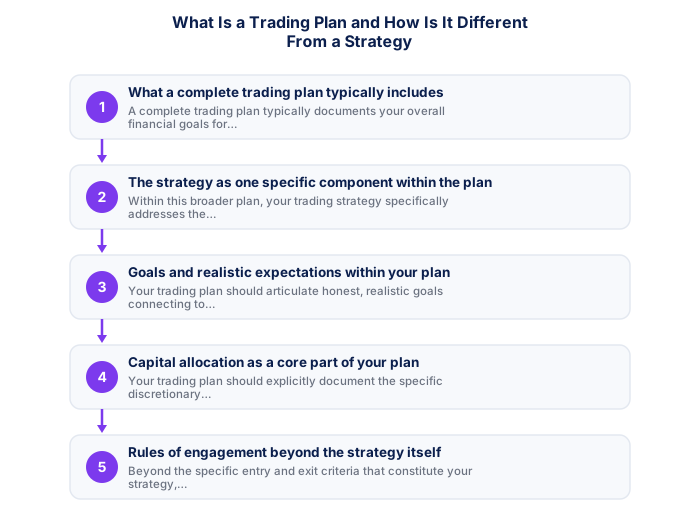
1. What a complete trading plan typically includes
A complete trading plan typically documents your overall financial goals for trading, the specific discretionary capital you've allocated, your general risk tolerance and maximum acceptable drawdown, your chosen trading style and typical time commitment, and the specific strategy or strategies you'll actually use to make trading decisions.
This complete scope means a trading plan is considerably broader than a strategy alone. It addresses the full context within which your strategy actually operates, rather than focusing narrowly on just the entry and exit decision logic itself.
| Feature | Trading Plan | Trading Strategy |
|---|---|---|
| Scope | Broad, covers goals, capital, rules | Narrow, entry/exit method |
| Includes strategy | Yes, as one component | N/A |
| Covers capital allocation | Yes | No |
2. The strategy as one specific component within the plan
Within this broader plan, your trading strategy specifically addresses the narrower question of exactly when to enter and exit trades, the specific technical or fundamental criteria that trigger your actual trading decisions. A complete trading plan might incorporate one strategy, or sometimes multiple distinct strategies for different market conditions or instrument categories, all operating within the same broader plan's overall goals and risk parameters.
Understanding this relationship clearly helps explain why having a sound strategy alone, without the broader planning context, is genuinely insufficient. Even an excellent strategy applied without clear goals, appropriate capital allocation, and defined risk tolerance lacks the broader framework that gives that strategy genuine practical direction and purpose.
- Quantifiable rules remove subjectivity
- Backtestable on historical data
- Works consistently when edge is genuine
- Clear entry/exit criteria reduce hesitation
- Past performance does not guarantee future results
- Risk of overfitting to historical data
- Market regimes change, edges decay
- Requires discipline through drawdown periods
- Price and volume patterns
- Works on any liquid instrument
- Faster to learn basics
- Ignores fundamental context
- Economic and financial data
- Better for longer timeframes
- Deeper knowledge required
- Ignores entry precision
3. Goals and realistic expectations within your plan
Your trading plan should articulate honest, realistic goals, distinguishing, for example, between trading as a learning activity, a modest supplementary income source, or a more ambitious long-term goal toward eventually replacing other income, each of which implies meaningfully different capital requirements, timelines, and risk tolerance appropriate to that specific goal.
Documenting these goals explicitly, rather than leaving them vague or unexamined, helps ensure your strategy choices and capital allocation decisions genuinely align with what you're actually trying to achieve, rather than pursuing a strategy or capital approach disconnected from your actual underlying goals.
- Written entry/exit rules with zero ambiguity
- Backtested on minimum 3 years of data
- Walk-forward tested on out-of-sample data
- SA-specific events included in test period
- Maximum drawdown within personal tolerance
- 100+ live demo trades with consistent performance
Being specific here matters more than it might initially seem. "I want to make money trading" isn't a goal a plan can actually be built around, since it gives no indication of timeline, acceptable risk, or what success would even look like. "I want to learn the mechanics of forex trading over six months with capital I could afford to lose entirely" is a goal that translates directly into concrete decisions about position size, instrument choice, and how seriously to weigh any individual trade's outcome.
4. Capital allocation as a core part of your plan
Your trading plan should explicitly document the specific discretionary capital allocated to trading, separate from emergency savings, essential expenses, and other financial goals, along with your defined risk percentage per trade that operationalises this capital allocation into specific, consistent trading decisions via position sizing.
This capital allocation documentation within your broader plan gives the specific numerical foundation that your strategy's position sizing calculations actually operate from. Without this clearly defined capital allocation, position sizing calculations lack the clear, predetermined base figure they need to function consistently.
| Win rate | 1:1 RR | 1.5:1 RR | 2:1 RR |
|---|---|---|---|
| 40% | Losing | Break even | Profitable |
| 50% | Break even | Profitable | Profitable |
| 55% | Profitable | Profitable | Profitable |
| 60% | Profitable | Profitable | Profitable |
It's worth revisiting this figure periodically rather than setting it once and forgetting about it. As your financial situation changes, or as your account balance itself grows or shrinks through trading results, the amount that genuinely qualifies as discretionary capital can shift, and a plan that still references an outdated figure gradually loses its usefulness as an accurate guide for current decisions.
5. Rules of engagement beyond the strategy itself
Beyond the specific entry and exit criteria that constitute your strategy, your broader trading plan should document additional rules of engagement: cooling-off period rules to guard against revenge trading, criteria for when you'll pause trading entirely (perhaps after a defined drawdown threshold), and how frequently you'll review and potentially adjust your overall approach based on accumulated trading journal evidence.
These broader rules of engagement sit alongside, but are distinct from, your specific strategy's entry and exit logic. They govern your overall conduct and discipline as a trader, complementing rather than duplicating what your strategy itself addresses.
These rules tend to matter most precisely when they're hardest to follow, immediately after a loss, during a winning streak that tempts overconfidence, or during a period of genuine life stress unrelated to trading itself. Writing them down in advance, while thinking clearly, is what gives them a real chance of actually holding up in the moments they're designed for.
6. Why having both documented clearly genuinely helps
Having both your broader trading plan and your specific strategy clearly documented in writing, rather than held only as a vague mental framework, gives the same kind of concrete, predetermined reference point that matters when faced with a difficult, emotionally charged trading decision. A clear, written plan and strategy to refer back to supports disciplined decision-making considerably more reliably than relying on memory or in-the-moment judgement alone.
This documentation also supports honest, evidence-based review, comparing your actual trading behaviour against your own documented plan and strategy reveals exactly where and how your actual practice may be deviating from your stated intentions, giving genuinely useful, specific information for ongoing improvement.
A trading plan covers how to conduct yourself as a trader overall.
A trading strategy covers entry and exit rules. A trading plan covers broader behaviour, including risk limits, daily schedule, loss limits, and when to stop trading, both are needed and complement each other.
★ Why It Matters
Worth writing down explicitly if you haven't already: your plan's response to a specific bad scenario, like three consecutive losing months. Deciding this in advance, while calm, produces a meaningfully different (and usually better) decision than deciding it live, while already in that exact stressful situation.
✕ Common mistakes
- Confusing a trading plan with a trading strategy entirely. The plan covers broader goals and risk tolerance; the strategy is the specific entry and exit logic within it.
- Treating the plan as a one-time document rather than something to revisit. Plans benefit from periodic review as circumstances and experience change.
- Building a strategy without first establishing the broader plan it sits within. The plan provides essential context the strategy alone doesn't capture.
Key Takeaways
- A trading plan covers your broader goals, capital, and rules, while a strategy is the specific entry and exit logic within that plan. Learn the distinction.
- A trading plan covers your broader goals, available capital, and overall risk tolerance; a trading strategy is the specific entry and exit logic operating within that plan.
- The plan is the container for your overall approach; the strategy is one specific component within it.
- What a complete trading plan typically includes.
- The strategy as one specific component within the plan.
See also: What Is the Best Trading Strategy for a Beginner?.
Frequently asked follow-up questions
Can I have multiple strategies within one trading plan?
Yes, many traders incorporate different strategies suited to different market conditions or instruments, all operating within the same broader plan's overall goals and risk parameters.
How often should I revisit my trading plan?
Periodic review, perhaps quarterly or after significant trading experience milestones, helps ensure your plan remains aligned with your evolving goals and circumstances.
Is a trading plan only necessary for advanced traders?
No, beginners benefit significantly from this kind of clear, documented framework, arguably even more than advanced traders who may have already internalised much of this structure through experience.
