i Short answer
A demo account gives you a virtual balance, commonly R100,000, to trade real-time market prices on the same platform a live account uses, with no money at stake.
It's the same trading experience mechanically, just without real capital.
📋 ON THIS PAGE
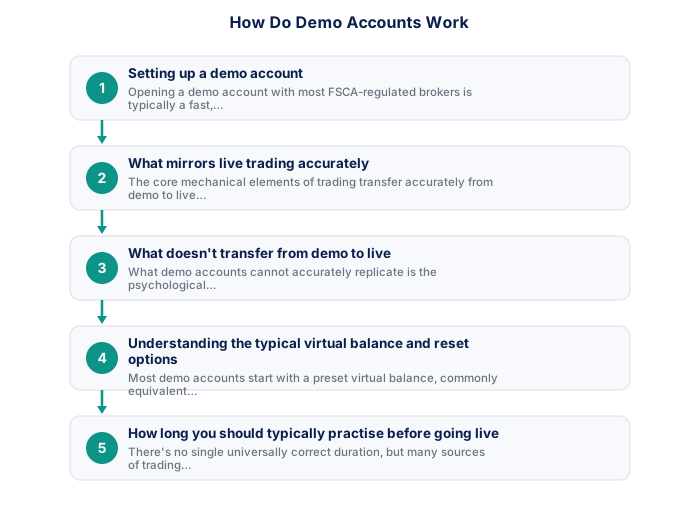
- Setting up a demo account
- What mirrors live trading accurately
- What doesn't transfer from demo to live
- Understanding the typical virtual balance and reset options
- How long you should typically practise before going live
- Transitioning thoughtfully from demo to a live account
- What to actually do during the demo months
1. Setting up a demo account
Opening a demo account with most FSCA-regulated brokers is typically a fast, low-friction process, often requiring just an email address and basic contact details, without the identity verification (KYC) documentation required for a live, real-money account. You're generally given immediate access to the full trading platform, populated with a preset virtual balance, and can begin placing simulated trades against live, real-time market prices right away.
Because no real money or identity verification is involved at this stage, demo accounts are accessible to anyone wanting to explore a broker's platform or practise trading concepts, regardless of whether they ultimately intend to open a live account with that specific provider, this makes demo accounts a useful tool for comparing platforms across multiple brokers before committing to any one provider for live trading.
It's worth taking advantage of this low-friction access specifically to compare a handful of different brokers' platforms side by side before committing to any single provider for live trading, since the absence of verification requirements at this stage removes any real barrier to testing several options in parallel.
See also: An Account Inactivity Period vs Dormancy
| Element | Mirrors Live Trading? |
|---|---|
| Price feeds and charting | Yes, typically accurate |
| Platform navigation and execution mechanics | Yes |
| Emotional pressure of real money | No |
| Slippage and execution during volatility | Often understated |
| Psychological discipline under risk | No |
2. What mirrors live trading accurately
The core mechanical elements of trading transfer accurately from demo to live accounts: real-time price feeds (meaning you're seeing the same live market prices a real account would see, not delayed or artificial pricing), the full range of order types (market orders, limit orders, stop-losses), charting tools and technical indicators, and the general user interface and navigation of the platform itself. This means skills specifically related to platform usage, placing orders correctly, setting stop-losses, reading charts, translate directly and reliably to a live account.
Strategy testing also transfers reasonably well in a mechanical sense: if you're testing whether a particular technical pattern or rule-based approach would have produced profitable signals on real historical and live price movement, a demo account lets you observe this without financial risk, since the price data itself is genuine even though the money behind your simulated trades isn't.
- 100+ demo trades completed with consistent rules
- Positive expectancy over full demo sample
- Every demo trade documented in journal
- Written trading plan: entry, exit, position sizing
- FSCA-regulated broker chosen and FSP verified
- Starting capital is genuinely disposable
- Backup connectivity tested
Open a demo
Choose an FSCA-regulated broker. Start with R50,000-R100,000 virtual capital.
Write trading rules
Define entry criteria, stop-loss method, and position sizing in writing.
Trade 2-3 months
Complete at least 50-100 trades across varied market conditions.
Journal everything
Record rationale, emotion, and outcome for every trade.
Evaluate objectively
Move to live only when consistent rule-following meets your benchmark.
3. What doesn't transfer from demo to live
What demo accounts cannot accurately replicate is the psychological experience of trading with real money genuinely at risk. The emotional weight of watching an actual deposit, money that could otherwise pay a bill, fund a holiday, or sit safely in a savings account, fluctuate in value tends to produce behavioural responses (fear-driven early exits, greed-driven overextension, hesitation at critical decision points) that simply don't manifest in the same way when the balance at risk is virtual and consequence-free.
This gap is well-documented anecdotally across trading communities and is one of the most consistently cited reasons traders who perform well on demo accounts sometimes struggle when transitioning to live trading, not because their strategy or technical understanding was flawed, but because the psychological dimension of real-money trading introduced behavioural patterns that hadn't been tested or developed during demo practice.
4. Understanding the typical virtual balance and reset options
Most demo accounts start with a preset virtual balance, commonly equivalent to R100,000 or a similar round figure, intended to give enough simulated capital to practise realistic position sizing rather than constraining you to trivially small trades. Many brokers also allow you to reset a demo account back to its starting balance at any point, which is useful if you want to start fresh after testing a strategy through to a natural conclusion, or after a string of simulated losses that you'd rather not carry forward into further practice.
This reset flexibility is itself something to use thoughtfully: resetting immediately after every losing stretch, without reflecting on what produced those losses, undermines the actual learning value of the exercise, getting genuine value from a demo account benefits from treating losing periods as data to analyse rather than simply erasing and starting over without review.
It's worth setting your demo account's virtual balance to roughly match whatever capital you actually plan to trade live with, rather than leaving the default figure unchanged, since practising position sizing calculations against a realistic account size builds more directly transferable habits than practising against an arbitrary, much larger virtual balance.
5. How long you should typically practise before going live
There's no single universally correct duration, but many sources of trading education suggest spending at least a few weeks to a few months on a demo account before transitioning to live trading, specifically to accumulate enough simulated trades across varied market conditions to develop genuine familiarity with both the platform and your chosen strategy's behaviour. A handful of demo trades over a few days generally isn't enough to draw meaningful conclusions about whether an approach has merit.
A useful benchmark some traders use is accumulating a meaningful sample size of completed trades (sometimes cited as 50-100 or more) following a consistent, defined strategy, rather than simply logging time on the platform without a structured testing approach, volume and consistency of testing matter more than calendar time alone in building genuine confidence in a strategy's mechanics.
It's worth deliberately varying the market conditions your demo practice covers, trending periods, choppy range-bound stretches, high-volatility news events, rather than only practising during calm, favourable conditions, since a strategy that looks strong only under ideal conditions hasn't genuinely been tested for the fuller range of situations live trading will eventually present.
6. Transitioning thoughtfully from demo to a live account
Given that demo accounts can't replicate the psychological dimension of real-money trading, a sensible transition approach involves starting live trading with a small amount specifically to begin building experience with that psychological dimension, rather than assuming demo profitability will automatically and fully translate to live results from the very first live trade. Treating this initial live period as its own distinct learning phase, focused on observing your own emotional responses and discipline under real stakes, tends to produce a more realistic and sustainable progression than expecting an instant, smooth continuation of demo performance.
If early live trading reveals behavioural patterns that didn't show up on demo (hesitating on entries, deviating from your tested strategy under pressure, or experiencing anxiety that affects decision-making), recognising this honestly and addressing it directly, potentially returning to smaller position sizes or even back to demo practice temporarily to rebuild discipline, is a more productive response than pushing forward with increasing live capital despite clear signs the psychological transition hasn't yet been successfully managed.
They cannot replicate the psychological experience of real stakes.
Demo accounts accurately replicate real-time pricing and platform mechanics. What they can't replicate is the psychological experience of trading with genuine financial stakes.
★ Why It Matters
Something we'd actively recommend testing: deliberately trade your demo account exactly as if it were real money, including feeling reluctant to click 'close' on a loss, traders who treat demo casually tend to get a falsely confident read on their own discipline before going live.
✕ Common mistakes
- Trading demo casually without real discipline. This produces a falsely confident read on your own readiness, see demo trading's real value and limits.
- Using an unrealistic virtual balance compared to your real plan. A mismatch distorts how position sizing will feel on a live account.
- Treating demo profitability as proof of a genuine edge. It tests platform familiarity more than long-term statistical edge.
- Skipping demo entirely and going straight to live trading. This removes a low-cost opportunity to build platform competence first.
Can I practise this on a demo first?
Yes, on live prices, but execution is simulated: slippage, rejection and partial fills do not appear. Demo against live covers the gap.
How long should I use a demo before going live?
Trade on demo for at least two to three months under varied market conditions and with consistent rule-following before switching to a live account. Time in the market is less important than the quality and consistency of practice.
7. What to actually do during the demo months
Most demo accounts are wasted because the period has no structure. Treated properly it has four distinct phases. The first fortnight is platform mechanics only: placing, modifying and closing orders, and setting stops and targets until it is automatic. The next fortnight narrows to a single instrument with written entry and exit rules. Months two and three are execution: 50 to 100 trades on those rules, every one journalled with the reason for entry. The final step is reviewing the journal for rule deviations before any real capital is involved.
Two settings make the difference between a useful demo and a misleading one. Set the demo balance to the amount you will actually fund, not the R500,000 the platform offers by default, because position sizing habits formed on fictional capital do not transfer. And treat every trade as though the rand were real, since the emotional patterns are the main thing the period is meant to expose. The full beginner's sequence sets out where the demo period fits.
Key Takeaways
- A demo account gives you virtual funds to trade real market prices risk-free. Learn how setup works and what carries over to live trading.
- A demo account gives you a virtual balance, commonly R100,000, to trade real-time market prices on the same platform a live account uses, with no money at stake.
- It's the same trading experience mechanically, just without real capital.
- Setting up a demo account.
- What mirrors live trading accurately.
See also: What Happens If I Deposit More Than I Intended? and What Is a Joint Trading Account and Can I Open One in South Africa?.
Frequently asked follow-up questions
Is demo account performance a reliable predictor of live performance?
It's a reasonable indicator of whether a strategy's mechanics make sense, but it is not a reliable predictor of live psychological performance, since the emotional dimension of real risk is absent from demo trading.
Do demo accounts expire?
Some brokers set time limits or inactivity expirations on demo accounts; check your specific broker's terms, though many allow indefinite access or easy renewal.
Can I have a demo and a live account at the same time?
Yes, most brokers allow you to maintain both simultaneously, which can be useful for continuing to test new strategy ideas on demo while trading an established approach live.
