i Short answer
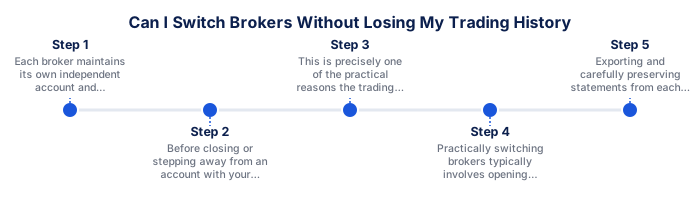
Your formal trading history stays within your original broker's records and typically can't transfer to a new broker as a continuous history.
You can export complete statements before switching, and your own trading journal continues regardless of broker.
📋 ON THIS PAGE
- Why trading history doesn't transfer directly between brokers
- Exporting your complete statements before switching
- Why your own independent journal matters more in this scenario
- The practical process of actually switching brokers
- Tax record-keeping considerations across a broker switch
- Common reasons traders decide to switch brokers
1. Why trading history doesn't transfer directly between brokers
Every broker keeps its own independent records, and there is no standard mechanism for porting your history from one platform to another. Each firm maintains its own database, its own statement formats, and its own trade records, and there is no industry infrastructure for transferring those records between separate institutions the way you might transfer funds.
This isn't a deliberate obstacle. It's the structural reality of separate regulated entities keeping separate regulatory records. Knowing this in advance means you plan your switch properly rather than expecting a handoff that won't happen.
The practical consequence is that continuity in your trading history requires you to be the keeper of that continuity: not your broker. Your broker holds their records for their regulatory purposes; your records serve your purposes and need to exist independently of any single broker relationship.
This structural reality applies equally to performance analytics and any reporting features your broker's platform provides. Tools built into your broker's platform (performance dashboards, win-rate calculators, equity curves) are not portable. If you've come to rely on those tools, replicating that functionality on a new platform from scratch is part of the switching cost worth factoring into your decision.
| Item | Transfers? | What to Do Instead |
|---|---|---|
| Trade history records | No | Export statements before switching |
| Platform performance dashboards | No | Keep your own independent journal |
| Deposited funds | Yes, via withdrawal and redeposit | Withdraw, then fund new account |
| Tax records for SARS | No, automatically | Retain your own annual statements |
2. Exporting your complete statements before switching
Before you close or step away from an account, export your full trading history and statements. Most platforms have a built-in export function in the account history or reporting section that produces a CSV or PDF covering your complete activity. Do this before account closure, not after: accessing historical statements from a closed account is typically possible but more involved than a simple self-service export.
Make this a habit whenever you're considering leaving a broker, even if you're not certain you'll need the records right away. The cost of exporting is a few minutes; the cost of not having records when you need them: for tax purposes, for performance review, or for a broker dispute, can be substantial.
- Search FSP name or number at fsca.co.za
- Confirm licence is current and not suspended
- Check scope covers forex and CFD activity
- Confirm client funds in segregated accounts
- Read FSCA enforcement actions history
- Test customer support before depositing
- Client funds legally segregated
- FSCA complaints process available
- SA consumer protections apply
- ZAR account, no FX conversion costs
- Some offshore brokers offer wider instruments
- Regulatory overhead passed on in spreads
- Stricter position limits for retail clients
- FICA verification required before trading
- Client funds segregated
- Formal complaints process
- FSCA dispute resolution
- SA consumer law applies
- ZAR account available
- Fund safety not guaranteed
- Disputes overseas only
- SA law does not apply
- Currency conversion costs
- Tax reporting more complex
Exporting in multiple formats where available is worth the minor additional effort. A CSV gives you raw data you can work with in a spreadsheet; a PDF gives you a formally presented statement that's more useful for tax documentation. Having both means you're covered for different use cases without needing to return to the broker for additional records.
Storing exported statements in a location that isn't dependent on any single broker's platform or service is also important. A cloud backup, a local drive copy, and an email archive of key statements provides redundancy that accounts for the possibility of a broker changing its data retention approach, being acquired, or encountering platform issues that affect historical record access.
3. Why your own independent journal matters more in this scenario
This is exactly why a trading journal maintained outside any broker's platform is worth the habit. It continues smoothly regardless of which broker you use, what platform you're on, or whether you've recently switched. Your journal is the one record that follows you through every account relationship and every platform migration.
Traders who rely entirely on broker-side history lose that continuity when they switch. The performance record, the pattern of decisions, the context around specific trades: all of that lives in a system you no longer have standard access to. An independent journal means those insights are yours permanently rather than tied to a particular broker relationship.
This continuity advantage is worth weighing seriously if you've been relying purely on a broker's built-in analytics and history reporting. The convenience of in-platform tools comes at the cost of portability. An external journal: even a simple spreadsheet tracking entry, exit, rationale, and outcome for each trade, is lower-tech but permanently accessible and broker-agnostic.
A well-maintained journal also serves purposes that broker-side records don't. Broker records show what you traded; a journal records why, what your plan was, how you managed the position, and what you learned from the outcome. That qualitative layer is precisely the material that drives genuine skill development over time.
4. The practical process of actually switching brokers
In practice, switching means opening and verifying a new account with your chosen broker, withdrawing your remaining funds from the old account, and depositing into the new one. Planning this transition deliberately: rather than switching abruptly with positions still open, avoids the complication of managing two platforms simultaneously while trying to manage active positions on both.
Planning the transition around a natural pause in your trading activity is usually the cleanest approach. Closing open positions before initiating the switch, processing the withdrawal and deposit fully before opening new positions on the new platform, and confirming that all pending withdrawals have settled before closing the old account avoids the operational complexity of a mid-strategy switch.
| Protection | FSCA Regulated | Offshore Unregulated |
|---|---|---|
| Client fund segregation | ✓ Required | Varies by broker |
| SA complaints process | ✓ Available | ✗ Not available |
| SA consumer law applies | ✓ Yes | ✗ No |
| ZAR account available | ✓ Typically | Often USD/EUR only |
It's worth verifying the withdrawal processing time from your old broker and the deposit processing time at your new one before committing to a switch timeline. Capital that's in transit: withdrawn from one broker but not yet credited at the new one, is not available for trading, and extended transit periods can be frustrating if you're eager to resume trading on the new platform.
FICA re-verification at the new broker is part of the onboarding process regardless of how long you've been trading at your previous broker. Having your current ID documents, proof of address, and banking details ready from the outset of the new account application prevents the most common delays in the verification process.
5. Tax record-keeping considerations across a broker switch
Your SARS tax obligation covers your total trading activity for the full tax year, regardless of how many brokers you used during that period. All realised gains and losses from trading at all brokers during the tax year need to be included in your return: the switch itself doesn't create any special tax treatment or reset.
If you switch mid-tax-year, be especially diligent about preserving full records from both brokers for that year. Combining profit and loss data from two different platforms and two different statement formats into a single, accurate picture for your tax return is more work than working from a single source: but it's a necessary part of accurate SARS reporting.
Organising records clearly by broker and date range as you go: rather than assuming you'll be able to reconstruct them retrospectively, makes tax time substantially simpler. A simple folder structure with labelled statement exports from each broker, covering each relevant tax period, is all the organisation you need to ensure you can compile an accurate annual tax picture.
If you're in the process of switching and have open positions at the old broker when a tax year ends, confirming the year-end balance and unrealised positions for your records is worth doing at that point. Some brokers produce year-end tax statements automatically; others require you to compile your own from transaction history.
6. Common reasons traders decide to switch brokers
Traders switch brokers for plenty of practical reasons: better spreads or fees elsewhere, access to instruments or platform features their current broker doesn't offer, concerns about regulatory standing, changes in the broker's service quality, or simply wanting to consolidate multiple accounts onto a single better-suited platform.
Whatever the specific reason, a deliberate transition: with exported records, planned position closure, an independent journal already running, and a clear timeline, produces a much better outcome than an impulsive or rushed switch driven by frustration or market pressure.
A well-regulated broker will also hold client funds in segregated accounts, separate from the company's own operating capital. Checking that both your current and intended new broker maintain this segregation is part of the due diligence worth doing when switching: not just checking the features that attracted you to the new provider.
Something worth building as a standing habit regardless of whether you plan to switch: export full statements periodically as a routine practice, not just in anticipation of a broker change. Regular statement archives mean you're never caught scrambling to retrieve historical records under time pressure, whether for tax purposes, a broker dispute, or an unexpected platform change.
✕ Common mistakes
- Waiting until the switch is imminent to export records. Older historical data sometimes becomes harder to retrieve over time.
- Assuming history transfers automatically between brokers. It generally doesn't, your own exported statements are the real record.
- Not maintaining an independent trading journal alongside broker statements. A personal trading journal survives any broker switch intact.
- Switching brokers without a clear reason tied to your own needs. Frequent switching without cause adds friction without benefit.
How long does account verification take at most SA brokers?
Most FSCA-regulated brokers complete identity verification within one to three business days when all required documents are submitted correctly. Electronic document submission often speeds up the process.
Key Takeaways
- Your trading history stays with your original broker, but you can export statements and continue your own journal independently. Learn how switching works.
- Your formal trading history stays within your original broker's records and typically can't transfer to a new broker as a continuous history.
- You can export complete statements before switching, and your own trading journal continues regardless of broker.
- Why trading history doesn't transfer directly between brokers.
- Exporting your complete statements before switching.
Frequently asked follow-up questions
Can I have accounts with two different brokers at the same time during a transition?
Yes, there's generally no restriction preventing this, and maintaining both briefly during a planned transition can actually simplify the switching process by avoiding gaps in market access.
Does switching brokers affect my FSCA-related protections?
No, provided your new broker is also genuinely FSCA-regulated, the same broad regulatory protections apply to your new account just as they did with your previous broker.
Will my new broker need to see my trading history from my old broker?
Generally not as a standard requirement, though in some specific cases involving professional client classification or certain account types, prior trading experience evidence might be relevant, checking your new broker's specific requirements clarifies this for your situation.
