i Short answer
Brokers set specific trading hours per instrument reflecting underlying market sessions, with some variation in exact opening, closing, and break times.
📋 ON THIS PAGE
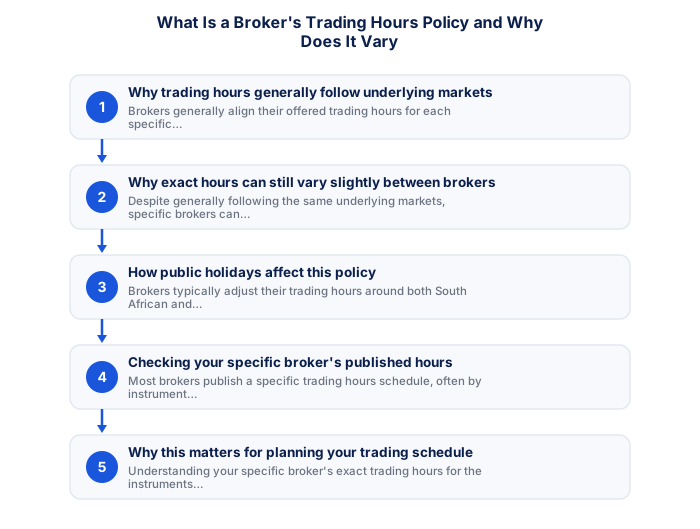
- Why trading hours generally follow underlying markets
- Why exact hours can still vary slightly between brokers
- How public holidays affect this policy
- Checking your specific broker's published hours
- Why this matters for planning your trading schedule
- What happens if you try to trade outside these hours
1. Why trading hours generally follow underlying markets
Brokers generally align their offered trading hours for each specific instrument with that instrument's genuine underlying market activity, since trading outside genuine market hours wouldn't reflect any real, active price discovery anyway.
It's worth understanding this connection specifically because it explains why forex trading hours look so different from share or index trading hours on the same platform. Forex trades nearly continuously across a rolling sequence of global financial centres, while individual shares and many indices remain tied to their specific home exchange's fixed daily session, a genuine structural difference in the underlying markets themselves, not an arbitrary broker choice.
2. Why exact hours can still vary slightly between brokers
Despite generally following the same underlying markets, specific brokers can apply slightly different precise opening and closing times, sometimes related to their own specific liquidity provider arrangements, or internal operational policies, making it worth checking your specific broker's published schedule directly.
See also: My Broker Merges Brands: What Happens to My Account?
These small variations are worth confirming directly if precise timing matters to your strategy, a trader planning to enter or exit right at a market's opening or closing moment specifically benefits from knowing their own broker's exact published time, rather than assuming a general, rounded figure applies precisely to their particular platform.
- Search FSP name or number at fsca.co.za
- Confirm licence is current and not suspended
- Check scope covers forex and CFD activity
- Confirm client funds in segregated accounts
- Read FSCA enforcement actions history
- Test customer support before depositing
- Client funds legally segregated
- FSCA complaints process available
- SA consumer protections apply
- ZAR account, no FX conversion costs
- Some offshore brokers offer wider instruments
- Regulatory overhead passed on in spreads
- Stricter position limits for retail clients
- FICA verification required before trading
- Client funds segregated
- Formal FSCA complaints process
- SA consumer protections apply
- ZAR account available
- Fund safety not guaranteed
- Overseas disputes only
- SA law does not apply
- Currency conversion costs
3. How public holidays affect this policy
Brokers typically adjust their trading hours around both South African and major international public holidays, reflecting reduced or closed activity in the relevant underlying markets during these specific periods.
It's worth building a habit of checking your broker's holiday trading calendar ahead of any period you know includes a public holiday, either South African or in a major market relevant to your traded instruments, since reduced hours or full closures around these periods can catch traders unprepared if they're expecting normal, unrestricted access.
4. Checking your specific broker's published hours
Most brokers publish a specific trading hours schedule, often by instrument category, directly on their platform or website, providing the most accurate, authoritative source for your specific provider's exact hours.
Bookmarking this specific page, rather than relying on memory or a general industry assumption, is a small habit worth adopting, particularly if you trade a range of different instrument categories that may each follow somewhat different specific hour schedules on your particular platform.
| Protection | FSCA Regulated | Offshore Unregulated |
|---|---|---|
| Client fund segregation | ✓ Required | Varies by broker |
| SA complaints process | ✓ Available | ✗ Not available |
| SA consumer law applies | ✓ Yes | ✗ No |
| ZAR account available | ✓ Typically | Often USD/EUR only |
5. Why this matters for planning your trading schedule
Understanding your specific broker's exact trading hours for the instruments you actively trade supports more accurate planning, particularly important for time-sensitive strategies like day trading or scalping.
This is worth factoring specifically into any structured, time-bounded trading routine, discussed elsewhere on this site, particularly if you're balancing trading around a full-time job or other significant commitments. Knowing precisely when your specific instruments are actually tradeable helps you plan realistic analysis and execution windows around your other obligations, rather than discovering a mismatch only once you've already set aside time to trade.
6. What happens if you try to trade outside these hours
Attempting to place a trade outside an instrument's published trading hours typically simply isn't possible through the platform, with order entry restricted or queued until the market genuinely reopens, rather than resulting in any kind of penalty or specific consequence beyond this basic access restriction.
Confirm what happens if a position moves past your balance. negative balance protection varies between brokers, and the terms are the only reliable source.
Forex trades nearly 24 hours Monday to Friday, while equity and index trading hours depend on which exchange they're linked to. Checking your broker's specific hours for each instrument is worth doing.
★ Why It Matters
Worth checking specifically around daylight saving transitions: trading hours displayed in your local time can shift unexpectedly when South Africa and the relevant market's home country move their clocks on different dates, worth double-checking during these transition weeks .
✕ Common mistakes
- Not accounting for daylight saving differences between South Africa and other markets. South Africa doesn't observe daylight saving, so overlap windows shift seasonally relative to local time.
- Assuming displayed hours are universal across all instruments. Each instrument follows its own underlying market's actual schedule.
- Trading right at the edge of stated hours without buffer. Liquidity can thin out noticeably near session open and close.
- Ignoring how holiday schedules in other countries affect your traded instruments. The relevant calendar is the market's, not necessarily South Africa's own.
Key Takeaways
- Brokers set specific trading hours per instrument reflecting underlying market sessions, with some variation in exact opening, closing, and break times.
- Why trading hours generally follow underlying markets.
- Why exact hours can still vary slightly between brokers.
- How public holidays affect this policy.
- Checking your specific broker's published hours.
Frequently asked follow-up questions
Does crypto trading follow the same hours restrictions as forex?
Generally no, unlike the more restricted hours typical of traditional forex and share markets.
Can I set up a pending order to execute once the market reopens?
Yes, this is a common way to prepare a trade in advance of a market's scheduled reopening.
Do all instruments offered by one broker share identical trading hours?
No, different instrument categories, typically follow their own specific underlying market hours rather than one universal schedule across everything a broker offers.
Does daylight saving time affect published trading hours?
Yes, seasonal time changes in major financial centres can shift the specific local time at which markets open and close from a South African time zone perspective, worth checking periodically.
Should I expect identical trading hours if I switch between brokers?
Generally similar given shared underlying markets, though confirming your new specific broker's exact published schedule avoids any assumption-based scheduling error.
