What this page covers
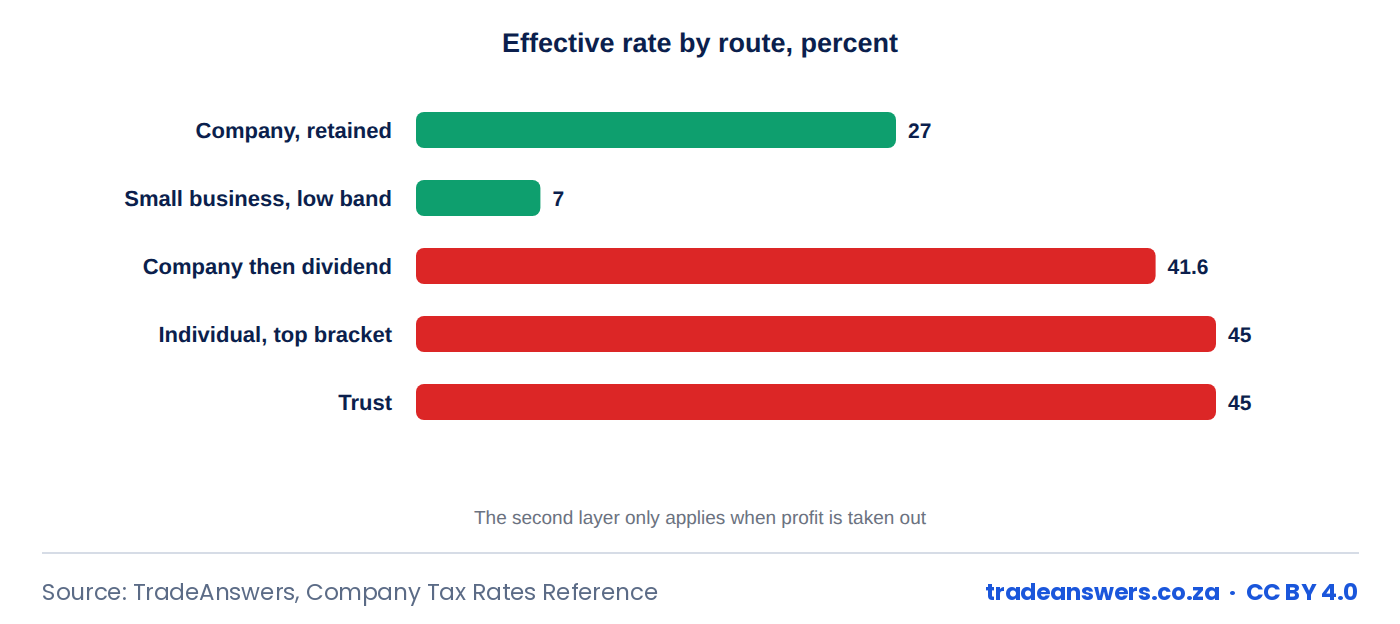
Quick answer: A company pays a flat rate on taxable income, but two concessionary regimes exist for small businesses, and which one applies changes the effective rate substantially. Key figures: company rate 27% (since 2023); with dividends tax 41.6% (SARS, dividends tax); small business scale 0-27%; trust rate 45%. Figures current at 15 November 2026, from South African Revenue Service, companies.
A company pays a flat rate on taxable income, but two concessionary regimes exist for small businesses, and which one applies changes the effective rate substantially.

⬇ Download this chart (PNG) · Free to reuse with the credit “Source: TradeAnswers, Company Tax Rates in South Africa 2026/27” (CC BY 4.0).
| Entity | Rate | Note |
|---|---|---|
| Company | 27% | Flat, on taxable income |
| Small business corporation | 0% to 27% | Sliding scale, conditions apply |
| Micro business, turnover tax | 0% to 3% | On turnover, not profit |
| Trust | 45% | Flat, unless income is distributed |
| Personal service provider | 27% | Company rate, limited deductions |
| Dividends paid out | 20% | Withheld from the shareholder |
Source: TradeAnswers, Company Tax Rates in South Africa 2026/27. Free to reuse with attribution (CC BY 4.0).
| Taxable income | Rate |
|---|---|
| R0 to R99,000 | 0% |
| R99,001 to R365,000 | 7% of the amount above R99,000 |
| R365,001 to R550,000 | R18,620 plus 21% above R365,000 |
| Above R550,000 | R57,470 plus 27% above R550,000 |
TradeAnswers · CC BY 4.0
| Profit | Company at 27% | Then dividends tax at 20% | Total | Effective rate |
|---|---|---|---|---|
| R200,000 | R54,000 | R29,200 | R83,200 | 41.6% |
| R500,000 | R135,000 | R73,000 | R208,000 | 41.6% |
| R1,000,000 | R270,000 | R146,000 | R416,000 | 41.6% |
| R2,000,000 | R540,000 | R292,000 | R832,000 | 41.6% |
TradeAnswers · CC BY 4.0
📋 ON THIS PAGE
How these figures work
The combined 41.6% is what a company structure costs once profit is taken out as a dividend. Below about R2.7 million of income, trading personally at your marginal rate is usually cheaper.
A small business corporation must meet several conditions at once, including that no shareholder holds an interest in another company and that no more than 20% of income is investment income. A pure trading company often fails that second test. To apply these figures to your own numbers, use the dividend withholding tax calculator to work out dividends tax on what the company pays out.
Worked example: the small business corporation scale
A qualifying small business corporation with taxable income of R400,000 pays R18,620 plus 21% of the R35,000 above R365,000, which is R7,350, so R25,970 in total, an effective rate of about 6.5%. At the flat 27% company rate the same income would be taxed R108,000.
The scale has conditions, including limits on gross income and on income from investments and personal services, and individuals must hold the shares. Whether a company that earns its income from trading qualifies depends on how that income is classified, so check it with a tax practitioner before relying on the lower rate.
★ What this means in practice
Money left in the company is taxed once at 27%. The second layer only applies when it comes out.
✕ Common mistakes
- Comparing the 27% company rate with your personal rate. Dividends tax of 20% on payouts takes the combined rate to about 41.6%.
- Assuming a trading company qualifies as a small business corporation. A company with mostly investment income usually fails the conditions.
- Mixing personal and company money. Personal spending paid by the company can be taxed as a loan or a dividend.
Terms used on this page
Recent changes to this page
- : Small business corporation tax table updated to 2026/27
Every change is recorded on the Updates Log.
Spotted an outdated figure? If a figure or rate on this page no longer matches its source, email us the page and the source. A material correction is dated on the Updates Log; how figures are compiled and checked is set out in our data methodology.
Cite this page
Barosso, G. (2026, September 29). Company Tax Rates in South Africa 2026/27. TradeAnswers. https://www.tradeanswers.co.za/company-tax-rates-reference.htmlBarosso, G (2026) Company Tax Rates in South Africa 2026/27, TradeAnswers, figures current at 29 September 2026, https://www.tradeanswers.co.za/company-tax-rates-reference.htmlThe tables and the CSV on this page are free to reuse under a CC BY 4.0 licence: attribution with a link to this page. See the Press & Data Licence page.
Frequently asked questions
Is a company cheaper than trading personally?
Only above roughly R2.7 million of profit. Below that, the combined 41.6% of company tax plus dividends tax usually exceeds your personal marginal rate.
What is the small business corporation rate?
A sliding scale from 0% to 27%, but the conditions are strict and a pure trading company usually fails the 20% investment income test.
Can I leave profit in the company?
Yes, and then only 27% applies. The second layer of 20% dividends tax arises when you take it out.
What is turnover tax?
A simplified regime taxing turnover rather than profit, at 0% to 3%, for micro businesses below R1 million of turnover.
Did the company rate change in 2026?
No. It remains 27%, as announced in Budget 2026.
What is a personal service provider?
A company whose income is effectively your own personal services. It is taxed at the company rate with most deductions denied.
Do small businesses pay a lower rate?
Qualifying small business corporations pay on a sliding scale, with lower rates on the first part of taxable income; other companies pay the flat rate.
 Download this data