What this page covers
Quick answer: Three separate deductions come off a South African payroll, each with its own rate, ceiling and return. Key figures: UIF each side 1%; UIF ceiling R17,712; SDL on payroll 1%; EMP201 due 7th. Figures current at 19 November 2026, from South African Revenue Service, employers.
Three separate deductions come off a South African payroll, each with its own rate, ceiling and return. A trader running a company with even one employee is in all three systems.
Key findings
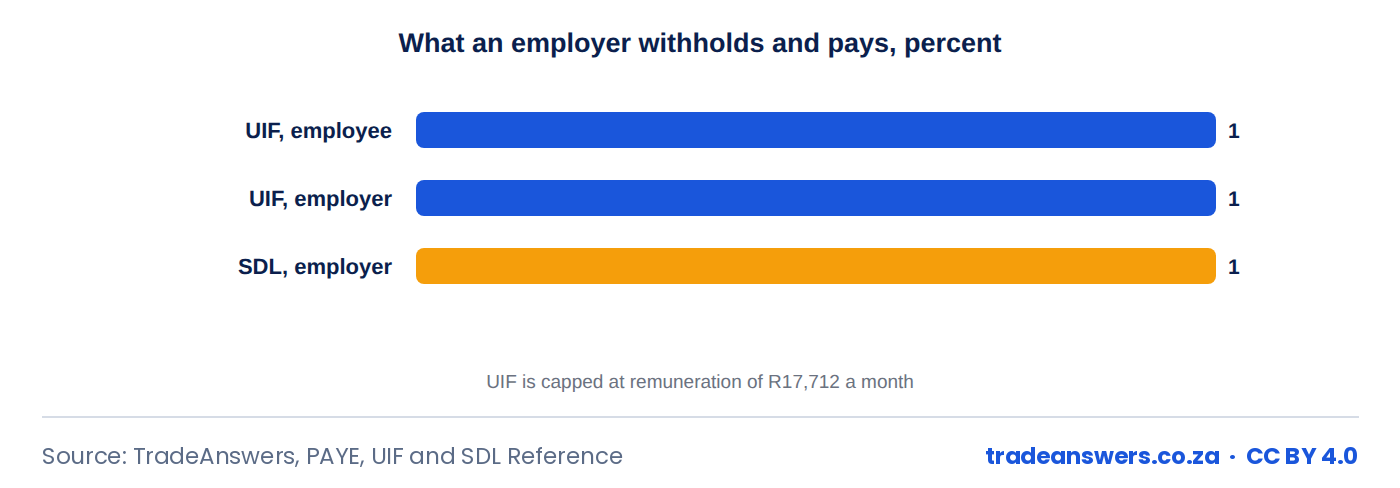
- Employees and employers each pay 1% of remuneration to UIF, up to a ceiling of R17,712 a month.
- Employers pay a further 1% of total payroll as the skills development levy, unless payroll is below R500,000 a year.
- PAYE, UIF and SDL are paid to SARS on the EMP201 return by the 7th of the following month.

⬇ Download this chart (PNG) · Free to reuse with the credit “Source: TradeAnswers, PAYE, UIF and SDL Rates 2026/27: Tables and Thresholds” (CC BY 4.0).
| Item | Employee pays | Employer pays | Ceiling |
|---|---|---|---|
| PAYE | At the individual tax tables | Nothing | None |
| UIF | 1% of remuneration | 1% of remuneration | R17,712 a month |
| SDL | Nothing | 1% of total payroll | None, but exempt below R500,000 a year |
| ETI | Nothing | A credit against PAYE | Qualifying employees only |
Source: TradeAnswers, PAYE, UIF and SDL Rates 2026/27: Tables and Thresholds. Free to reuse with attribution (CC BY 4.0).
| Monthly salary | Employee 1% | Employer 1% | Total |
|---|---|---|---|
| R10,000 | R100.00 | R100.00 | R200.00 |
| R17,712 | R177.12 | R177.12 | R354.24 |
| R25,000 | R177.12 | R177.12 | R354.24 |
| R50,000 | R177.12 | R177.12 | R354.24 |
TradeAnswers · CC BY 4.0
| Return | Covers | Due |
|---|---|---|
| EMP201 | Monthly PAYE, UIF and SDL | 7th of the following month |
| EMP501, interim | March to August | End of October |
| EMP501, annual | March to February | End of May |
| IRP5 to employees | The tax year | With the annual reconciliation |
| UI-19 | Employee changes | 7th of the following month |
TradeAnswers · CC BY 4.0
📋 ON THIS PAGE
How these figures work
UIF is capped at a remuneration of R17,712 a month, so the contribution stops rising above R177.12 each from employer and employee.
SDL only applies once total annual payroll exceeds R500,000, which exempts most one or two person companies.
Worked example: the cost of one employee
An employer pays one employee R25,000 a month. UIF is capped at the R17,712 ceiling, so the employee contributes R177.12 and the employer another R177.12. The total payroll is R300,000 a year, below R500,000, so no skills development levy is due.
The employer’s monthly cost is therefore R25,177.12, plus PAYE withheld from the employee’s salary and paid over with the EMP201 by the 7th of the next month. Once total payroll passes R500,000 a year, the 1% SDL applies to all of it.
★ What this means in practice
A director of a private company is treated as an employee for PAYE. Paying yourself only in dividends to avoid this attracts attention.
A company with one employee
Hypothetical example: a trading company pays one employee R20,000 a month. UIF is capped at the ceiling of R17,712, so each side pays 1% of that, about R177.12, a total of about R354.24 a month. SDL does not apply because annual payroll of R240,000 is below R500,000. PAYE is worked out from the tax tables. All three are paid on the EMP201 by the 7th of the following month.
Loans to employees
A loan from an employer at an interest rate below the official rate creates a taxable fringe benefit, worked out on the difference between the interest charged and the official rate. The benefit is added to the employee’s pay for PAYE purposes. The official rate is set out on the SARS interest rates reference page.
✕ Common mistakes
- Calculating UIF on the full salary. Contributions stop at the monthly earnings ceiling.
- Registering for SDL on any payroll. SDL applies only once annual payroll exceeds R500,000.
- Paying a director without PAYE. Directors of private companies are treated as employees for PAYE.
Terms used on this page
Spotted an outdated figure? If a figure or rate on this page no longer matches its source, email us the page and the source. A material correction is dated on the Updates Log; how figures are compiled and checked is set out in our data methodology.
Cite this page
Barosso, G. (2026, September 29). PAYE, UIF and SDL Rates 2026/27: Tables and Thresholds. TradeAnswers. https://www.tradeanswers.co.za/paye-uif-and-sdl-reference.htmlBarosso, G (2026) PAYE, UIF and SDL Rates 2026/27: Tables and Thresholds, TradeAnswers, figures current at 19 November 2026, https://www.tradeanswers.co.za/paye-uif-and-sdl-reference.htmlThe tables and the CSV on this page are free to reuse under a CC BY 4.0 licence: attribution with a link to this page. See the Press & Data Licence page.
Frequently asked questions
What is the UIF ceiling?
Contributions are capped at remuneration of R17,712 a month, so the maximum is R177.12 each from employer and employee.
When is SDL payable?
Once total annual payroll exceeds R500,000. Below that the employer is exempt.
When is EMP201 due?
By the 7th of the month following the month it covers.
Am I an employee of my own company?
For PAYE purposes a director of a private company is treated as an employee, so PAYE applies to what you draw.
Can I pay myself only in dividends?
You can, but SARS looks closely at a director with no remuneration, and the combined tax is usually higher anyway.
What is the ETI?
The employment tax incentive, a credit against PAYE for employing qualifying younger workers.
Who pays the Skills Development Levy?
Employers with annual payroll above R500,000.
 Download this data