i Short answer
Persistently high unemployment reflects structural economic challenges, indirectly contributing to broader investor caution and Rand pressure over time.
📋 ON THIS PAGE
- South Africa's persistently high unemployment context
- How this connects to broader structural growth challenges
- Why this data typically produces less immediate market reaction
- The longer-term investor sentiment connection
- How this relates to social and political stability considerations
- What traders should take from this broader context
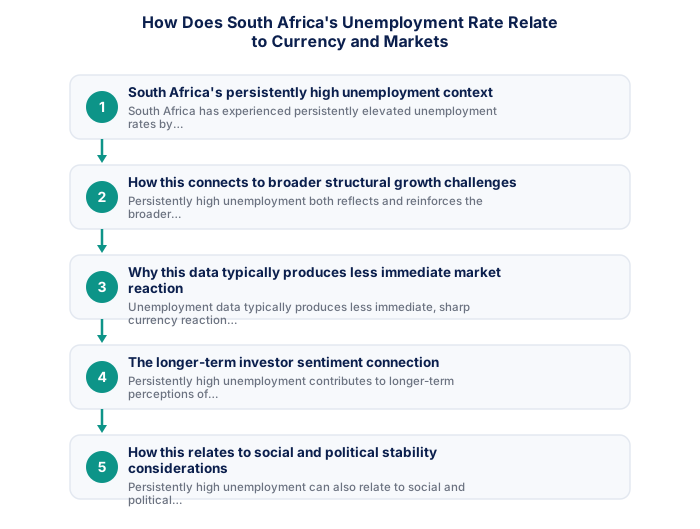
1. South Africa's persistently high unemployment context
South Africa has experienced persistently elevated unemployment rates by international standards, reflecting various structural economic challenges, including skills mismatches and broader economic growth constraints.
It's worth understanding this as a genuinely long-term, structural condition rather than a temporary, cyclical downturn, this distinction matters because structural unemployment tends to respond slowly to short-term policy changes, meaning it's worth incorporating into your longer-term fundamental view of South African markets rather than expecting rapid improvement to show up in near-term data.
2. How this connects to broader structural growth challenges
Persistently high unemployment both reflects and reinforces the broader structural growth challenges, representing two closely related dimensions of the same underlying economic picture.
It's worth researching the specific structural factors commonly cited in this context, skills mismatches, infrastructure constraints, regulatory environment, since understanding the actual underlying causes gives you a more informed basis for judging whether any specific policy announcement genuinely addresses the root issue or simply the symptom.
- FSCA-regulated broker verified at fsca.co.za
- Demo account tested for minimum 60 days
- Trading plan written: entry, exits, position sizing
- Risk per trade defined (1-2% of account)
- Backup internet connection tested for load shedding
- Tax implications understood
3. Why this data typically produces less immediate market reaction
Unemployment data typically produces less immediate, sharp currency reaction compared to interest rate decisions, since markets generally already anticipate this structural challenge rather than treating it as a sudden surprise.
It's worth contrasting this with how markets react to genuinely surprising, high-frequency data like a sudden interest rate change, unemployment's structural, slow-moving nature means markets have generally already priced in the broadly expected level, leaving room for reaction mainly when actual figures diverge meaningfully from that expectation.
4. The longer-term investor sentiment connection
Persistently high unemployment contributes to longer-term perceptions of structural economic weakness, which can indirectly affect investor sentiment and capital allocation decisions over extended periods.
It's worth thinking of this as a background factor shaping the overall investment narrative around South Africa, rather than something that moves markets on any single data release, persistent unemployment feeds into the kind of longer-term structural assessment that affects investment decisions over years rather than days.
| Item | Detail |
|---|---|
| Regulator | FSCA, fsca.co.za |
| Exchange control | SARB, resbank.co.za |
| Tax authority | SARS, sars.gov.za |
| JSE hours | 09:00-17:00 SAST Mon-Fri |
| Best forex session | 15:00-17:00 SAST |
| CGT annual exclusion | R50,000 (individuals) |
5. How this relates to social and political stability considerations
Persistently high unemployment can also relate to social and political stability considerations that investors sometimes factor into their broader assessment of South African market risk over time.
It's worth appreciating this connection as one reason unemployment data carries broader significance beyond its narrow economic definition, investors sometimes weigh social stability implications of persistent unemployment as part of their overall country risk assessment, a genuinely different consideration from the purely economic growth and inflation implications.
6. What traders should take from this broader context
Understanding this unemployment context provides useful background for interpreting other, more immediately market-moving data and events, rather than expecting unemployment releases themselves to produce sharp, immediate trading reactions.
Persistently high unemployment factors into broader social stability and country risk assessments that international investors actually weigh, beyond just the headline number.
South African traders have a natural analytical advantage on rand-paired currencies because they observe the domestic drivers of ZAR directly and continuously. The technical relationships between major currency pairs and the USD/ZAR, particularly the negative correlation between USD/ZAR and risk-on periods, become more predictable once you understand which component of USD/ZAR movement is driven by global USD strength and which is driven by SA-specific fundamental factors. Building this analytical separation into your daily market review produces more precise ZAR trading hypotheses than treating USD/ZAR as a single undifferentiated signal.
★ Why It Matters
Something worth separating in your own thinking: the youth unemployment figure specifically tends to feature more prominently in international investor risk assessments of South Africa's social stability than the headline overall unemployment rate.
✕ Common mistakes
- Expecting a sharp market reaction to the unemployment release alone. This data tends to move slowly into sentiment rather than producing sharp reactions.
- Ignoring the social stability angle international investors actually weigh. Persistently high unemployment factors into broader country risk assessments.
- Treating this purely as an economic statistic disconnected from policy. It often features in discussions of fiscal and social policy direction too.
- Not distinguishing structural from cyclical unemployment trends. These carry different implications for longer-term Rand sentiment.
Key Takeaways
- Persistently high unemployment reflects structural economic challenges, indirectly contributing to broader investor caution and Rand pressure over time.
- South Africa's persistently high unemployment context.
- How this connects to broader structural growth challenges.
- Why this data typically produces less immediate market reaction.
- The longer-term investor sentiment connection.
See also: Why Is August Historically the Rand's Worst Month?.
Frequently asked follow-up questions
How often is South African unemployment data released?
This is typically released quarterly by Statistics South Africa; checking their official release calendar provides the most accurate, current schedule for this specific data.
Does a single unemployment data release typically move the Rand significantly?
Generally less significantly than higher-impact releases given this structural challenge is generally already anticipated rather than representing a sudden surprise.
Are there meaningful regional differences in unemployment across South Africa?
Yes, unemployment rates vary considerably by region and demographic group within South Africa; checking detailed Statistics South Africa data provides this more granular breakdown.
Does youth unemployment specifically receive separate attention in this data?
Yes, youth unemployment is often reported and discussed separately given its particular significance in South African economic and policy discourse.
Should this data influence my specific trading decisions directly?
This provides useful broader economic context, more than a direct, immediate trading signal in the way some higher-frequency data releases might function.
