What this page covers
The FSCA publishes a searchable register of every licensed provider. It takes about a minute to check, and it answers a question no marketing page will answer honestly.
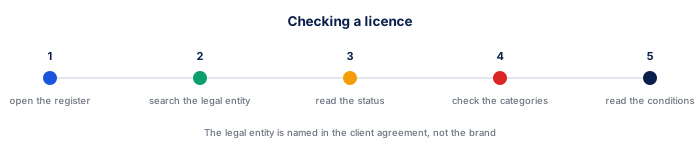
| Field | What to read from it |
|---|---|
| FSP number | The licence identifier; confirm it matches what the broker advertises |
| Legal name | Must match the entity you are contracting with, not the brand |
| Status | Active, lapsed, suspended or withdrawn |
| Categories | What the firm may do; see the categories reference |
| Product subcategories | The specific products the licence covers |
| Conditions | Restrictions attached to the licence |
| Key individuals | Who is accountable at the firm |
| Finding | Why it matters |
|---|---|
| No record at all | The firm is not licensed here |
| Status not active | The licence is not currently in force |
| Legal name differs from the contracting entity | You would be contracting with an unlicensed entity |
| Products you were sold are not listed | The licence does not cover them |
| Only a representative record | The firm itself is not the licensed provider |
| Status | What it means |
|---|---|
| Active | The licence is in force |
| Lapsed | Not renewed; the firm may not conduct licensed business |
| Suspended | In force but restricted, pending a regulatory process |
| Withdrawn | Cancelled |
| No record | Not licensed in South Africa at all |

Download this data
Every table on this page as a spreadsheet, with the source and the date it was checked in the header rows.
⬇ Download CSVHow these figures work
The register is a public database of every licensed provider, searchable by name or by FSP number. Each record shows the legal entity, the status, the categories held, the product subcategories within each, any conditions, and the key individuals responsible.
The check that matters is not whether a record exists but whether the record matches what you are being sold, by the entity you are actually contracting with.
★ A worked example
A trader is about to open an account with a platform marketed under a short brand name.
The client agreement, in the fine print, names a different legal entity registered offshore. Searching the brand on the register returns a South African entity with an active Category I licence. Searching the entity on the agreement returns nothing.
The South African licence belongs to a marketing arm. The contracting party is the offshore entity, and it is not licensed here. Every protection the licence implies applies to a company that is not the one holding the money.
✕ Common mistakes
- Searching the brand rather than the legal entity. The contracting party is named in the client agreement, and it is often a different company.
- Accepting an FSP number from the website. Numbers are copied and lapsed licences keep theirs. The register is the only authority.
- Not reading the status field. A suspended licence still produces a record. Active is the only status that means what it appears to.
- Skipping the conditions. A licence can carry restrictions that exclude exactly the activity being offered to you.
Notes on reading these figures
- The brand on the website and the legal entity on the client agreement are often different. Check the agreement, then search that name.
- An FSP number in a footer proves nothing on its own. Numbers are copied, and a lapsed licence keeps its number.
- Where a broker is licensed elsewhere and not here, that is a choice you can make knowingly. What you lose is recourse through the FAIS Ombud.
To put these figures to work, the FSCA FSP Licence Categories runs the arithmetic on your own numbers, and FAIS Ombud Complaint Process covers the same ground in ordinary language. Comparing FSCA regulated brokers and South African Financial Laws Reference go into the detail this table only summarises.
Terms used on this page
Put this table on your own site
The table below can sit on your own page and stays current without you editing anything.
- Preview the embeddable table as it will appear on your site
Add the code below to your own site. The table it renders is served from here, so it never goes stale.
<iframe src="https://www.tradeanswers.co.za/embed/ref-how-to-verify-an-fsp-licence.html" width="100%" height="620" style="border:0" title="How to Verify an FSP Licence"></iframe>Free to use with attribution. The link back to this page is built into the embed.
Frequently asked questions
Where is the register?
On the FSCA site, under FAIS regulated entities. It is public, free and requires no account.
What if the broker is not listed?
Then it is not licensed in South Africa. That is a decision you can make knowingly, but you fall outside the FAIS Ombud.
How often is the register updated?
Continuously, as licences are granted, amended, suspended and withdrawn. Check it again before a large deposit.
What is a key individual?
The person accountable for the licensed activities at the firm. The register names them, which is useful when a firm changes hands.
Does a foreign licence count?
Not for South African client protections. A firm licensed elsewhere may be well regulated there, but the FAIS Ombud cannot help you.
What should I keep a record of?
A screenshot of the register entry on the day you opened the account, with the legal entity name and status visible.