i Short answer
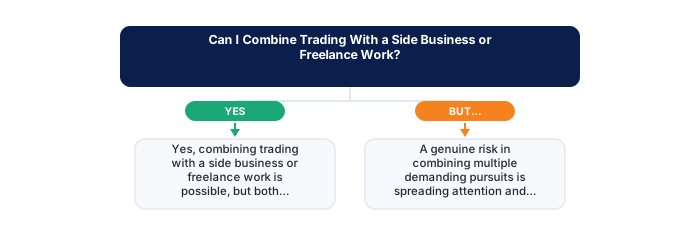
Yes, combining trading with a side business or freelance work is possible, but both activities compete for the same limited time and attention.
Realistic scheduling and honest prioritisation between these competing demands is essential for genuinely sustainable combination of both.
📋 ON THIS PAGE
- The shared resource problem: time and attention
- Which trading styles combine better with other demanding work
- Scheduling strategies for combining both activities
- The risk of spreading yourself too thin across both
- Financial considerations when combining these income streams
- Honest prioritisation when genuine conflicts arise
2. Which trading styles combine better with other demanding work
Swing and position trading tend to fit better alongside other demanding work than day trading or scalping, since they don't demand continuous real-time attention. A swing trader who reviews positions once or twice a day and works from daily or weekly charts can genuinely integrate that activity alongside a busy work schedule. A day trader cannot.
This is worth deciding deliberately rather than defaulting to whatever style initially appealed to you, since attempting the wrong style in the wrong life context reliably produces poor outcomes in both dimensions. The appeal of day trading is disproportionate to its compatibility with most people's actual schedules and work demands.
- FSCA-regulated broker verified at fsca.co.za
- Demo account tested for minimum 60 days
- Trading plan written: entry, exits, position sizing
- Risk per trade defined (1-2% of account)
- Backup internet connection tested for load shedding
- Tax implications understood
The session times available to you also matter in this calculation. For South African traders with daytime professional commitments, the London-New York overlap session from roughly 15:00 to 17:00 SAST falls outside typical core working hours, making it genuinely accessible for focused trading without sacrificing work quality. This window favours a specific set of strategies on major forex pairs and liquid CFDs rather than a general approach.
Position trading, where trades are held for weeks or months based on broader macro and technical analysis, has the most natural compatibility with demanding professional schedules because the required analysis is periodic and depth-focused rather than continuous. The trade-off is that longer timeframes demand more patience and psychological robustness during extended adverse periods.
3. Scheduling strategies for combining both activities
Carving out a dedicated trading review window, separate from your freelance or business hours, and protecting it with the same discipline you'd apply to a client meeting is the structural approach that tends to work. Even if that window doesn't fall at the same time every day, having a defined end-of-day review process means your open positions get the attention they require without the attention bleeding into the rest of your working time.
It's worth protecting this window with the same seriousness you'd give a client commitment, rather than treating it as the first thing to sacrifice when the day runs long. The most common failure mode here isn't choosing the wrong trading style, it's choosing a realistic style and then not consistently executing the review process it requires.
For freelancers and business owners who have control over their own schedule, building the trading review into a fixed slot, even fifteen to thirty minutes at a consistent time of day, creates a habit that requires less willpower to maintain than an ad hoc approach that competes with work demands for priority.
A useful technique is treating the trading review as a transition between work and personal time rather than an interruption to either. Reviewing open positions, updating your journal, and checking economic calendars for the next session takes a fixed amount of time once the habit is established, making it less cognitively disruptive than sporadic checking throughout the day.
4. The risk of spreading yourself too thin across both
Spread across too many demanding pursuits simultaneously and you risk doing neither well. This is the same depth-versus-breadth trade-off that applies to any combination of skill-intensive activities, the cost shows up gradually in the form of declining performance in each activity rather than a single visible failure point.
A useful honesty check worth applying periodically: are both activities genuinely receiving the focused attention they require, or has one become a lower-quality background activity that gets the cognitive leftovers? The traders and freelancers who manage this combination well tend to be specific and honest in answering this question rather than assuming that parallel activity implies adequate attention for both.
| Item | Detail |
|---|---|
| Regulator | FSCA, fsca.co.za |
| Exchange control | SARB, resbank.co.za |
| Tax authority | SARS, sars.gov.za |
| JSE hours | 09:00-17:00 SAST Mon-Fri |
| Best forex session | 15:00-17:00 SAST |
| CGT annual exclusion | R50,000 (individuals) |
There's also a risk management dimension to this that's worth naming explicitly. A trading mistake made during a period when your cognitive resources are depleted by other demands often has a different character than a mistake made in a clear-headed state, it's more likely to involve poor risk sizing, emotional decision-making, or missed signals that you'd have caught with full attention.
The most sustainable version of this combination keeps the two activities clearly demarcated rather than blended. Checking your positions during a client call, or managing a client deadline while a trade approaches a key level, is the pattern that tends to produce the worst outcomes in both dimensions.
5. Financial considerations when combining these income streams
A side income from freelancing or a business provides a buffer that changes the psychological character of your trading. It takes the pressure off trading to generate income you immediately need, which is one of the most direct and well-documented contributors to poor trading decisions. Traders who genuinely don't need their trading account for living expenses make better decisions from a fundamentally less pressured state.
This buffer effect is worth appreciating as a psychological advantage with real financial consequences, not just an abstract comfort. The absence of income pressure allows you to hold positions for the duration your analysis requires rather than closing them early for relief, to sit out low-quality setups rather than trading out of boredom or desperation, and to size positions proportionate to risk rather than to what you feel you need to make that month.
There's also a tax dimension to consider for South African traders. Trading income and freelance or business income are both taxable in South Africa, and the interaction between them affects your overall tax position. SARS may treat both as income from a trade, which has implications for how losses in one activity interact with profits in the other, how provisional tax is calculated, and whether certain deductions are available.
A registered tax practitioner familiar with both trading income and freelance or business taxation is worth consulting once either income stream becomes meaningful. The administrative overhead of combining these income sources correctly from the start is much lower than correcting prior years' tax treatment retrospectively.
6. Honest prioritisation when genuine conflicts arise
When a real conflict comes up, between a freelance deadline and a planned trading review, or between a business commitment and a market event you'd planned to trade, decide based on which one is genuinely more important to you at this stage of your life, not based on whichever feels more urgent in the moment.
The traders who manage this combination well tend to treat their freelance or business income as the financial foundation that makes patient, disciplined trading possible, rather than treating trading as the serious activity and freelancing as the inconvenient interruption. Getting that priority order honest, and letting it govern your decisions when conflicts arise, is one of the most important structural choices in combining these activities.
It's also worth having a prepared response for the scenario where a significant market opportunity or crisis coincides with a critical work commitment. Knowing in advance that the trade will be missed, or that work will be delegated, removes the decision from a high-pressure moment where impulsive choices are more likely. The plan you make in a calm moment is almost always better than the one you improvise in the moment of conflict.
Periodic, honest reviews of how the combination is actually performing, rather than how you expect it to be performing, are the most reliable mechanism for catching deterioration in either activity before it becomes significant. A monthly review of both your trading P&L and your work output tends to make the trade-offs visible in a way that day-to-day management doesn't.
✕ Common mistakes
- Treating trading profit as a substitute for freelance income. This adds pressure that distorts trading decisions.
- Not allocating dedicated time for each activity separately. Without boundaries, one activity usually crowds out the other.
- Letting freelance income volatility affect trading risk decisions. Combining two variable income streams compounds financial stress.
- Ignoring tax complexity from running two income sources. Declaring both correctly takes more care than a single income stream.
Key Takeaways
- Yes, but both activities compete for the same limited time and attention, making realistic scheduling and honest prioritisation essential for sustainability.
- Yes, combining trading with a side business or freelance work is possible, but both activities compete for the same limited time and attention.
- Realistic scheduling and honest prioritisation between these competing demands is essential for genuinely sustainable combination of both.
- The shared resource problem: time and attention.
- Which trading styles combine better with other demanding work.
Frequently asked follow-up questions
Should I prioritise my side business or trading if I can only do one well?
This depends on your personal financial situation and goals; many find a side business or freelance work provides more reliable income, making it reasonable to prioritise while treating trading as a longer-term, patient pursuit.
Can income from a side business count as discretionary trading capital?
Yes, provided it genuinely meets the standard for discretionary capital, income from other sources can reasonably fund trading capital allocation.
Is it harder to maintain trading discipline when juggling multiple commitments?
It can be, given the competing demands involved, making a structured routine and clear time-blocking particularly valuable for maintaining discipline.
