i Short answer
Higher interest rates generally make a currency more attractive to international investors seeking yield, tending to strengthen it; rate cuts typically have the opposite effect.
This is a genuine economic relationship, though far from the only factor affecting currency prices.
📋 ON THIS PAGE
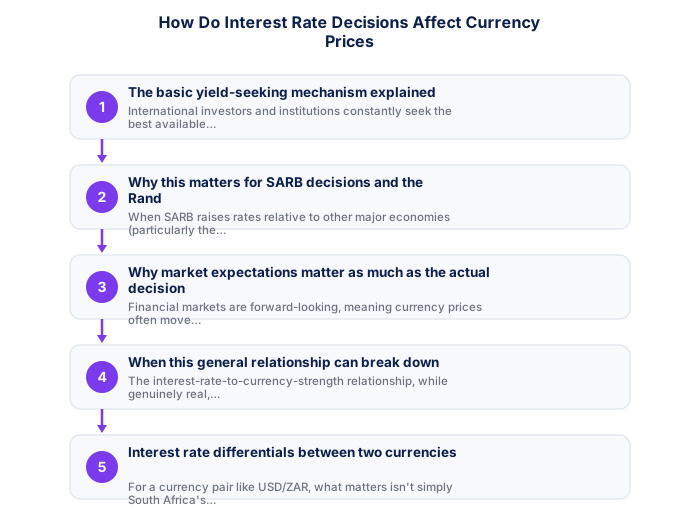
- The basic yield-seeking mechanism explained
- Why this matters specifically for SARB decisions and the Rand
- Why market expectations matter as much as the actual decision
- When this general relationship can break down
- Interest rate differentials between two currencies
- Practical implications for traders following rate decisions
1. The basic yield-seeking mechanism explained
International investors and institutions constantly seek the best available risk-adjusted returns across global markets, and interest rates set by central banks directly influence the yield available on currency-denominated deposits, bonds, and other interest-bearing instruments in that specific currency. When a central bank raises rates, holding that currency becomes relatively more attractive from a pure yield perspective, encouraging capital inflows that increase demand for the currency and, all else equal, push its value higher relative to other currencies.
This mechanism works in reverse for rate cuts, lower rates reduce a currency's relative yield appeal, potentially encouraging capital to flow toward other currencies offering better yield, which tends to weaken the currency experiencing the rate cut relative to those alternatives.
It's worth picturing this mechanism concretely with a simple example: if South African government bonds suddenly offer a meaningfully higher yield than equivalent US bonds, international capital has a genuine financial incentive to flow toward Rand-denominated assets to capture that higher return, and that capital flow itself is part of what supports Rand strength.
2. Why this matters specifically for SARB decisions and the Rand
For USD/ZAR, SARB interest rate decisions are among the most significant scheduled events affecting Rand value, precisely because of this yield-seeking mechanism. When SARB raises rates relative to other major economies (particularly the US, given the Fed's broad global influence), this can attract yield-seeking capital toward Rand-denominated assets, supporting Rand strength, while SARB rate cuts, especially if other major economies aren't cutting in parallel, can have the opposite effect.
This is one of the key fundamental mechanisms underlying why economic calendar awareness, specifically flags SARB decisions as worth monitoring closely for traders engaging with Rand-denominated instruments.
- FSCA-regulated broker verified at fsca.co.za
- Demo account tested for minimum 60 days
- Trading plan written: entry, exits, position sizing
- Risk per trade defined (1-2% of account)
- Backup internet connection tested for load shedding
- Tax implications understood
It's worth building a habit of checking the SARB's scheduled decision dates specifically, alongside the broader economic calendar discussed elsewhere on this site, since this single set of dates carries disproportionate weight for USD/ZAR specifically compared to many other individual scheduled events.
3. Why market expectations matter as much as the actual decision
Financial markets are forward-looking, meaning currency prices often move significantly based on what market participants expected a central bank to do, compared against what the bank actually decided, a rate decision that exactly matches widespread market expectations often produces relatively muted price movement, since this outcome was already substantially "priced in" to the currency's value beforehand. A genuinely surprising decision, even a smaller one, can produce considerably larger price movement specifically because it wasn't anticipated.
This expectations dynamic means simply knowing a rate decision is scheduled isn't sufficient context on its own, understanding what the market broadly expects beforehand, often discussed in financial news coverage ahead of major scheduled decisions, gives considerably more useful context for anticipating how the actual announcement might move prices.
It's worth checking analyst consensus forecasts before any scheduled SARB decision specifically, most financial news sources and economic calendars publish this expectation ahead of time, giving you the reference point needed to judge whether an actual decision is likely to surprise the market or simply confirm what was already broadly anticipated.
4. When this general relationship can break down
The interest-rate-to-currency-strength relationship, while genuinely real, isn't an absolute, mechanical rule that always holds regardless of other circumstances. If a rate hike is driven by concerns about runaway inflation or broader economic instability, this negative underlying context can sometimes outweigh the positive yield-seeking effect, resulting in currency weakness despite the rate increase, markets sometimes interpret a rate hike as a worrying signal about underlying economic problems rather than simply a straightforward yield-attraction event.
Similarly, broader global risk sentiment can sometimes override interest rate considerations entirely, particularly for emerging-market currencies like the Rand, during periods of acute global risk aversion, capital can flow away from emerging markets generally, regardless of relatively attractive local interest rates, simply because investors are reducing risk exposure broadly rather than making currency-specific yield comparisons.
| Item | Detail |
|---|---|
| Regulator | FSCA, fsca.co.za |
| Exchange control | SARB, resbank.co.za |
| Tax authority | SARS, sars.gov.za |
| JSE hours | 09:00-17:00 SAST Mon-Fri |
| Best forex session | 15:00-17:00 SAST |
| CGT annual exclusion | R50,000 (individuals) |
It's worth holding this relationship as a useful, generally reliable tendency rather than a mechanical law you can trade on blindly, the same epistemic humility that applies to any single fundamental factor discussed throughout this site applies here too, worth combining with other analysis rather than relying on in isolation.
5. Interest rate differentials between two currencies specifically
For a currency pair like USD/ZAR, what matters isn't simply South Africa's interest rate level in isolation, but the differential, the gap between South African and US interest rates . A SARB rate hike combined with the Fed simultaneously cutting rates would represent a particularly significant widening of this differential in the Rand's favour, while both central banks moving rates in the same direction by similar amounts might leave the differential, and therefore this specific yield-seeking driver, largely unchanged.
This differential-focused thinking is why experienced currency traders typically watch both relevant central banks' policy stances together, rather than analysing either currency's domestic interest rate situation in isolation, when forming a view on how interest rate dynamics might affect a specific currency pair.
It's worth tracking this differential explicitly over time rather than only checking each central bank's absolute rate level separately, a simple running note of both SARB's and the Fed's current rates, and the gap between them, gives you a quick, useful reference for understanding the broader yield-seeking dynamic currently at play.
6. Practical implications for traders following rate decisions
Practically, this means traders interested in USD/ZAR or other Rand-denominated instruments benefit from following both SARB and relevant foreign central bank (particularly the Fed) policy decisions and commentary together, rather than focusing exclusively on local South African monetary policy in isolation. Understanding the broader interest rate differential trajectory, alongside the expectations context discussed above, provides considerably more complete fundamental context than tracking either central bank's decisions independently without this comparative framing.
This fundamental awareness complements, rather than replaces, technical analysis. Many traders specifically use this kind of fundamental interest rate context to inform their broader directional bias, while still using technical analysis for precise entry and exit timing within that broader fundamental framework.
A genuine surprise relative to expectations moves prices sharply.
What matters isn't simply South Africa's interest rate level in isolation, but how it compares to expectations and to other major economies' rate trajectories, especially the US Federal Reserve's.
★ Why It Matters
A nuance that catches less experienced traders: it's often the change in expectations leading up to a rate decision, not the decision itself, that drives the bigger price move, by the time the actual announcement happens the market has frequently already priced in the widely expected outcome.
✕ Common mistakes
- Assuming higher rates always mean automatic currency strength. Other factors, like economic outlook, can offset this relationship.
- Ignoring the central bank's forward guidance alongside the decision. Hints about future decisions often move markets more than the current one.
- Trading the headline number without checking the full statement. Context within the statement often explains the market's actual reaction.
Key Takeaways
- Higher interest rates generally attract foreign capital seeking yield, strengthening a currency, while rate cuts typically have the opposite effect.
- Higher interest rates generally make a currency more attractive to international investors seeking yield, tending to strengthen it; rate cuts typically have the opposite effect.
- This is a genuine economic relationship, though far from the only factor affecting currency prices.
- The basic yield-seeking mechanism explained.
- Why this matters specifically for SARB decisions and the Rand.
Frequently asked follow-up questions
Does a rate hike always strengthen a currency immediately?
Not always or immediately, the expectations factor and broader economic context discussed above mean the actual market reaction can vary considerably from this general theoretical relationship.
Should I trade immediately after a SARB rate announcement?
Many traders specifically avoid opening new positions in the most volatile minutes immediately following a major announcement, given the unpredictable, sharp price movement that can occur before the market settles into a clearer post-announcement direction.
Do interest rate decisions affect gold and other commodities too?
Yes, Interest rate levels affect gold's relative appeal as a non-yielding asset, making this a broader macro factor relevant across multiple instrument categories, not just currency pairs alone.
