i Short answer
A cross rate is calculated indirectly through two currencies' shared relationship to a third common currency, typically the US Dollar.
This provides an exchange rate even when no direct quote is readily available between them. Our Cross Rate Calculator works this out automatically from your two source rates.
📋 ON THIS PAGE
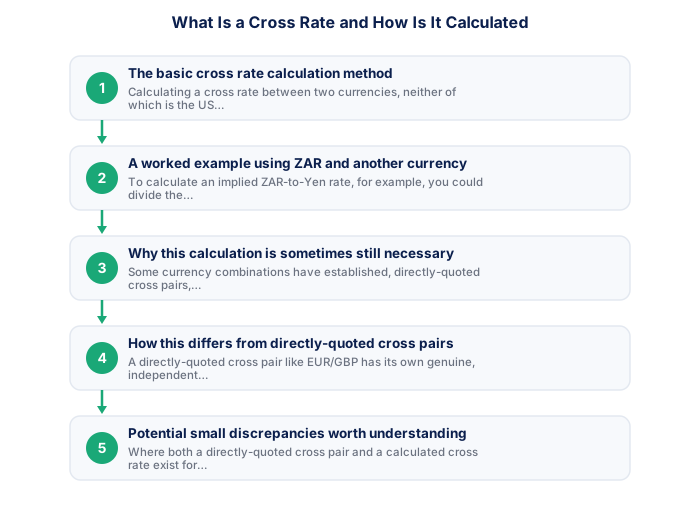
1. The basic cross rate calculation method
Calculating a cross rate between two currencies, neither of which is the US Dollar, generally involves dividing or multiplying their respective Dollar exchange rates together, using the Dollar as a common intermediate reference point connecting both currencies' otherwise separate quoted relationships.
The specific operation, dividing or multiplying, depends entirely on which currency sits as the base and which as the quote in each of the two Dollar-referenced pairs you're starting from. Getting this the wrong way round produces a cross rate that's inverted relative to the correct figure, which is why it's worth double-checking the quote convention of each underlying pair before performing the calculation, rather than assuming division always applies.
2. A worked example using ZAR and another currency
To calculate an implied ZAR-to-Yen rate, for example, you could divide the USD/ZAR rate by the USD/JPY rate (or apply the appropriate inverse calculation depending on each pair's specific quote convention), arriving at an implied cross rate between these two currencies even without a directly, commonly quoted ZAR/JPY pair being readily available.
Most modern charting platforms and financial data sites will calculate and display this kind of implied cross rate automatically, so manually working through the division isn't something most traders need to do routinely, understanding the logic behind where that displayed number actually comes from is still useful for sanity-checking a figure that looks unexpectedly out of line.
- FSCA-regulated broker verified at fsca.co.za
- Demo account tested for minimum 60 days
- Trading plan written: entry, exits, position sizing
- Risk per trade defined (1-2% of account)
- Backup internet connection tested for load shedding
- Tax implications understood
3. Why this calculation is sometimes still necessary
Some currency combinations have established, directly-quoted cross pairs, while others, particularly involving less commonly paired currencies like the Rand against more unusual counterparts, may require this kind of manual or implied calculation rather than a readily available direct market quote.
This is worth knowing specifically because it explains why some currency combinations feel less 'standard' or harder to find live pricing for than major pairs, it's not that the underlying relationship is somehow less valid, simply that trading volume and market infrastructure haven't developed the same direct, independently quoted market for every conceivable currency combination.
4. How this differs from directly-quoted cross pairs
A directly-quoted cross pair like EUR/GBP has its own genuine, independent market liquidity and pricing, while a purely calculated cross rate is simply a mathematical derivation rather than reflecting genuine, independent trading activity in that specific combination.
This distinction matters most for traders considering whether to actually trade a specific currency combination rather than simply reference it for informational purposes. A pair with genuine, independent liquidity typically offers tighter, more reliable spreads and execution than attempting to synthetically replicate the same exposure through two separate Dollar-referenced positions.
| Item | Detail |
|---|---|
| Regulator | FSCA, fsca.co.za |
| Exchange control | SARB, resbank.co.za |
| Tax authority | SARS, sars.gov.za |
| JSE hours | 09:00-17:00 SAST Mon-Fri |
| Best forex session | 15:00-17:00 SAST |
| CGT annual exclusion | R50,000 (individuals) |
5. Potential small discrepancies worth understanding
Where both a directly-quoted cross pair and a calculated cross rate exist for the same currency combination, minor discrepancies can sometimes occur between them, reflecting the different liquidity and market dynamics behind genuine direct trading versus a purely mathematical, derived calculation.
These discrepancies are usually modest under normal market conditions but can widen during periods of unusual volatility or reduced liquidity in one of the underlying Dollar pairs feeding the calculation. This is worth keeping in mind if you ever find a calculated figure meaningfully diverging from a directly quoted equivalent, the difference itself can be a signal of unusual conditions in one of the underlying markets.
6. Practical relevance for everyday trading
For most South African retail traders, this calculation matters more as useful background understanding of how currency relationships interconnect than as a frequent, practical necessity, since most commonly traded combinations are already directly available through standard broker platforms without requiring this kind of manual derivation.
Cross rates don't involve USD and are sometimes derived mathematically.
Cross rates are currency pairs that don't involve the US Dollar on either side. They can be mathematically derived from two underlying Dollar pairs, and typically carry wider spreads given lower liquidity.
★ Why It Matters
Worth verifying if you trade cross pairs: compare your broker's quoted cross rate against the rate implied by their own two underlying USD pairs. Small discrepancies sometimes exist and reveal something about how that specific broker prices cross pairs internally.
✕ Common mistakes
- Not checking liquidity specifically for less commonly traded cross pairs. Liquidity for crosses is often thinner than for major Dollar pairs.
- Treating cross-pair spreads as comparable to major pairs. Crosses typically carry wider spreads given lower trading volume.
- Ignoring how volatility in either underlying Dollar pair affects the cross. A cross can inherit volatility from both its component relationships.
Key Takeaways
- A cross rate is calculated indirectly through two currencies' shared relationship to a third, typically the Dollar, even when no direct quote is available.
- A cross rate is calculated indirectly through two currencies' shared relationship to a third common currency, typically the US Dollar.
- This provides an exchange rate even when no direct quote is readily available between them.
- The basic cross rate calculation method.
- A worked example using ZAR and another currency.
Frequently asked follow-up questions
Does my trading platform calculate cross rates automatically?
For commonly traded pairs, platforms typically display directly-quoted rates without requiring manual calculation. This derivation matters more for less commonly paired, unusual combinations.
Can I trade based on a purely calculated cross rate?
Generally you'd trade through whatever directly available instrument your broker offers, rather than executing based on a purely theoretical, calculated figure.
Why might a calculated rate differ slightly from a directly quoted one?
This reflects different underlying liquidity and market dynamics between genuine direct trading activity and a purely mathematical derivation.
