i Short answer
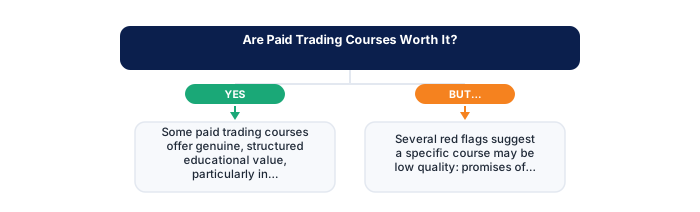
Some paid trading courses genuinely earn their price, especially when it comes to organising an otherwise overwhelming learning process into something coherent. But quality swings wildly across this industry, and no course, however good, replaces your own disciplined practice and testing.
📋 ON THIS PAGE
1. What genuinely good courses can offer
A well-designed course mainly gives you structure. Rather than piecing together scattered, sometimes contradictory information on your own, you move through concepts in a logical sequence, with each module building on the previous one. For some learners, this alone represents meaningful time savings over self-directed research.
This structural benefit is worth weighing honestly against the genuinely free option of building your own structured learning path from reputable sources. Regulatory bodies, established financial institutions, and quality educational platforms publish substantial free content. The question isn't whether paid courses offer something free resources don't, it's whether the curation and delivery format justifies the cost for you specifically.
A good course also typically provides context that isolated tutorials don't. Understanding why a concept matters, what it connects to, and where it fits in a broader trading framework is harder to absorb from fragmented sources. Courses that explain relationships between ideas, how position sizing connects to drawdown management, for instance, tend to deliver more lasting value than those that treat each topic in isolation.
Accountability structures built into some courses, whether cohort-based learning, instructor feedback, or community components, can also provide genuine value for traders who find self-directed learning difficult to sustain. The external commitment can function as a forcing mechanism that keeps learning consistent over weeks rather than stalling after initial enthusiasm fades.
| Signal | Red Flag | Green Flag |
|---|---|---|
| Track record | Unverifiable or vague claims | Documented, verifiable results |
| Risk discussion | Minimal or absent | Balanced, prominent |
| Pricing pressure | Urgency, limited-time offers | No pressure tactics |
| Content focus | Lifestyle, income promises | Process, risk management, skill-building |
2. The enormous quality variance across this industry
This industry has an unusually wide quality range. Genuinely knowledgeable educators sit alongside operations built almost entirely on aggressive marketing, vague promises, and content thin enough that it could have been assembled from a few hours of YouTube research.
It's worth being specific with yourself about why this variance exists: teaching trading well and trading profitably yourself are two genuinely different skills, and success in one doesn't imply success in the other. Some of the most polished, professionally produced courses are taught by people whose primary business model is education, not trading. That's not automatically disqualifying, but it's worth understanding.
- FSCA-regulated broker verified at fsca.co.za
- Demo account tested for minimum 60 days
- Trading plan written: entry, exits, position sizing
- Risk per trade defined (1-2% of account)
- Backup internet connection tested for load shedding
- Tax implications understood
In the South African context, a further layer of complexity applies. Some course providers operating here are not registered or overseen by the FSCA and make claims that would require licensing in a regulated context. Before enrolling in anything that approaches investment advice or promises specific returns, verify the provider's regulatory status directly on the FSCA's public register.
The social proof problem in this industry is also worth understanding: testimonials, screenshots of winning trades, and community member success stories are easily fabricated or selectively curated. Genuine track records with independently verifiable performance data are rare, and the absence of such evidence shouldn't be normalised by treating it as standard practice.
3. Red flags suggesting a course is low quality
A few red flags are worth watching for. Guarantees of near-certain profit contradict the risk every honest course openly acknowledges. Heavy emphasis on lifestyle imagery, expensive cars, watches, and holiday photographs, suggests the business model is selling aspiration rather than education. Courses priced at several thousand rand or dollars with no transparent curriculum available before purchase deserve extra scrutiny.
It's worth paying particular attention to how a course discusses risk and losses specifically. A genuinely honest educator talks openly about drawdown, the probability of loss, and the reality that most retail traders underperform the market over time. Courses that treat these topics lightly, or mention them only in fine print, are likely more interested in your enrollment than your development.
Time pressure tactics, flash sales, disappearing bonuses, limited seats, are a consistent marker of courses that rely on impulse purchasing rather than informed decision-making. Any serious educational investment deserves time for independent research and reflection, and providers who discourage that are, at minimum, revealing their priorities.
Checking whether the course instructor has a genuine, verifiable public presence in financial markets or trading education is one of the more reliable filters. A track record of published analysis, media appearances, or institutional background that can be independently verified provides more signal than a well-produced promo video.
4. What no course, however good, can substitute for
Even an excellent course can't do your backtesting for you, or your journaling and self-reflection. Accumulated experience, the hours logged in real or simulated market conditions working through the specific decisions your strategy requires, can't be purchased or compressed beyond a certain point.
A course hands you concepts and frameworks. Turning that into demonstrated skill still takes the same disciplined practice it always has, regardless of how much you've paid. The mechanics of recognising a setup, sizing the position appropriately, managing the trade through noise, and handling the emotional reality of being wrong are all things that develop through repetition rather than instruction.
| Item | Detail |
|---|---|
| Regulator | FSCA, fsca.co.za |
| Exchange control | SARB, resbank.co.za |
| Tax authority | SARS, sars.gov.za |
| JSE hours | 09:00-17:00 SAST Mon-Fri |
| Best forex session | 15:00-17:00 SAST |
| CGT annual exclusion | R50,000 (individuals) |
This is worth internalising before enrolling in anything, since it reframes what you're actually paying for. A course can meaningfully compress the time it takes to reach a coherent conceptual foundation. It cannot compress the time it takes to turn that foundation into reliable execution. Understanding which phase of development you're in, and which phase a course actually addresses, is the most useful filter before committing money.
The practical implication for South African traders is that a course focused on concepts and strategy development has a different value proposition than one focused on platform mechanics, tax treatment of trading income under SARS rules, or the specific characteristics of instruments traded locally. Matching the course content to your actual development gaps matters more than the course's general reputation.
5. Evaluating a specific course's track record honestly
Before paying for anything, look for independent reviews that have nothing to do with the course's own marketing. Check whether the instructor has a genuine, verifiable public presence, published analysis, academic or professional credentials, or a history of engagement in financial markets that predates their education business.
It's worth searching specifically for negative or mixed reviews, not just positive ones. A course with only glowing feedback and zero critical commentary has either been curated carefully or hasn't been around long enough to generate a realistic distribution of outcomes. Neither is reassuring.
If a trial period, sample module, or money-back guarantee is available, use it actively. Work through the trial content as if you've already paid, apply the concepts to real or simulated trading, and measure whether the approach resonates with how you actually think about markets. Passive consumption of preview material is far less informative than attempting to use it.
Asking specific questions before purchasing, about refund policies, what prior knowledge is assumed, how the curriculum handles the transition from theory to practice, and what ongoing support looks like after the course ends, also reveals a lot about the provider's culture and how seriously they take student outcomes versus enrollment numbers.
6. A balanced approach to paid trading education
Good courses genuinely can offer time-saving value for the right learner at the right stage of development. The balance comes down to keeping expectations realistic about what any course can actually deliver, and matching the investment to a clearly identified gap in your current knowledge or approach.
One pattern worth watching for: courses that spend their first module on mindset and risk management before ever mentioning a specific strategy tend to be more honestly constructed than those that lead with strategy and treat risk as an afterthought. How a course sequences its material reveals something about what the creator actually understands about trading.
The broader principle is that no single course, however good, should represent a significant financial commitment relative to your trading capital. A course that costs you more than one to two percent of your trading account is asking you to take a larger risk on the education than your trading framework likely allows on any single position, which is its own useful signal about proportionality.
Keeping a learning journal throughout any course you undertake, noting which concepts are genuinely new, which confirm what you already knew, and which you struggle to apply in practice, turns passive education into active development. Reviewing that journal after three months of live or paper trading gives you a far clearer picture of what the course actually delivered.
✕ Common mistakes
- Buying a course before defining what you actually need to learn. Random course-buying tends to produce scattered, overlapping knowledge.
- Treating completion as equivalent to competence. Finishing a course isn't the same as having a working trading strategy.
- Skipping the free, foundational content first. Many paid courses just repackage material already covered well elsewhere for free.
- Ignoring red flags like guaranteed-return promises. Legitimate education never promises specific outcomes, full stop.
Key Takeaways
- Some paid courses offer genuine structured value, but quality varies enormously, and no course can substitute for your own disciplined practice and testing.
- Some paid trading courses genuinely earn their price, especially when it comes to organising an otherwise overwhelming learning process into something coherent.
- But quality swings wildly across this industry, and no course, however good, replaces your own disciplined practice and testing.
- What genuinely good courses can offer.
- The enormous quality variance across this industry.
Frequently asked follow-up questions
How much should a reasonable trading course cost?
Pricing varies enormously across the industry, and cost alone isn't a reliable quality signal. Independent research into specific content and instructor credibility tells you far more than comparing price tags ever will.
Can free resources replace paid courses entirely?
Plenty of traders build solid foundational knowledge through free resources, though some genuinely benefit from paid structure to organise their specific learning process.
Should I be suspicious of courses promising specific return percentages?
Yes. Guaranteed or near-certain return promises generally contradict the genuine, acknowledged risk and uncertainty covered throughout this site's broader risk content.
