i Short answer
Common trading education scams share recognisable patterns: guaranteed-return promises, fabricated track records, aggressive sales tactics, and signal services requiring upfront payment without verification.
📋 ON THIS PAGE
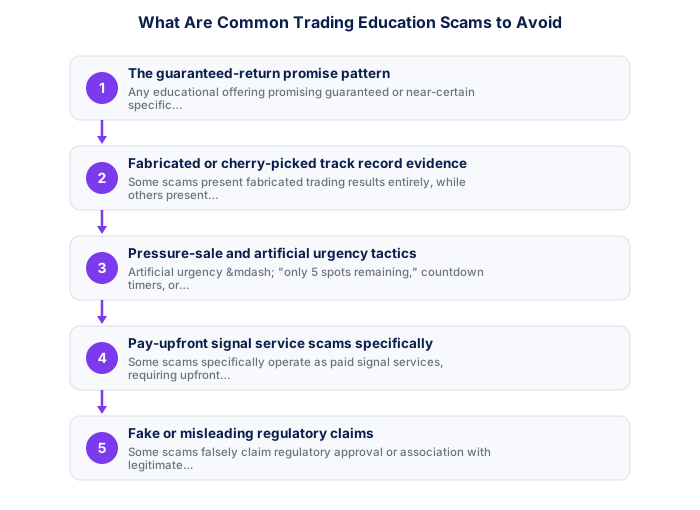
1. The guaranteed-return promise pattern
Any educational offering promising guaranteed or near-certain specific returns, "guaranteed 20% monthly" or similar specific, assured figures, directly contradicts the genuine, acknowledged risk and uncertainty inherent to trading, and should be treated as a clear, reliable warning sign regardless of how convincing the surrounding marketing material might otherwise appear.
It's worth internalising why this specific claim is so reliably disqualifying, genuine trading, discussed throughout this site, involves inherent uncertainty even for a strategy with a genuinely verified statistical edge, any offering claiming to have eliminated that fundamental uncertainty is making a claim about markets that simply isn't true.
| Pattern | What to Watch For |
|---|---|
| Guaranteed returns | Any promise of fixed or guaranteed profit |
| Fabricated track record | Unverifiable or cherry-picked results |
| Artificial urgency | Limited-time pressure to pay now |
| Pay-upfront signals | Payment required before any verifiable value shown |
| Fake regulatory claims | Unverifiable or misleading FSCA references |
2. Fabricated or cherry-picked track record evidence
Some scams present fabricated trading results entirely, while others present genuinely real but heavily cherry-picked results, showing only winning periods or specific successful trades while omitting losing periods entirely, creating a misleadingly favourable impression of overall performance. Seeking complete, verifiable track record evidence rather than accepting selectively curated highlights, the same standard that applies to evaluating mentors, helps guard against this specific manipulation.
It's worth applying the same verification standard discussed elsewhere on this site regarding evaluating any trading educator, requesting genuine, complete, independently verifiable results rather than accepting selectively presented screenshots or summaries at face value.
- FSCA-regulated broker verified at fsca.co.za
- Demo account tested for minimum 60 days
- Trading plan written: entry, exits, position sizing
- Risk per trade defined (1-2% of account)
- Backup internet connection tested for load shedding
- Tax implications understood
3. Pressure-sale and artificial urgency tactics
Artificial urgency, "only 5 spots remaining," countdown timers, or pressure to decide immediately without time for genuine, careful consideration, is a common manipulation tactic designed to short-circuit careful evaluation. Legitimate educational opportunities generally don't need this kind of artificial time pressure to justify a genuinely sound purchasing decision.
It's worth treating any genuine time pressure to decide as a red flag in itself, regardless of the specific offer's other merits, a legitimate educational opportunity generally survives a few days of careful, unhurried consideration, artificial urgency exists specifically to prevent that consideration.
4. Pay-upfront signal service scams specifically
Some scams specifically operate as paid signal services, requiring upfront subscription payment for trade signals with no genuine, verifiable track record of past performance, sometimes simply generating essentially random signals while collecting subscription revenue regardless of actual signal quality or accuracy. This connects to the broader concerns around signal-following generally, compounded by the financial scam risk this particular structure introduces.
| Item | Detail |
|---|---|
| Regulator | FSCA, fsca.co.za |
| Exchange control | SARB, resbank.co.za |
| Tax authority | SARS, sars.gov.za |
| JSE hours | 09:00-17:00 SAST Mon-Fri |
| Best forex session | 15:00-17:00 SAST |
| CGT annual exclusion | R50,000 (individuals) |
5. Fake or misleading regulatory claims
Some scams falsely claim regulatory approval or association with legitimate regulatory bodies like the FSCA, specifically to create unwarranted credibility and trust. Verifying any such claim directly through the FSCA's own official public register, the same check that applies to verifying broker regulatory status, rather than simply accepting a claimed affiliation at face value, helps guard against this deceptive tactic.
It's worth independently verifying any regulatory claim directly through the official FSCA register, discussed throughout this site's legal content, rather than trusting a badge, logo, or stated claim on a website or marketing material, since these are trivially easy to display without genuine underlying authorisation.
6. Practical steps if you've already paid a scammer
If you believe you've already paid for a fraudulent educational service or signal scheme, documenting all communication and payment evidence, reporting the matter to your bank or payment provider regarding potential reversal options, and reporting the fraud to relevant South African authorities, including the South African Police Service and potentially the FSCA if any false regulatory claims were involved, are reasonable, practical next steps.
No legitimate trading educator makes guaranteed profit claims. Lifestyle-heavy marketing, urgency tactics, and claims of FSCA endorsement are all warning signs worth taking seriously.
★ Why It Matters
Worth doing as a check: search the exact phrase used in a course's marketing material in quotes. Scam educational content is frequently recycled near-verbatim across multiple rebranded courses and "gurus," a quick search sometimes reveals the same script reused elsewhere under a different name.
✕ Common mistakes
- Trusting guaranteed-return promises without scepticism. No legitimate education or strategy can guarantee specific outcomes.
- Assuming aggressive sales tactics are simply enthusiastic marketing. High-pressure tactics are a recognised pattern in this specific space.
- Ignoring the absence of any verifiable, independent track record. Claims that can't be checked independently warrant real caution.
Key Takeaways
- Common scams include guaranteed-return promises, fake track records, pressure-sale tactics, and signal services requiring upfront payment with no verification.
- Common trading education scams share recognisable patterns: guaranteed-return promises, fabricated track records, aggressive sales tactics, and signal services requiring upfront payment without verification.
- The guaranteed-return promise pattern.
- Fabricated or cherry-picked track record evidence.
- Pressure-sale and artificial urgency tactics.
See also: Are Paid Trading Courses Worth It? and Should I Trade Based on Social Media Tips and Signals? and Should I Join a Paid Trading Discord or Telegram Group?.
Frequently asked follow-up questions
Are all paid trading courses scams?
No, genuinely legitimate, valuable courses exist. The patterns above help distinguish scams from genuine educational offerings.
Can I get my money back if I've been scammed?
This depends on the specific payment method and circumstances. Contacting your bank or payment provider promptly, and reporting to relevant authorities, gives the best realistic chance of any possible recovery.
Does a professional-looking website guarantee legitimacy?
No, professional appearance alone doesn't verify legitimacy. The substantive checks above matter considerably more than surface-level presentation quality.
