What this page covers
Quick answer: A current account deficit means the country spends more abroad than it earns there, and the gap has to be funded by foreign capital (SARB, Quarterly Bulletin). Key figures: current account -1.5%; trade balance Surplus; primary income Deficit; the 2021 peak +3.7%. Figures current at 15 November 2026, from South African Reserve Bank, quarterly bulletin.
A current account deficit means the country spends more abroad than it earns there, and the gap has to be funded by foreign capital. For the rand, how that funding behaves matters more than the size of the deficit.

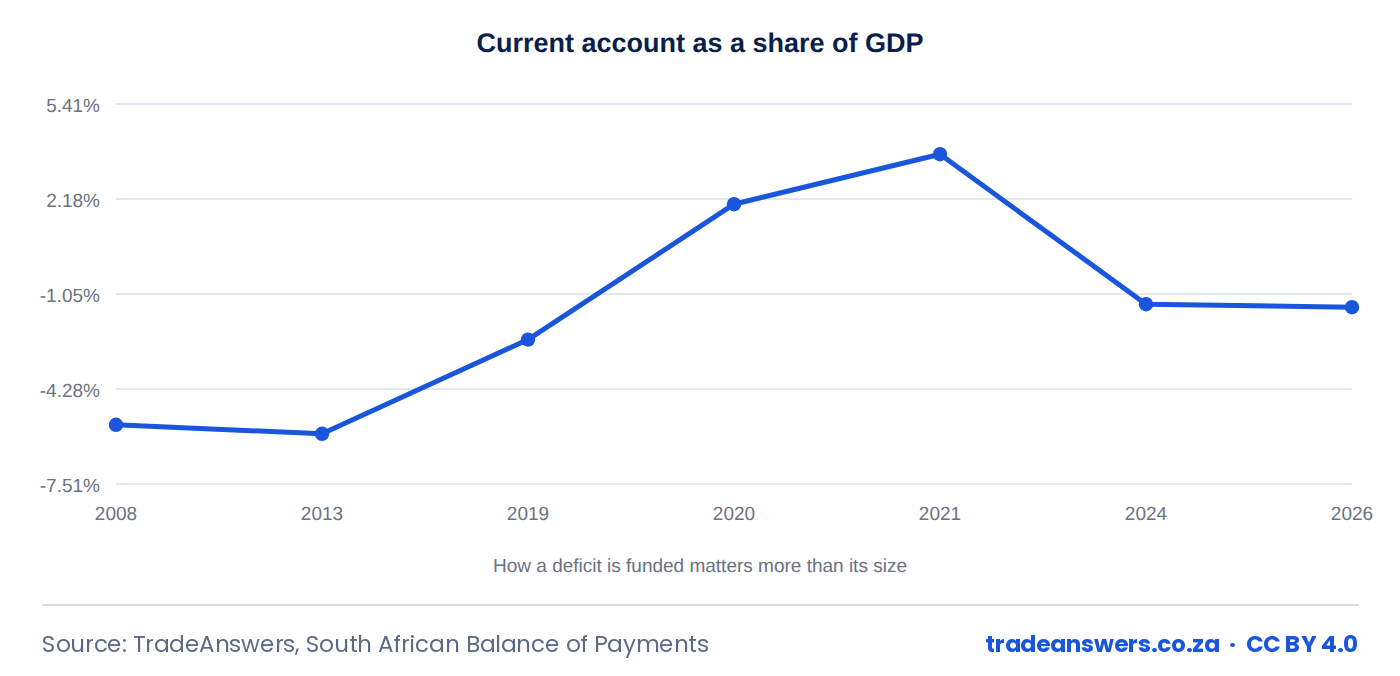
⬇ Download this chart (PNG) · Free to reuse with the credit “Source: TradeAnswers, South African Balance of Payments” (CC BY 4.0).
| Year | Current account | Trade balance | Context |
|---|---|---|---|
| 2026 (to date) | About -1.5% | Surplus | Commodity prices supportive |
| 2025 | About -0.5% | Surplus | Improved terms of trade |
| 2024 | About -0.7% | Surplus | Moderate deficit |
| 2022 | About -0.5% | Large surplus | Commodity boom |
| 2021 | About +3.7% | Record surplus | Commodity prices and weak imports |
| 2020 | About +2.0% | Surplus | Imports collapsed in the pandemic |
| 2019 | About -2.6% | Small surplus | Typical of the decade |
| 2013 | About -5.8% | Deficit | The widest of the modern era |
| 2008 | About -5.5% | Deficit | Before the crisis |
Source: TradeAnswers, South African Balance of Payments. Free to reuse with attribution (CC BY 4.0).
| Component | Typical position | Driver |
|---|---|---|
| Trade in goods | Surplus | Mining exports against oil and machinery imports |
| Services | Deficit | Transport and travel |
| Primary income | Large deficit | Dividends paid to foreign shareholders |
| Secondary income | Deficit | SACU transfers to neighbouring states |
TradeAnswers · CC BY 4.0
| Situation | Effect on the rand |
|---|---|
| Deficit funded by direct investment | Stable, that capital is sticky |
| Deficit funded by portfolio flows | Fragile, that capital leaves quickly |
| Surplus | Supportive |
| Terms of trade improving | Supportive |
| Deficit widening with weak funding | The classic emerging market vulnerability |
TradeAnswers · CC BY 4.0
📋 ON THIS PAGE
How these figures work
The primary income deficit is structural: South Africa's largest companies have substantial foreign shareholding, and the dividends they pay out leave the country every year.
A deficit is not itself a problem. What matters is whether it is funded by long-term investment or by portfolio flows that can reverse in a week. To apply these figures to your own numbers, use the rand basket decomposition calculator to see which currencies are driving a rand move.
How to read a balance of payments release
The Reserve Bank publishes the figures quarterly, and three numbers tell most of the story. First the current account as a share of GDP: a deficit of about 1.5%, as in 2026, means the country needs foreign capital of that size each year. Second, how that deficit is funded in the financial account: direct investment is sticky, while portfolio flows into bonds and shares can leave in days. Third, the trade balance, which shows whether the deficit comes from goods or, as usual in South Africa, from dividends paid to foreign shareholders.
A widening deficit funded mainly by portfolio flows is the combination that has preceded sharp rand sell-offs, so it matters more than the headline deficit alone.
★ What this means in practice
The 2021 surplus was exceptional, driven by a commodity price spike and imports suppressed by the pandemic. It is not a level to expect again.
✕ Common mistakes
- Reading any deficit as bad for the rand. What matters is how it is funded; steady long-term inflows are less fragile than short-term portfolio money.
- Ignoring revisions. The SARB revises earlier quarters as more data arrives.
- Comparing quarterly figures without annualising. The SARB reports the current account as an annualised share of GDP.
Terms used on this page
Recent changes to this page
- : Current account figures corrected for 2024 and 2025
Every change is recorded on the Updates Log.
Spotted an outdated figure? If a figure or rate on this page no longer matches its source, email us the page and the source. A material correction is dated on the Updates Log; how figures are compiled and checked is set out in our data methodology.
Cite this page
Barosso, G. (2026, September 29). South African Balance of Payments. TradeAnswers. https://www.tradeanswers.co.za/south-african-balance-of-payments.htmlBarosso, G (2026) South African Balance of Payments, TradeAnswers, figures current at 29 September 2026, https://www.tradeanswers.co.za/south-african-balance-of-payments.htmlThe tables and the CSV on this page are free to reuse under a CC BY 4.0 licence: attribution with a link to this page. See the Press & Data Licence page.
Frequently asked questions
What is the current account?
Trade in goods and services plus income and transfers with the rest of the world. A deficit means the country spends more abroad than it earns there.
Is a deficit bad?
Not by itself. What matters is whether it is funded by long-term direct investment or by portfolio flows that can reverse in a week.
Why is the primary income account always in deficit?
South Africa's largest companies have substantial foreign shareholding, and the dividends they pay leave the country each year.
What happened in 2021?
A record surplus, driven by a commodity price spike and imports suppressed by the pandemic. It is not a level to expect again.
How does it affect the rand?
A deficit funded by portfolio flows is the classic emerging market vulnerability, because that capital can leave quickly.
Who publishes it?
The Reserve Bank, in the quarterly bulletin.
How often is it published?
Quarterly, in the Reserve Bank’s Quarterly Bulletin, with revisions to earlier quarters as data improves.
 Download this data