i Short answer
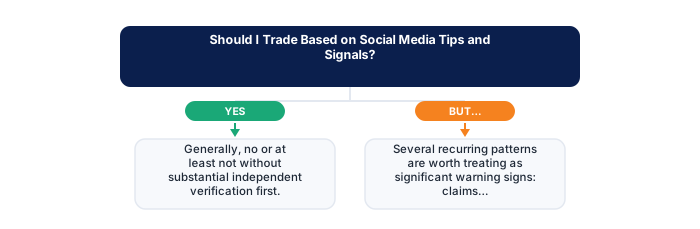
Generally, no, or at least not without substantial independent verification first.
Most social media tips and paid "signal services" lack verifiable track records, and this space attracts a disproportionate amount of misleading or fraudulent content.
📋 ON THIS PAGE
- Why this specific space attracts so much poor-quality content
- Common red flags in signal service and tip marketing
- The fundamental verification problem with most signals
- Survivorship bias in social proof and testimonials
- If you still want to evaluate a specific signal service
- A more productive alternative to following external signals
1. Why this specific space attracts so much poor-quality content
Trading-related content, particularly forex and CFD signal services and tips, has become a genuinely significant category of social media content specifically because it combines low barriers to entry for content creators (no specific verification or licensing required to post trading-related content on most platforms) with an audience that's often motivated by a desire for quick, low-effort financial gain, creating strong incentives for content creators to make compelling, often exaggerated claims that attract engagement and, frequently, paid signal subscriptions or referral commissions, regardless of those claims' actual accuracy.
This combination of low accountability and strong financial incentive to attract followers and paying subscribers has made trading-related social media content a common vector for misleading marketing and, in more serious cases, outright fraudulent schemes, warranting a considerably higher baseline level of scepticism than might be appropriate for many other categories of social media content.
It's worth understanding this incentive structure clearly, since it explains why the sheer volume of confident, engaging trading content online doesn't correlate with genuine quality, the platforms reward engagement and follower growth, not verified trading competence, two entirely different things worth keeping separate in your own evaluation.
2. Common red flags in signal service and tip marketing
Several recurring patterns are worth treating as significant warning signs: claims of consistently high win rates (genuinely above what's realistically sustainable for most trading approaches) without any independently verifiable, audited track record supporting these specific claims; displaying screenshots of individual successful trades without showing a complete, continuous, verifiable trading history including losing trades, which any genuine track record would necessarily include; lifestyle marketing (luxury cars, exotic travel, conspicuous displays of wealth) presented as direct evidence of trading success, which is easily fabricated and proves nothing about actual trading skill or signal accuracy; and high-pressure urgency tactics (limited-time offers, claims of an imminent, unmissable opportunity) designed to prompt impulsive subscription decisions before genuine, careful evaluation can occur.
The presence of any one of these patterns alone doesn't automatically prove a specific signal service or trading tip source is fraudulent, but the consistent, combined presence of several of these patterns together is a meaningful, practically useful signal warranting serious additional scepticism before trusting or paying for that source's signals or advice.
- Quantifiable rules remove subjectivity
- Backtestable on historical data
- Works consistently when edge is genuine
- Clear entry/exit criteria reduce hesitation
- Past performance does not guarantee future results
- Risk of overfitting to historical data
- Market regimes change, edges decay
- Requires discipline through drawdown periods
- Price and volume patterns
- Works on any liquid instrument
- Faster to learn basics
- Ignores fundamental context
- Economic and financial data
- Better for longer timeframes
- Deeper knowledge required
- Ignores entry precision
It's worth keeping a mental or written checklist of these specific patterns, checking any new signal source you encounter against this list systematically, rather than relying on a general impression, gives a more consistent, reliable basis for your evaluation.
3. The fundamental verification problem with most signals
A genuinely verifiable trading track record requires either a transparent, independently auditable trading account history (for example, verified through a recognised third-party trade-verification service that signal providers sometimes, though not always, use) or, at minimum, a long, continuous, and complete public record of specific calls made in advance (not edited or curated after the fact) that can be independently checked against actual subsequent market movement.
Most social media trading tips and signal services provide neither of these genuine verification mechanisms, instead relying on selective screenshots, unverifiable claims, or testimonials that, even when seemingly genuine, don't constitute the kind of rigorous, complete, and independently checkable track record that would actually justify real confidence in a specific signal source's claimed accuracy and reliability.
- Written entry/exit rules with zero ambiguity
- Backtested on minimum 3 years of data
- Walk-forward tested on out-of-sample data
- SA-specific events included in test period
- Maximum drawdown within personal tolerance
- 100+ live demo trades with consistent performance
It's worth asking directly for exactly this kind of independently verifiable evidence before trusting any specific signal source, and treating reluctance or inability to provide it as meaningful information in itself, a genuinely legitimate source with real results has little reason to avoid this kind of verification.
4. Survivorship bias in social proof and testimonials
Even genuine, non-fabricated testimonials praising a specific signal service or trading approach are subject to survivorship bias, the specific people who happen to experience success (whether due to genuine signal quality, favourable timing, or simple chance) are considerably more likely to publicly share and promote that positive experience than the likely much larger number of people who experienced poor results and simply stopped using the service quietly without leaving any public comment or review at all.
This means visible testimonials and social proof, even when entirely genuine and not fabricated, can create a significantly distorted, overly positive impression of a signal service's actual average or typical performance across its full user base, since the underlying sample of publicly visible feedback is itself systematically biased toward the positive outliers rather than representing the genuine typical experience.
| Win rate | 1:1 RR | 1.5:1 RR | 2:1 RR |
|---|---|---|---|
| 40% | Losing | Break even | Profitable |
| 50% | Break even | Profitable | Profitable |
| 55% | Profitable | Profitable | Profitable |
| 60% | Profitable | Profitable | Profitable |
It's worth actively searching for critical or negative experiences with any specific service you're considering, rather than relying solely on the testimonials the service itself prominently displays, a more complete, balanced picture requires seeking out the accounts that don't make it into official marketing.
5. If you still want to evaluate a specific signal service
If you're specifically considering a particular signal service despite these general concerns, apply meaningfully rigorous, specific evaluation: request and carefully examine a genuinely independently verified track record covering a substantial historical period (ideally a year or more) rather than accepting a short, recent, cherry-picked sample of results; calculate the realistic, all-in cost of following the signals including the subscription cost itself plus realistic trading costs (spreads, commissions) on the recommended trade volume; and, critically, test any specific service initially on a demo account, following its signals exactly as if real money were at stake, before committing actual capital based on those same signals.
This demo-testing approach for an external signal service mirrors broader backtesting and forward-testing principles. You shouldn't trust any trading approach, whether developed personally or sourced externally from a paid signal service, without first subjecting it to the same rigorous, evidence-based testing standard.
6. A more productive alternative to following external signals
Rather than relying primarily on external signals or tips whose underlying logic and track record you can't genuinely verify or fully understand, investing time in developing your own basic technical and fundamental analysis skills, even gradually, alongside continued learning, builds genuine, durable understanding you retain and can apply consistently, rather than creating an ongoing dependency on an external source whose reliability you can never be fully certain about and whose underlying reasoning you may not understand even when their specific calls happen to prove correct.
This isn't to say all external trading education or analysis commentary is worthless, reputable financial news sources and well-established, transparent educational content can be valuable supplementary resources, but the specific category of social media "signal services" and quick-tip-style content warrants particular scepticism given the structural incentives and verification challenges specifically affecting that particular category of trading-related content.
Independent analysis builds the skill that persists across market conditions.
Following signals without independent analysis builds no lasting skill and creates dependency. Developing independent analysis builds the genuine skill that persists across changing market conditions.
★ Why It Matters
Worth doing as a specific test: pick a social media 'guru' account and track their public calls forward for a month yourself, rather than trusting their claimed historical record, the gap between a track record someone states and one you verify independently is, in our experience, rarely in the guru's favour.
✕ Common mistakes
- Trusting a claimed track record without independent verification. Tracking a 'guru's' public calls forward yourself often tells a different story.
- Acting on a tip without any of your own supporting analysis. This removes the very judgement that separates trading from following.
- Assuming popularity or follower count indicates genuine skill. These measure audience size, not verified trading competence.
- Not recognising how much misleading content this specific space attracts. Social media trading content carries disproportionate scam and exaggeration risk.
Key Takeaways
- Generally no, most social media trading tips lack verifiable track records and can be actively misleading. Learn how to evaluate signal services critically.
- Generally, no, or at least not without substantial independent verification first.
- Most social media tips and paid "signal services" lack verifiable track records, and this space attracts a disproportionate amount of misleading or fraudulent content.
- Why this specific space attracts so much poor-quality content.
- Common red flags in signal service and tip marketing.
See also: Why Is Trading Psychology So Important? and Is Forex Trading the Same as Gambling? and What Is Outcome Bias and How Does It Distort Self-Assessment?.
Frequently asked follow-up questions
Are all paid signal services scams?
Not necessarily all, but the category as a whole carries elevated risk of poor quality or fraudulent content, making rigorous independent verification particularly important before trusting or paying for any specific service.
Is it safer to follow free tips than paid signals?
Not inherently, free tips can be equally unreliable or misleading, and the absence of a payment doesn't indicate higher quality or accuracy; the same verification principles apply regardless of whether a service is free or paid.
Can I learn anything useful from social media trading content?
Some educational content from reputable, transparent sources can be genuinely useful, but specific tips, signals, or guaranteed-result claims warrant heightened scepticism regardless of the specific platform or source.
