What this page covers
An ETF trades like a share and holds a basket. For a South African investor it is the cheapest route to diversified exposure, and the main decisions are what it tracks and what it costs.
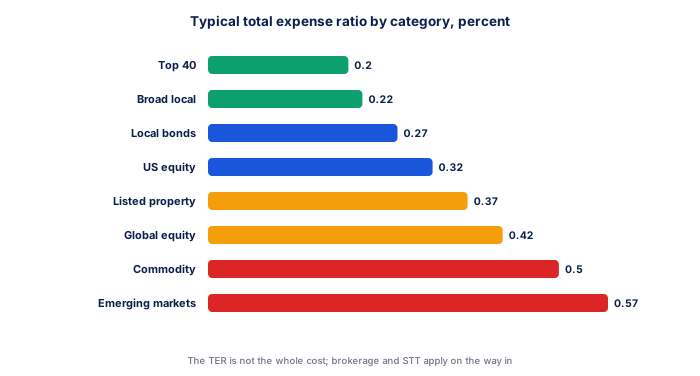
| Category | Typical benchmark | Typical TER |
|---|---|---|
| Broad local equity | Capped SWIX All Share | 0.10% to 0.35% |
| Top 40 | Top 40 or Top 40 SWIX | 0.10% to 0.30% |
| Global equity | MSCI World or All Country World | 0.25% to 0.60% |
| US equity | S&P 500 | 0.20% to 0.45% |
| Emerging markets | MSCI Emerging Markets | 0.40% to 0.75% |
| Local bonds | All Bond Index | 0.15% to 0.40% |
| Listed property | SA Listed Property | 0.25% to 0.50% |
| Commodity | Physical gold or platinum | 0.30% to 0.70% |
| Investment | At 0.15% TER | At 0.40% | At 0.70% | Over 20 years at 0.70% vs 0.15% |
|---|---|---|---|---|
| R100,000 | R150 a year | R400 | R700 | About R25,000 forgone |
| R500,000 | R750 a year | R2,000 | R3,500 | About R125,000 forgone |
| R1,000,000 | R1,500 a year | R4,000 | R7,000 | About R250,000 forgone |
| Item | Outside a wrapper | Inside a TFSA |
|---|---|---|
| Local dividends | 20% withheld | Exempt |
| Foreign dividends | Taxed with partial exemption | Foreign withholding still applies |
| Interest distributions | Taxed at your marginal rate | Exempt |
| Capital gain on sale | CGT applies | Exempt |
| Securities transfer tax on purchase | 0.25% | 0.25%, still applies |

Download this data
Every table on this page as a spreadsheet, with the source and the date it was checked in the header rows.
⬇ Download CSVHow these figures work
The figures on this page come from published sources and change on a schedule rather than continuously, which is what makes them worth recording in one place. The total expense ratio is not the whole cost. Brokerage, securities transfer tax and the bid-ask spread all apply on the way in, and on a small monthly contribution they can exceed the TER several times over.
A global equity ETF listed on the JSE gives offshore exposure without using your offshore allowance, because the purchase is in rand on a local exchange.
★ A worked example
Reading the tables together is where the value is. Two ETFs tracking the same index can differ by more than their TERs, through tracking difference. Compare actual performance against the benchmark, not just the published cost.
✕ Common mistakes
- The total expense ratio is not the whole cost. The total expense ratio is not the whole cost. Brokerage, securities transfer tax and the bid-ask spread all apply on the way in, and on a small monthly contribution they can exceed the TER several times over.
- A global equity ETF listed on the JSE gives offshore exposure without . A global equity ETF listed on the JSE gives offshore exposure without using your offshore allowance, because the purchase is in rand on a local exchange.
- Two ETFs tracking the same index can differ by more than their TERs, t. Two ETFs tracking the same index can differ by more than their TERs, through tracking difference. Compare actual performance against the benchmark, not just the published cost.
- Taking a figure without its date. A number from a reference page is only as good as when it was last checked, which is why the date sits at the top of this one.
Notes on reading these figures
- The total expense ratio is not the whole cost. Brokerage, securities transfer tax and the bid-ask spread all apply on the way in, and on a small monthly contribution they can exceed the TER several times over.
- A global equity ETF listed on the JSE gives offshore exposure without using your offshore allowance, because the purchase is in rand on a local exchange.
- Two ETFs tracking the same index can differ by more than their TERs, through tracking difference. Compare actual performance against the benchmark, not just the published cost.
To put these figures to work, the How to invest in ETFs runs the arithmetic on your own numbers, and Which ETF should a beginner buy? covers the same ground in ordinary language. JSE Trading Cost Schedule and Tax-Free Savings Account Limits go into the detail this table only summarises. The Unit trust vs ETF covers the part this table leaves out.
Put this table on your own site
The table below can sit on your own page and stays current without you editing anything.
- Preview the embeddable table as it will appear on your site
Add the code below to your own site. The table it renders is served from here, so it never goes stale.
<iframe src="https://www.tradeanswers.co.za/embed/ref-jse-etf-reference.html" width="100%" height="620" style="border:0" title="JSE ETF Reference"></iframe>Free to use with attribution. The link back to this page is built into the embed.
Terms used on this page
Frequently asked questions
What is a total expense ratio?
The annual cost the fund deducts, expressed as a percentage of assets. It is charged inside the fund rather than billed to you.
Is the TER the whole cost?
No. Brokerage, securities transfer tax and the spread apply on the way in, and on a small monthly contribution they can exceed the TER several times over.
Does an offshore ETF use my allowance?
Not if it is JSE-listed and bought in rand. That is the main reason local investors use them for offshore exposure.
What is tracking difference?
The gap between a fund's return and its benchmark, beyond the stated TER. Two funds tracking the same index can differ by more than their costs.
Does securities transfer tax apply to ETFs?
Yes, at 0.25% on purchase, because a JSE-listed ETF is a listed security.
Are ETF distributions taxed?
Outside a tax-free savings account, yes, by type: dividends at 20% withheld and interest at your marginal rate.