i Short answer
Most traders who reach consistent profitability report needing 1 to 2 years of dedicated, structured practice, including demo trading followed by small-stakes live trading.
There's no reliable shortcut that genuinely compresses this timeline, regardless of marketing claims.
📋 ON THIS PAGE
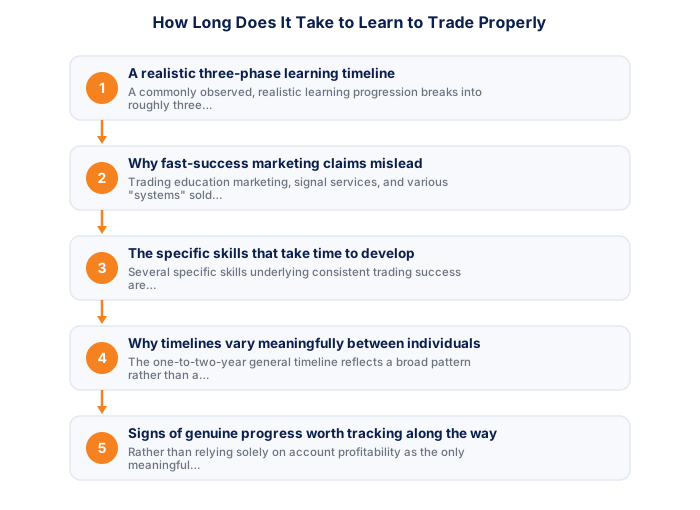
1. A realistic three-phase learning timeline
A commonly observed, realistic learning progression breaks into roughly three phases. The first phase, often spanning the initial one to three months, focuses on learning platform mechanics, basic chart reading and technical analysis concepts, and core risk management principles like position sizing and leverage, mostly conducted through demo trading and educational study without significant live capital exposure. The second phase, often spanning months four through nine, shifts toward developing and rigorously testing a personal trading strategy, building the habit of maintaining a trading journal, and refining specific risk management rules based on accumulating demo trading experience and review.
The third phase, often spanning months nine through eighteen or beyond, involves transitioning to live trading with deliberately small position size position sizes, specifically to build genuine experience with the psychological and emotional dimension of real financial risk that demo trading can't replicate, this phase often takes the longest to manage successfully, since it requires developing emotional discipline under real pressure, which simply can't be rushed through additional demo practice alone.
It's worth mapping your own current progress against these three phases honestly, rather than assuming you're further along than you genuinely are, an accurate sense of which phase you're actually in helps you set appropriate expectations and choose suitably matched next steps.
2. Why fast-success marketing claims mislead
Trading education marketing, signal services, and various "systems" sold online frequently imply that quick, even immediate, profitable results are realistic with the right course, indicator, or strategy purchase. This framing is misleading because it conflates the relatively achievable goal of learning trading mechanics and platform usage (which genuinely can be learned reasonably quickly) with the considerably more difficult, time-intensive goal of developing genuine trading skill and psychological discipline that produces consistent profitability over time, two very different things often blurred together in marketing messaging.
Recognising this distinction helps set more accurate expectations: understanding how a moving average crossover strategy works, for example, might take an afternoon of study; developing the discipline to execute that strategy consistently, manage risk properly, and maintain emotional composure through inevitable losing streaks over an extended period is a meaningfully different and more time-intensive undertaking entirely.
- FSCA-regulated broker verified at fsca.co.za
- Demo account tested for minimum 60 days
- Trading plan written: entry, exits, position sizing
- Risk per trade defined (1-2% of account)
- Backup internet connection tested for load shedding
- Tax implications understood
It's worth applying this same scrutiny to any specific timeline claim you encounter, a course or mentor promising genuine trading competency within a small number of weeks is making a claim that runs directly against this well-documented, extended timeline, worth treating with significant scepticism regardless of how compelling the specific marketing appears.
3. The specific skills that genuinely take time to develop
Several specific skills underlying consistent trading success are well-documented as requiring extended practice and experience rather than simply intellectual understanding: emotional discipline under real financial pressure (which, Demo trading specifically cannot develop, since it requires actual financial stakes to test); pattern recognition that develops through exposure to many varied real market conditions over time, building an intuitive feel for typical versus unusual price behaviour that's difficult to develop quickly through study alone; and the patience and consistency to follow a tested strategy's rules even during periods when doing so feels uncomfortable or counterintuitive in the moment.
None of these skills respond well to compressed timelines or shortcuts, since they fundamentally depend on accumulated, varied experience and repeated practice under genuine conditions, they're considerably more similar to skills like learning a musical instrument or a physical sport, which improve through sustained, repeated practice over time, than to skills that can be acquired primarily through reading or watching educational content alone.
It's worth being patient with yourself specifically regarding these particular skills, since no amount of additional reading or course consumption substitutes for the accumulated, lived experience these skills genuinely require to develop properly.
4. Why timelines vary meaningfully between individuals
The one-to-two-year general timeline reflects a broad pattern rather than a guaranteed, fixed outcome for every individual trader, actual timelines vary based on factors including how much consistent time and attention an individual can realistically dedicate to deliberate practice and review (someone trading part-time alongside a demanding full-time job will naturally progress more slowly in calendar time than someone able to dedicate considerably more daily attention), how rigorously and honestly someone reviews their own results and adjusts their approach based on that review, and individual differences in emotional regulation and discipline that some people may find come more naturally than others.
Given this variability, comparing your own progress against a fixed calendar timeline too rigidly can be counterproductive, focusing instead on whether you're demonstrating genuine, incremental improvement in specific, trackable areas (consistency of strategy execution, quality of risk management, emotional composure during losses) tends to be a more useful measure of progress than simply counting elapsed months against a generic benchmark.
| Item | Detail |
|---|---|
| Regulator | FSCA, fsca.co.za |
| Exchange control | SARB, resbank.co.za |
| Tax authority | SARS, sars.gov.za |
| JSE hours | 09:00-17:00 SAST Mon-Fri |
| Best forex session | 15:00-17:00 SAST |
| CGT annual exclusion | R50,000 (individuals) |
5. Signs of genuine progress worth tracking along the way
Rather than relying solely on account profitability as the only meaningful progress indicator, which can be noisy and influenced by short-term luck in either direction, especially early on, several other signs suggest genuine underlying skill development is occurring: increasing consistency in actually following your defined strategy rules rather than deviating impulsively; improving emotional composure specifically during losing trades, responding with predetermined process rather than impulsive reaction; growing ability to honestly and objectively review your own trading journal and identify genuine patterns or mistakes; and a strategy's results becoming more consistent and explainable over a larger sample of trades, rather than appearing essentially random.
Tracking these process-oriented indicators alongside, rather than instead of, raw profitability gives a more complete and genuinely useful picture of whether your trading skill is actually developing in a sustainable direction, even during periods when short-term account performance might be flat or temporarily negative due to normal market variation.
6. Avoiding common traps that promise to accelerate the timeline
Be appropriately skeptical of any course, mentor, signal service, or trading "system" claiming to meaningfully compress this fundamentally experience-dependent learning timeline through some specific proprietary method, indicator, or shortcut. While legitimate trading education can genuinely accelerate the early mechanical learning phase (understanding platform usage, basic technical analysis concepts, risk management principles), no legitimate offering can substitute for the accumulated practice and experience required to build emotional discipline and pattern recognition under real, varied market conditions over time.
This skepticism is particularly warranted for any offering specifically promising guaranteed or near-guaranteed profitable results within a short, specific timeframe, genuine trading skill development, Simply doesn't work this way, and offerings claiming otherwise are worth treating with considerable caution regardless of how compelling the specific marketing claims or testimonials might appear.
The reality involves non-linear growth and a longer timeline.
Learning to trade properly rarely follows a straight upward line and typically takes considerably longer than most traders initially expect, with periods of apparent regression along the way.
★ Why It Matters
Something worth reframing: the 1-2 year timeframe most traders cite isn't continuous linear improvement, it typically includes one or more periods of apparent regression where a previously working approach stops working, traders who expect this pattern in advance seem to handle it better than those who interpret it as failure.
✕ Common mistakes
- Expecting steady, linear progress throughout the learning period. Periods of apparent regression are a normal part of the process, not failure.
- Assuming a faster path exists that skips the typical 1-2 year timeframe. No verified shortcut reliably compresses this learning curve.
- Treating early profitability as evidence the learning process is complete. Early results often reflect favourable conditions more than mastery.
- Comparing your own timeline to others without considering differing starting points. Prior experience and available practice time vary considerably between traders.
How much capital do I need for this?
Enough that a correctly sized position is still meaningful after costs, and little enough that losing it changes nothing. Starting capital covers the arithmetic.
Which skill matters most here?
Position sizing, because it decides whether a run of losses is survivable. The skill to build first covers why it outranks entry selection.
Key Takeaways
- Most traders need 1-2 years of dedicated practice to reach consistent profitability. Learn the realistic learning timeline and why shortcuts don't work.
- Most traders who reach consistent profitability report needing 1 to 2 years of dedicated, structured practice, including demo trading followed by small-stakes live trading.
- There's no reliable shortcut that genuinely compresses this timeline, regardless of marketing claims.
- A realistic three-phase learning timeline.
- Why fast-success marketing claims mislead.
See also: How Do I Start Forex Trading in South Africa?.
Frequently asked follow-up questions
Can a trading course shorten this learning timeline?
A good course can accelerate the mechanical learning phase (platform usage, basic concepts, risk management principles), but cannot substitute for the accumulated real-world practice needed to build emotional discipline and pattern recognition over time.
Is it normal to still be learning after a full year of trading?
Yes, this aligns with commonly observed timelines; continuous learning and refinement is a normal, expected part of the process well beyond the first year for most traders.
Should I expect to be profitable within my first few months?
Most realistic timelines suggest the first few months are primarily a learning and strategy-testing phase rather than a profitability-focused phase; expecting consistent profitability this early often leads to discouragement or rushed, undisciplined decisions.
