What this page covers
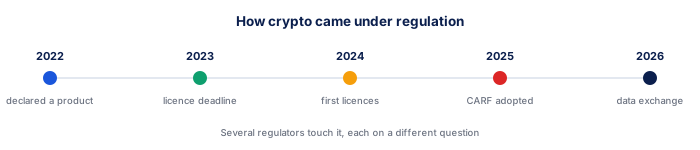
A crypto asset became a financial product under FAIS in 2022, which means a platform offering it to South Africans needs a licence. Several regulators touch it, and each covers a different question.
| Body | Covers |
|---|---|
| FSCA | Licensing of crypto asset service providers under FAIS |
| Financial Intelligence Centre | Identity verification and suspicious transaction reporting |
| SARS | Tax on disposals, mining and staking rewards |
| SARB | Cross-border movement of value and exchange control |
| Prudential Authority | Where a bank is involved |
| Item | Detail |
|---|---|
| Declared a financial product | October 2022 |
| Licence required | Category I FSP, crypto asset subcategory |
| Deadline for applications | November 2023 |
| Who needs it | Anyone advising on or intermediating crypto assets to South Africans |
| Who does not | A person buying and holding for their own account |
| Activity | Treatment |
|---|---|
| Buying and holding, then selling | Capital or revenue, on the usual intention test |
| Frequent trading | Revenue, taxed at your marginal rate |
| Mining rewards | Revenue when received |
| Staking rewards | Revenue when received |
| Crypto to crypto swap | A disposal, taxable, even with no rand involved |
| Paying for goods | A disposal of the crypto |

Download this data
Every table on this page as a spreadsheet, with the source and the date it was checked in the header rows.
⬇ Download CSVHow these figures work
The figures on this page come from published sources and change on a schedule rather than continuously, which is what makes them worth recording in one place. A crypto-to-crypto swap is a disposal. Many people discover this only on audit, because no rand moved and nothing felt like a sale.
CARF, the Crypto-Asset Reporting Framework, changes what SARS can see. Participating jurisdictions exchange platform data automatically, which removes the practical obscurity offshore platforms once offered.
★ A worked example
Reading the tables together is where the value is. An unlicensed offshore exchange is not illegal to use, but it sits outside the FAIS Ombud and outside South African client protections, exactly as an unlicensed forex broker does.
✕ Common mistakes
- A crypto-to-crypto swap is a disposal. A crypto-to-crypto swap is a disposal. Many people discover this only on audit, because no rand moved and nothing felt like a sale.
- CARF, the Crypto-Asset Reporting Framework, changes what SARS can see. CARF, the Crypto-Asset Reporting Framework, changes what SARS can see. Participating jurisdictions exchange platform data automatically, which removes the practical obscurity offshore platforms once offered.
- An unlicensed offshore exchange is not illegal to use, but it sits out. An unlicensed offshore exchange is not illegal to use, but it sits outside the FAIS Ombud and outside South African client protections, exactly as an unlicensed forex broker does.
- Taking a figure without its date. A number from a reference page is only as good as when it was last checked, which is why the date sits at the top of this one.
Notes on reading these figures
- A crypto-to-crypto swap is a disposal. Many people discover this only on audit, because no rand moved and nothing felt like a sale.
- CARF, the Crypto-Asset Reporting Framework, changes what SARS can see. Participating jurisdictions exchange platform data automatically, which removes the practical obscurity offshore platforms once offered.
- An unlicensed offshore exchange is not illegal to use, but it sits outside the FAIS Ombud and outside South African client protections, exactly as an unlicensed forex broker does.
To put these figures to work, the Crypto Position Size Calculator runs the arithmetic on your own numbers, and How SARS taxes crypto gains covers the same ground in ordinary language. What CARF changes and Is crypto trading legal? go into the detail this table only summarises. The FSCA FSP Licence Categories covers the part this table leaves out.
Put this table on your own site
The table below can sit on your own page and stays current without you editing anything.
- Preview the embeddable table as it will appear on your site
To put the live table on your own page, paste this where you want it to appear. It stays current without you editing anything.
<iframe src="https://www.tradeanswers.co.za/embed/ref-crypto-asset-regulation-reference.html" width="100%" height="620" style="border:0" title="Crypto Asset Regulation Reference"></iframe>Free to use with attribution. The link back to this page is built into the embed.
Terms used on this page
Frequently asked questions
Do I need a licence to trade crypto?
No. The licence applies to platforms and intermediaries, not to someone buying and holding for their own account.
Is a crypto-to-crypto swap taxable?
Yes. It is a disposal, even though no rand moved, and many people discover this only on audit.
How does SARS treat mining and staking rewards?
As revenue when received, valued in rand at that date.
What is CARF?
The Crypto-Asset Reporting Framework, under which participating jurisdictions exchange platform data automatically. It removes the practical obscurity offshore platforms once offered.
Is an offshore exchange illegal to use?
No, but it sits outside the FAIS Ombud and outside South African client protections.
When did crypto become a financial product?
October 2022, under a FAIS declaration. Licence applications were due by November 2023.