i Short answer
Books generally offer more structured, thoroughly edited depth on foundational concepts, while online content offers greater timeliness and interactivity.
Both represent worthwhile, complementary components of a well-rounded learning curriculum.
📋 ON THIS PAGE
- The genuine strengths of the book format specifically
- The genuine strengths of online content by comparison
- Why foundational concepts age particularly well in book form
- The limitation of books for current market specifics
- Evaluating a specific book's credibility before reading
- A balanced approach combining both formats
1. The genuine strengths of the book format specifically
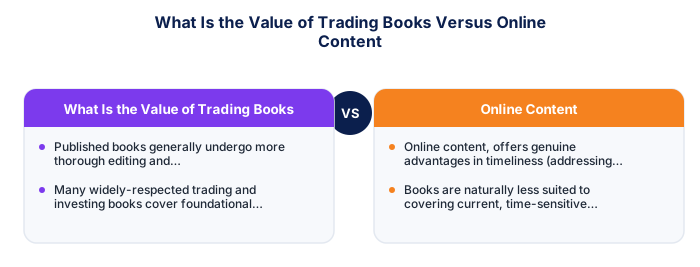
Published books generally undergo more thorough editing and structured development than typical online content, often resulting in more complete, carefully organised coverage of foundational concepts, with the author having had considerably more time to refine and structure their explanation than the often more rapid production pace of online content.
It's worth appreciating why a well-written book often provides a more coherent, complete framework than scattered online content, an author working through an entire manuscript has space to build ideas systematically in a way individual articles or videos, however good, rarely match.
See also: How Do I Build a Personal Trading Curriculum for Myself?
See also: What Is an Account Base Currency and Can I Change It?
See also: How Does Load Shedding Affect My Trading Day?
See also: How Do I Evaluate Trading Courses With Certificates?
See also: How Do I Read an Economic Calendar in South African Time?
2. The genuine strengths of online content by comparison
Online content offers genuine advantages in timeliness (addressing current market conditions or recent developments), interactivity (community discussion, question-and-answer formats), and accessibility (often free or lower-cost than books, with immediate availability rather than requiring acquisition and reading time).
It's worth using this immediacy deliberately for genuinely current questions, discussed elsewhere on this site regarding economic calendar usage and current market conditions, where a book's fixed publication date simply can't compete with content published this week.
- FSCA-regulated broker verified at fsca.co.za
- Demo account tested for minimum 60 days
- Trading plan written: entry, exits, position sizing
- Risk per trade defined (1-2% of account)
- Backup internet connection tested for load shedding
- Tax implications understood
3. Why foundational concepts age particularly well in book form
Many widely-respected trading and investing books cover foundational concepts, risk management principles, psychological patterns, basic technical analysis logic, that remain genuinely relevant regardless of publication date, since these underlying human and market behaviour patterns don't fundamentally change even as specific markets and instruments evolve over time.
It's worth seeking out books covering these genuinely timeless foundations specifically, position sizing, psychology, risk management principles, discussed throughout this site, tend to remain valid regardless of when a book was written, unlike more perishable, market-specific content.
4. The limitation of books for current market specifics
Books are naturally less suited to covering current, time-sensitive specifics, current South African regulatory details, currently available broker options, or very recent market developments, given the inherent publishing lag between writing and the book reaching readers, making online sources more appropriate for this kind of time-sensitive, current information.
It's worth checking a book's publication date explicitly before relying on any market-specific or regulatory detail it contains, discussed elsewhere on this site regarding checking current regulatory status directly, since these particulars can shift meaningfully after a book's content was finalised.
| Item | Detail |
|---|---|
| Regulator | FSCA, fsca.co.za |
| Exchange control | SARB, resbank.co.za |
| Tax authority | SARS, sars.gov.za |
| JSE hours | 09:00-17:00 SAST Mon-Fri |
| Best forex session | 15:00-17:00 SAST |
| CGT annual exclusion | R50,000 (individuals) |
5. Evaluating a specific book's credibility before reading
Checking a specific book's author credentials, looking for independent reviews beyond the book's own marketing, and being similarly alert to guaranteed-success claims, applies to book selection just as much as it does to online content evaluation.
It's worth applying similar scrutiny here to what you'd apply evaluating any other trading educator, discussed throughout this site, checking an author's genuine background and the book's general reputation before investing significant reading time.
6. A balanced approach combining both formats
Many traders benefit from using well-regarded books for building deep, foundational understanding of timeless concepts, while using online content for current, time-sensitive specifics and ongoing community engagement, treating these as complementary rather than competing learning resources.
The quality of trading education available to South African traders has improved substantially with the growth of FSCA-regulated broker educational content and global online resources. The critical evaluation skill, separating genuinely educational content from thinly disguised marketing for signals, courses, or investment schemes, is as important as the content itself. South African traders should additionally prioritise educational resources that address SA-specific topics including ZAR trading dynamics, SARB policy implications, FSCA regulatory requirements, and SARS tax treatment, since virtually all internationally produced trading education was created without these local dimensions in mind.
Online content is more current and better for specific or evolving topics.
Trading books provide structured, edited, in-depth foundational learning that holds up over time. Online content is more current and better suited to specific techniques, recent developments, or narrow topics.
★ Why It Matters
Worth doing deliberately: alternate between a foundational book and current online content on the same topic, rather than choosing one format exclusively. The book typically gives the durable underlying framework while current content fills in what's changed since the book was published.
✕ Common mistakes
- Assuming an older book's foundational content is now outdated. Core principles often remain durable even as specific tools and conditions change.
- Relying solely on current content without any foundational, structured study. Scattered current content can lack the depth a well-chosen book provides.
- Not cross-referencing book concepts against more recent online content for currency. Combining both fills gaps neither format alone fully addresses.
Key Takeaways
- Books generally offer more structured, thoroughly edited depth, while online content offers timeliness and interactivity, making both worthwhile complements.
- Books generally offer more structured, thoroughly edited depth on foundational concepts, while online content offers greater timeliness and interactivity.
- Both represent worthwhile, complementary components of a well-rounded learning curriculum.
- The genuine strengths of the book format specifically.
- The genuine strengths of online content by comparison.
See also: How Do I Build a Personal Trading Curriculum? and How Do I Evaluate YouTube and Influencer Trading Content?.
Frequently asked follow-up questions
Are older trading books still worth reading?
Many widely-respected books covering foundational concepts remain genuinely relevant despite their age, given the timeless nature of the underlying principles they cover.
Should I prioritise reading books before engaging with online content?
Either sequence can work. Some prefer building foundational understanding through books first, while others prefer starting with more immediately accessible online content before deepening understanding through books.
Are South African-specific trading books available?
Locally-published trading books exist, though the broader, internationally-published foundational books remain widely relevant regardless of the specific country focus.
