i Short answer
Checking host credentials and background, looking for balanced discussion of genuine risk alongside opportunity, and noticing whether content consistently promotes specific products all help assess a podcast's value.
📋 ON THIS PAGE
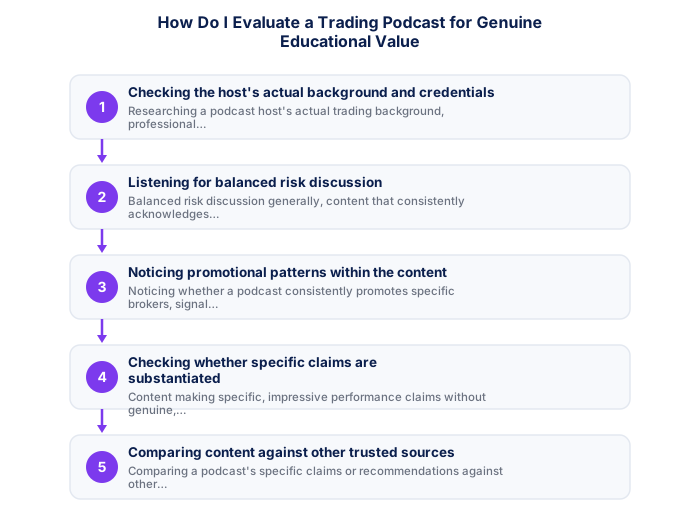
1. Checking the host's actual background and credentials
Researching a podcast host's actual trading background, professional credentials, or specific track record provides useful context for evaluating their genuine expertise and credibility.
It's worth spending a few minutes on this research before investing significant listening time in any specific podcast, a quick search for the host's name alongside terms like 'FSCA' or 'regulated' can reveal whether any specific licensing claims made hold up against the official register discussed elsewhere on this site.
See also: How Do I Evaluate Trading Podcasts and Audio Content?
| Signal | Red Flag | Green Flag |
|---|---|---|
| Host background | Vague or unverifiable | Checkable, transparent |
| Risk discussion | Minimal or absent | Balanced and prominent |
| Content pattern | Heavy promotion of paid offers | Substantive, educational focus |
| Claims made | Unsubstantiated | Backed by verifiable evidence |
2. Listening for balanced risk discussion
Balanced risk discussion generally, content that consistently acknowledges genuine trading risk and discusses losses honestly, alongside opportunities, generally reflects more credible, trustworthy educational content than content focusing exclusively on success and opportunity.
It's worth actively noticing your own reaction while listening, content that consistently makes trading sound easy, exciting, or reliably profitable without proportionate discussion of genuine difficulty and risk should prompt some scepticism, regardless of how engaging or confident the presentation style happens to be.
- FSCA-regulated broker verified at fsca.co.za
- Demo account tested for minimum 60 days
- Trading plan written: entry, exits, position sizing
- Risk per trade defined (1-2% of account)
- Backup internet connection tested for load shedding
- Tax implications understood
3. Noticing promotional patterns within the content
Noticing whether a podcast consistently promotes specific brokers, signal services, or paid courses, particularly without clear disclosure of any financial relationship, warrants additional scrutiny.
It's worth distinguishing between occasional, clearly disclosed sponsorship, which is a normal, legitimate part of how much free content gets funded, and a pattern where every episode conveniently steers listeners toward the same specific paid product or broker, the second pattern deserves considerably more scrutiny than the first.
4. Checking whether specific claims are genuinely substantiated
Content making specific, impressive performance claims without genuine, verifiable supporting evidence warrants the same healthy scepticism.
It's worth applying the same standard here that applies to evaluating any trading educator or vendor discussed elsewhere on this site, a specific, verifiable performance claim backed by genuine evidence is meaningfully different from a vague, impressive-sounding assertion with nothing concrete behind it.
| Item | Detail |
|---|---|
| Regulator | FSCA, fsca.co.za |
| Exchange control | SARB, resbank.co.za |
| Tax authority | SARS, sars.gov.za |
| JSE hours | 09:00-17:00 SAST Mon-Fri |
| Best forex session | 15:00-17:00 SAST |
| CGT annual exclusion | R50,000 (individuals) |
5. Comparing content against other trusted sources
Comparing a podcast's specific claims or recommendations against other established, trustworthy sources helps identify whether the content aligns with broader, more widely-validated understanding or represents unusual, unsubstantiated claims.
It's worth doing this comparison specifically for any claim that surprises you or contradicts what you've learned elsewhere, rather than accepting unusual claims simply because they came from a source you generally trust, even generally reliable sources can occasionally get something wrong or present a genuinely fringe view as more mainstream than it actually is.
6. Using podcasts as one input among several
Treating any single podcast as one input among several diverse sources, rather than your sole source of trading education, supports more balanced, well-rounded learning regardless of any single source's specific quality.
The quality of trading education available to South African traders has improved substantially with the growth of FSCA-regulated broker educational content and global online resources. The critical evaluation skill, separating genuinely educational content from thinly disguised marketing for signals, courses, or investment schemes, is as important as the content itself. South African traders should additionally prioritise educational resources that address SA-specific topics including ZAR trading dynamics, SARB policy implications, FSCA regulatory requirements, and SARS tax treatment, since virtually all internationally produced trading education was created without these local dimensions in mind.
Researching a host's verifiable background and noting whether they consistently discuss genuine risk are good signs. Constant promotion of products is a red flag worth watching for.
Evaluating trading educational content requires applying the same critical standards you would apply to any financial information source. The most valuable resources are those that focus on process, risk management, and psychological frameworks rather than those that primarily promise profits or specific returns. South African traders should additionally prioritise content that addresses SA-specific regulatory, tax, and market context, since most international trading education was produced without South African exchange control, SARS tax treatment, or ZAR-specific market conditions in mind.
★ Why It Matters
Something worth tracking across a few episodes: how often the host discusses a trade or call that didn't work out, versus only ever discussing successes, the ratio tends to be a more reliable honesty signal than anything stated explicitly about the host's track record.
✕ Common mistakes
- Assuming production quality reflects educational value. Polished editing doesn't guarantee substantive content.
- Not checking how often the host discusses failures or losses. A pattern of only success stories is a meaningful honesty signal.
- Treating podcast opinions as definitive rather than one input. Cross-referencing with other sources remains worthwhile.
- Following advice without checking the host's actual credentials. Confident delivery doesn't necessarily reflect genuine expertise.
Key Takeaways
- Checking host credentials, looking for balanced discussion of risk, and noticing whether content promotes specific products all help assess podcast value.
- Checking host credentials and background, looking for balanced discussion of genuine risk alongside opportunity, and noticing whether content consistently promotes specific products all help assess a podcast's value.
- Checking the host's actual background and credentials.
- Listening for balanced risk discussion.
- Noticing promotional patterns within the content.
Frequently asked follow-up questions
Are podcasts generally a reliable primary source for learning to trade?
Podcasts can supplement broader learning, though combining them with more structured, foundational education, generally provides a more complete learning approach.
Should I be suspicious of every podcast that mentions a specific broker?
Not automatically, since legitimate disclosure of sponsorship relationships is normal; the concern is specifically undisclosed promotion presented as neutral, independent advice.
Can a podcast host with limited formal credentials still provide valuable content?
Yes, genuine demonstrated knowledge and balanced, honest discussion matter more than formal credentials alone in assessing genuine educational value.
How do I find podcast recommendations from trustworthy sources?
Checking recommendations within established, reputable trading communities can help identify well-regarded options worth considering.
Does podcast length or frequency indicate genuine educational quality?
No, these production characteristics don't directly correlate with content quality, which depends more on substantive factors like accuracy and depth.
