i Short answer
Spot forex settles at the current market price almost immediately, typically within two business days.
Forward contracts lock in a specific exchange rate today for settlement at an agreed future date.
📋 ON THIS PAGE
1. Understanding spot settlement specifically
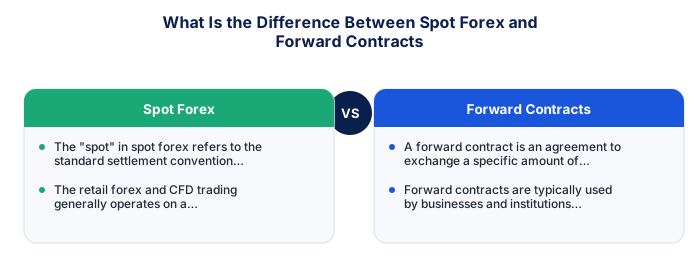
The "spot" in spot forex refers to the standard settlement convention of completing a currency transaction within two business days of the trade date, reflecting the practical time historically needed to settle and transfer the actual currencies between parties. This is the real-time exchange rate most commonly quoted in trading content generally.
It's worth appreciating that this near-immediate settlement window represents the standard, default way most retail forex activity is genuinely conducted, discussed throughout this site regarding forex trading generally, worth understanding this as your baseline reference point before considering the alternative forward structure.
| Feature | Spot Forex | Forward Contract |
|---|---|---|
| Settlement | Near-immediate (typically T+2) | Fixed future date |
| Price | Current market rate | Locked in today for future settlement |
| Typical user | Retail traders, speculators | Businesses hedging future currency needs |
| Purpose | Speculation on current price movement | Eliminating future exchange rate uncertainty |
| Used in retail CFD trading | Yes, this is the reference pricing | No, not directly |
2. How forward contracts actually work
A forward contract is an agreement to exchange a specific amount of currency at a predetermined rate on a specific future date, agreed today even though the actual exchange won't happen until that date arrives. This locked-in rate, calculated using the interest rate differential behind carry trade dynamics, may differ from whatever the spot rate happens to be at that future settlement date.
It's worth appreciating why this locked-in future rate genuinely appeals to certain participants specifically, businesses with known future foreign currency needs can eliminate exchange rate uncertainty entirely by locking in today's agreed rate for a transaction that won't actually occur for weeks or months.
| Lot type | Size | USD/ZAR pip value | Min recommended account |
|---|---|---|---|
| Standard | 100,000 units | ~R1.00 | R100,000+ |
| Mini | 10,000 units | ~R0.10 | R10,000+ |
| Micro | 1,000 units | ~R0.01 | R1,000+ |
| Nano | 100 units | ~R0.001 | R100+ |
- V = Pip value in account currency
- E = Current exchange rate of quote vs account currency
- L = Lot size (100,000 standard / 10,000 mini / 1,000 micro)
- USD/ZAR example = 1 pip = R1 per standard lot
- Leveraged instrument
- Long and short available
- Overnight financing applies
- No ownership of asset
- Typically unleveraged
- Physical currency received
- No daily financing
- Currency ownership
3. Who typically uses forward contracts and why
Forward contracts are typically used by businesses and institutions specifically wanting to hedge against future currency risk, for example, a South African importer expecting to pay a foreign supplier in three months might use a forward contract to lock in today's exchange rate, protecting against the risk of unfavourable currency movement before that future payment is actually due.
It's worth understanding this as fundamentally a hedging tool for these specific participants, rather than a speculative trading instrument, worth distinguishing this genuine business use case from the kind of speculative CFD trading discussed throughout this site.
4. The pricing difference between spot and forward rates
Forward rates typically differ from current spot rates in a way that reflects the interest rate differential between the two currencies over the contract's time period, similar in underlying logic to carry trade mechanics.
It's worth connecting this directly to the interest rate differential discussion elsewhere on this site, the gap between spot and forward rates for a currency pair largely reflects the interest rate difference between the two currencies over the contract's specific duration.
5. Does retail CFD trading involve forwards
Retail forex and CFD trading generally operates on a spot-equivalent basis, with the overnight financing charges known as rollover serving a somewhat similar economic function to forward pricing, without requiring retail traders to directly engage with formal forward contracts themselves.
It's worth understanding your own CFD trading as operating on spot-referenced pricing specifically, discussed elsewhere on this site regarding CFD mechanics, rather than the forward contract structure this section describes, which serves a genuinely different purpose for different participants.
6. Why this distinction matters for understanding markets generally
Understanding the spot-forward distinction provides useful broader context for how currency markets function beyond retail CFD trading specifically, including why financial news sometimes references forward rates or implied future exchange rate expectations, which reflect this genuinely separate, institutional-focused market segment operating alongside the spot trading most retail traders directly engage with.
Forward contracts lock in an exchange rate for a specific future date.
Spot forex settles in two business days at the current market rate and is the basis for most retail CFD trading. Forward contracts lock in a rate for a specific future date, mainly used by businesses hedging known future exposure.
★ Why It Matters
Worth checking if you ever need genuine currency conversion for non-trading purposes (like an offshore property purchase): a forward contract through your bank can lock in a rate months ahead, a meaningfully different tool and purpose than the spot CFD trading most of this site covers.
✕ Common mistakes
- Assuming forward contracts are relevant to typical retail CFD trading. They serve a different purpose, more relevant to genuine future currency conversion needs.
- Confusing spot CFD trading with the longer-settlement forward contract structure. These operate under genuinely different mechanics and serve different needs.
- Treating settlement timing as identical between these two instrument types. Spot settles almost immediately; forwards settle at an agreed future date.
Key Takeaways
- Spot forex settles at the current market price almost immediately, while forward contracts lock in a future exchange rate for settlement at a later date.
- Spot forex settles at the current market price almost immediately, typically within two business days.
- Forward contracts lock in a specific exchange rate today for settlement at an agreed future date.
- Understanding spot settlement specifically.
- How forward contracts actually work.
Frequently asked follow-up questions
Can retail traders access forward contracts directly?
Generally not through typical retail CFD brokers. Forward contracts are more commonly accessed through banks and institutional channels for specific hedging purposes.
Is overnight financing the same thing as a forward contract?
They share some similar underlying economic logic related to interest rate differentials, but are structured and used differently in practice.
Do forward rates predict future spot rates accurately?
Not reliably as a precise prediction. Forward rates mainly reflect current interest rate differentials rather than genuine forecasting of future spot market conditions.
