i Short answer
Paper trading competitions provide structured, low-stakes practice with added engagement.
Their incentive structure can sometimes encourage excessive, unrealistic risk-taking.
📋 ON THIS PAGE
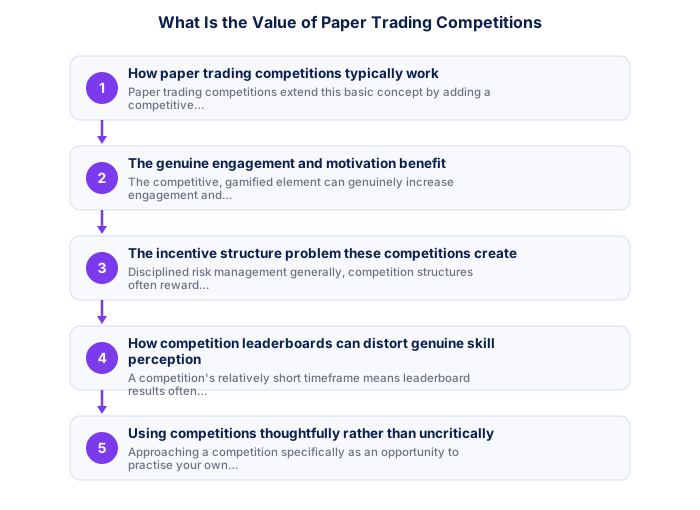
- How paper trading competitions typically work
- The genuine engagement and motivation benefit
- The incentive structure problem these competitions create
- How competition leaderboards can distort genuine skill perception
- Using competitions thoughtfully rather than uncritically
- Alternatives that might better serve genuine skill development
1. How paper trading competitions typically work
Paper trading competitions extend the standard demo account concept by adding a competitive leaderboard structure, typically with prizes, where participants compete to generate the highest percentage return over a defined period, often weeks to a few months. The format varies: some competitions run on a broker's demo platform, others through dedicated competition platforms, and entry costs range from free to nominal fees.
The appeal is intuitive: structured competition creates motivation to practice consistently, the leaderboard creates accountability and social engagement, and prizes give the practice a tangible consequence. For traders who find solo demo trading hard to sustain without external structure, a competition format can provide exactly the discipline scaffold they need.
See also: What Does Pending Order Mean in Trading?
See also: The JSE All Share Index vs the Top 40
See also: How Do I Build a Personal Trading Curriculum for Myself?
The practical mechanics are straightforward. Participants receive a standardised virtual capital amount, trade on market conditions identical to live markets, and are ranked by their return percentage at competition end. The competitive element is real; the financial consequences are not, except for any prize associated with placing well.
2. The genuine engagement and motivation benefit
The competitive format genuinely increases engagement and practice consistency compared to unstructured demo trading. Having a defined timeframe, a visible ranking, and external accountability creates a reason to show up regularly that purely self-directed practice doesn't provide for many people.
This motivation benefit is most pronounced for traders who struggle to maintain demo trading discipline over weeks without external structure. The same person who might neglect their trading journal for a week will check their competition ranking daily, and that daily engagement, even if motivated by competition rather than pure learning intent, produces practice repetitions that build skill.
- FSCA-regulated broker verified at fsca.co.za
- Demo account tested for minimum 60 days
- Trading plan written: entry, exits, position sizing
- Risk per trade defined (1-2% of account)
- Backup internet connection tested for load shedding
- Tax implications understood
There's also a social learning dimension that competitions enable: watching how top-ranked participants are positioning, reviewing their trade histories where visible, and comparing approaches provides exposure to different perspectives on the same market conditions. This observational learning is less structured than deliberate study but can surface ideas and approaches that independent practice wouldn't generate.
3. The incentive structure problem these competitions create
Competition structures systematically reward whoever takes the largest risks that happen to pay off within the competition window, creating a strong incentive toward aggressive, high-variance trading that's the opposite of sound strategy development. A trader who risks 50% of their account on a single binary event has a meaningful chance of winning a short competition, and zero chance of sustaining that approach on real capital over time.
This incentive distortion is worth understanding clearly before entering any competition. The strategies that produce leaderboard results are often fundamentally different from strategies that produce durable profitability in live trading. A competition winner who replicates their competition approach on live capital frequently discovers that what worked in a six-week competition doesn't reflect a genuinely viable edge.
The problem isn't just that risky strategies sometimes win, it's that sensible, risk-adjusted strategies are structurally disadvantaged in competitions. A trader following proper position sizing and managing drawdown carefully will rarely appear near the top of a competition leaderboard, even if their approach is producing better risk-adjusted returns than anyone above them.
4. How competition leaderboards can distort genuine skill perception
Short competition windows create a statistical environment where variance dominates over skill. Over six to eight weeks, even a random decision-making process can produce top-decile returns by chance. A skilled trader operating within their normal risk parameters may finish in the middle of the leaderboard behind several participants whose results reflect luck more than edge.
This creates a genuine risk of misattribution: both by competition winners who mistake a lucky competition result for demonstrated skill, and by traders who compare their disciplined performance unfavourably to competition leaders without recognising that they're not measuring the same thing. Competition rankings are not a reliable indicator of who is developing the best trading skills.
| Item | Detail |
|---|---|
| Regulator | FSCA, fsca.co.za |
| Exchange control | SARB, resbank.co.za |
| Tax authority | SARS, sars.gov.za |
| JSE hours | 09:00-17:00 SAST Mon-Fri |
| Best forex session | 15:00-17:00 SAST |
| CGT annual exclusion | R50,000 (individuals) |
The short timeframe also means competitions typically fail to capture how strategies perform across different market regimes. A trending market competition might reward trend-following approaches that would underperform in a ranging environment, making the result less meaningful as a measure of all-weather strategy quality.
5. Using competitions thoughtfully rather than uncritically
Entering a competition with a deliberate commitment to trade your predetermined strategy exactly as you would with real capital, rather than modifying your approach to chase leaderboard position, converts a potentially misleading experience into a genuinely useful one. The external pressure of a competition while maintaining your real risk parameters is meaningfully closer to live trading than unstructured demo practice.
Setting a personal benchmark before entering, defining what a successful competition looks like in terms of process rather than ranking, reframes the evaluation criteria in a way that protects against the distorted incentive structure. 'I followed my rules on 90% of trades and maintained my planned position sizing throughout' is a more meaningful success measure than a leaderboard position.
If you enter a competition specifically to observe how others trade, spending as much time reviewing other participants' trade histories and approaches as reviewing your own results can produce more learning than focusing primarily on your ranking.
6. Alternatives that might better serve genuine skill development
Standard demo trading without competitive pressure, paired with honest journaling and regular self-assessment against predetermined criteria, tends to serve genuine skill development better for traders specifically prioritising long-term profitability over short-term competition results. The absence of external structure requires more self-discipline, but it also removes the incentive distortions that competitions create.
For traders who need external accountability, finding a trading partner or small group to share journals and weekly performance reviews with provides social engagement and accountability without the incentive structure problem. Reviewing each other's trade rationale and risk management produces more transferable learning than comparing competition rankings.
Worth watching for in yourself if you enter a competition: notice whether your risk-taking during the competition genuinely matches how you'd trade with real capital. If it doesn't, the competition is teaching you a different skill than the one you actually need. Using a competition as an opportunity to practise the discipline of maintaining your real approach under mild external pressure, rather than as a test of how aggressively you can trade, is the most productive framing.
✕ Common mistakes
- Adopting competition-style aggressive risk-taking in your actual real account. Leaderboard incentives reward exactly the kind of risk-taking that's poor practice for genuine account management.
- Not noticing whether your competition behaviour matches how you'd trade real capital. This gap is worth watching specifically if you enter one of these competitions.
- Treating competition results as representative of genuine trading skill. The incentive structure can distort behaviour away from sound risk management.
- Using a competition as your only form of practice rather than one component. It works best alongside more measured, realistic practice methods.
Key Takeaways
- These competitions provide structured, low-stakes practice with added engagement, though their incentive structure can sometimes encourage excessive risk-taking.
- Paper trading competitions provide structured, low-stakes practice with added engagement.
- Their incentive structure can sometimes encourage excessive, unrealistic risk-taking.
- How paper trading competitions typically work.
- The genuine engagement and motivation benefit.
See also: How Do I Evaluate Trading-Related Online Courses With Certificates?.
Frequently asked follow-up questions
Are paper trading competition winners typically genuinely skilled traders?
Not necessarily. Short competition timeframes often favour high-risk approaches that happened to work out, rather than necessarily reflecting genuine, sustainable trading skill.
Should beginners specifically participate in these competitions?
This can give useful engagement and practice motivation, provided beginners stay aware of the incentive distortion risk and don't simply imitate leaderboard-chasing behaviour.
Do any legitimate brokers run these competitions for genuine educational purposes?
Some brokers do run these as part of broader educational offerings. Evaluating the specific competition's structure and incentives helps assess its genuine educational value.
Can I use a competition specifically to test a new strategy I'm developing?
Yes, this can be a reasonable use, provided you maintain your strategy's predetermined discipline rather than abandoning it purely to chase short-term competitive standing.
Does winning a paper trading competition translate to real account success?
Not reliably, given the different risk dynamics and incentive structures involved. Genuine live trading success requires sustained, disciplined practice.
