i Short answer
One clause worth locating is the treatment of a balance that goes below zero. negative balance protection is where that sits.
All FSCA regulation is not identical, an FSP licence category and any conditions attached to it genuinely affect what protections and services a specific broker can legally offer, making the licence detail itself worth checking directly rather than assumed uniform across every regulated broker.
📋 ON THIS PAGE
- Start with the licence category, not just the FSP number
- Look beyond advertised spreads to the full cost picture
- Confirm negative balance protection explicitly
- Test platform reliability and execution quality directly
- Evaluate the deposit and withdrawal experience specifically
- Weighing support quality and responsiveness
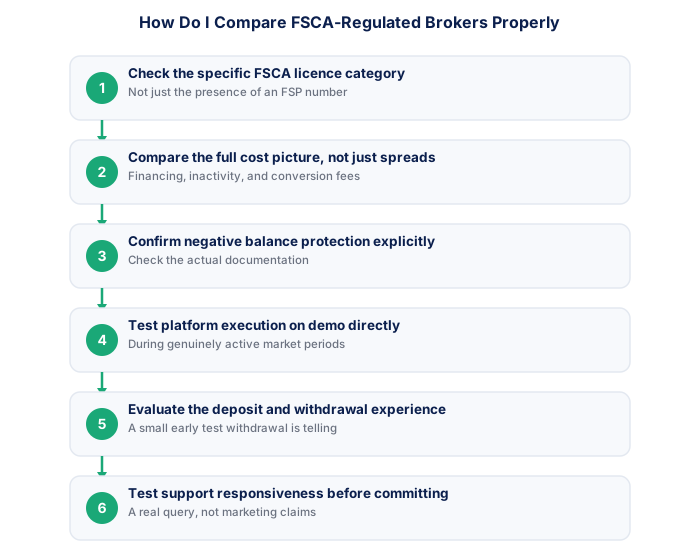
1. Start with the licence category, not just the FSP number
Confirm not just that a broker holds an active FSP number, but which specific licence category it holds on the FSCA register, since this determines what activities the broker is actually authorised to conduct, and whether any conditions or restrictions are attached to that specific licence.
The FSCA register displays this detail directly, a broker's marketing material claiming general "FSCA regulation" without this specific detail being independently verifiable should be treated with some caution.
2. Look beyond advertised spreads to the full cost picture
Advertised "spreads from" figures typically represent the best-case scenario under ideal market conditions, and actual spreads during normal or volatile trading can differ substantially. Checking a broker's live spread on your specific instruments of interest, during your typical trading hours, gives a more realistic picture.
See also: An Account Inactivity Period vs Dormancy
Beyond spreads, compare overnight financing charges, inactivity fees, withdrawal fees, and any currency conversion costs specific to your account currency, since these secondary costs can add up depending on your trading style and holding periods.
- Search FSP name or number at fsca.co.za
- Confirm licence is current and not suspended
- Check scope covers forex and CFD activity
- Confirm client funds in segregated accounts
- Read FSCA enforcement actions history
- Test customer support before depositing
- Client funds legally segregated
- FSCA complaints process available
- SA consumer protections apply
- ZAR account, no FX conversion costs
- Some offshore brokers offer wider instruments
- Regulatory overhead passed on in spreads
- Stricter position limits for retail clients
- FICA verification required before trading
- Client funds segregated
- Formal FSCA complaints process
- SA consumer protections apply
- ZAR account available
- Fund safety not guaranteed
- Overseas disputes only
- SA law does not apply
- Currency conversion costs
3. Confirm negative balance protection explicitly
While common among FSCA-regulated brokers, negative balance protection is not universally guaranteed by regulation alone, so confirm this specific protection directly in the broker's terms and conditions or product disclosure documents before committing real capital, rather than assuming it applies.
Some brokers offer this protection as standard across all account types, while others may apply it only to certain account tiers or under certain conditions, so read the specific documentation rather than relying on general industry assumption.
4. Test platform reliability and execution quality directly
A demo account is the most practical way to assess a broker's platform stability, order execution speed, and general usability before committing real capital, particularly testing execution during active market periods rather than only during quiet sessions.
Independent, non-broker-affiliated reviews and trading community discussions can provide useful additional perspective on real-world execution quality and any recurring platform issues, complementing rather than replacing your own direct testing.
| Protection | FSCA Regulated | Offshore Unregulated |
|---|---|---|
| Client fund segregation | ✓ Required | Varies by broker |
| SA complaints process | ✓ Available | ✗ Not available |
| SA consumer law applies | ✓ Yes | ✗ No |
| ZAR account available | ✓ Typically | Often USD/EUR only |
5. Evaluate the deposit and withdrawal experience specifically
Deposit speed is generally straightforward to assess directly. Withdrawal experience is harder to judge in advance, but checking independent trader reports specifically about withdrawal processing time and any reported friction is a meaningfully useful signal, since this is one of the more common sources of genuine broker complaints.
A small test withdrawal early in your relationship with a new broker, rather than only after a significant balance has built up, is a practical way to confirm this process works as expected before it matters more.
6. Weighing support quality and responsiveness
Testing a broker's support responsiveness directly before committing, a genuine query submitted through their stated channels during your evaluation period, gives a more reliable picture than any claim made in marketing material about "24/7 support" or similar.
Consider also whether support is available in a way that suits your practical needs, live chat versus email-only, local versus offshore support hours, since this affects how quickly a genuine issue can actually be resolved when it eventually arises.
The FSCA regulatory framework provides South African retail traders with meaningful protection that includes segregated client funds, mandatory disclosure requirements, and a formal complaints process backed by regulatory enforcement. Traders considering offshore brokers outside the FSCA framework should evaluate whether the incremental instrument access or other benefits justify the loss of these domestic regulatory protections, particularly for higher deposit amounts where the downside of unregulated broker failure would be material.
★ Why It Matters
Worth building a simple personal comparison table across your shortlist of two or three brokers, covering licence category, protections, costs, and your own demo testing notes, rather than relying on memory or marketing pages alone when making the final decision.
✕ Common mistakes
- Comparing brokers only on advertised 'spreads from' figures. Actual spreads during normal conditions often differ from best-case marketing figures.
- Assuming negative balance protection applies universally without checking. This varies by broker and sometimes by account tier; confirm it explicitly in the documentation.
- Skipping a demo test of actual execution quality before committing capital. Marketing claims about platform performance are not a substitute for direct testing.
- Only testing withdrawals after a significant balance has accumulated. A small early test withdrawal reveals process friction before it matters more.
How do I verify a broker is actually FSCA-licensed?
Search the broker's company name or FSP number on the FSCA public register at fsca.co.za. Confirm the licence is current, not suspended, and covers the specific category of financial services the broker provides.
What is a FSP number and where do I find it?
A FSP (Financial Services Provider) number is the unique identifier assigned to each FSCA-licensed entity. It appears on the broker's website and marketing materials and can be verified directly on the FSCA register.
When evaluating whether a broker is appropriate for South African retail trading, the FSCA public register provides the starting point, but the quality of regulatory compliance goes beyond simply holding a licence. Checking how long the broker has been licensed, whether there are any enforcement actions in their history, and what the FSCA inspection record shows, if available, provides a more complete picture than the licence alone. South African financial consumer bodies periodically publish guidance on broker evaluation that supplements the FSCA register as a due diligence resource.
South African traders choosing between locally-based and internationally-based brokers should weigh FSCA regulatory protection, rand deposit convenience, and ZAR account access against the potentially broader instrument range of some offshore providers. Most South African retail traders' needs are well served by FSCA-regulated brokers who maintain segregated client funds and provide ZAR accounts with EFT deposit and withdrawal support. For traders who specifically need instruments not available through FSCA-regulated providers, verifying the offshore broker's regulation through its home regulator's public register is the essential due diligence step before depositing.
Key Takeaways
- Properly comparing FSCA-regulated brokers means going beyond advertised spreads to check the specific licence category held, negative balance protection, platform reliability, deposit and withdrawal experience, and how the broker's support actually performs, not just its marketing claims.
- Start with the licence category, not just the FSP number.
- Look beyond advertised spreads to the full cost picture.
- Confirm negative balance protection explicitly.
- Test platform reliability and execution quality directly.
Frequently asked follow-up questions
Does a higher FSCA licence category always mean a better broker?
Not necessarily better in every practical sense, but it does indicate a different scope of authorised activity; the right category depends on what services you actually need from the broker.
How many brokers should I realistically compare before choosing?
A shortlist of two to three brokers, compared in genuine depth including demo testing, is generally more useful than a shallow comparison across many more options.
Is it worth switching brokers if I find a better comparison result later?
This depends on your existing broker's actual performance for you specifically; switching has its own transition costs and effort, worth weighing against the genuine, demonstrated benefit of the alternative.
