i Short answer
A pending order executes automatically when price reaches a level you specify in advance, unlike a market order, which executes immediately at the current price.
Pending orders let you plan trades without requiring continuous, active monitoring.
📋 ON THIS PAGE
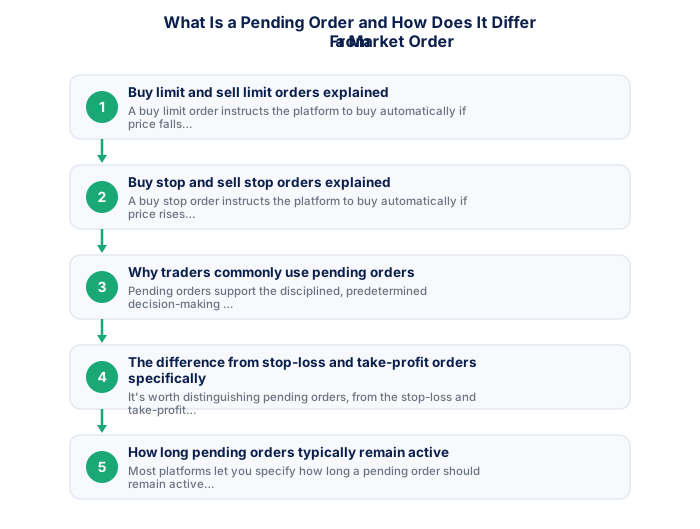
1. Buy limit and sell limit orders explained
A buy limit order instructs the platform to buy automatically if price falls to a specified level below the current price, useful if you believe an instrument is currently priced too high but would represent a good entry opportunity at a lower, specified level. A sell limit order instructs the platform to sell automatically if price rises to a specified level above the current price, useful if you believe price is currently too low but would represent a good shorting opportunity once it rises to your specified, more favourable level.
Limit orders, by design, aim to get you a more favourable price than the current market price, buying lower or selling higher than where price currently sits, which is precisely why they're called "limit" orders, since they specify a price limit beyond which you're not willing to transact.
A useful way to remember the naming logic: a limit order always waits for price to move to a more favourable level before executing, which is exactly why it can never guarantee execution at all, if price never reaches your specified level, the order simply expires unfilled, and the more favourable entry you were hoping for never actually materialised.
2. Buy stop and sell stop orders explained
A buy stop order instructs the platform to buy automatically if price rises to a specified level above the current price, useful for strategies betting on continued upward momentum once a certain breakout level is reached, rather than trying to catch a lower entry. A sell stop order instructs the platform to sell automatically if price falls to a specified level below the current price, useful for strategies betting on continued downward momentum once a certain breakdown level is reached.
Stop orders, unlike limit orders, generally accept a less favourable price than the current market price specifically because the strategy logic behind them values confirming a certain momentum or breakout condition over getting the absolute best possible entry price, this reflects a genuinely different strategic logic than limit orders, despite both being pending order types.
- FSCA-regulated broker verified at fsca.co.za
- Demo account tested for minimum 60 days
- Trading plan written: entry, exits, position sizing
- Risk per trade defined (1-2% of account)
- Backup internet connection tested for load shedding
- Tax implications understood
This trade-off is worth stating plainly: a stop order accepts a worse price in exchange for confirmation that the move is genuinely underway, while a limit order holds out for a better price at the risk of that level never being reached at all. Neither approach is universally correct, the right choice depends entirely on whether your specific strategy is built around anticipating a reversal or confirming a continuation.
3. Why traders commonly use pending orders
Pending orders support disciplined, predetermined decision-making, identifying a specific price level worth acting on during your structured analysis session, and setting a pending order to execute automatically if that level is reached, rather than requiring continuous active monitoring waiting for that specific level to occur.
This directly supports the kind of time-bounded, structured trading routine particularly suited to traders balancing trading with full-time work or other significant commitments, since pending orders let your analysis translate into action even during periods you're not actively watching the markets.
This is particularly valuable for traders who've identified a specific, well-reasoned setup during a dedicated analysis session but can't realistically watch the market continuously waiting for it to trigger. A pending order effectively lets your earlier, careful analysis execute itself later, without requiring you to be present at the exact moment conditions align.
4. The difference from stop-loss and take-profit orders specifically
It's worth distinguishing pending orders from stop-loss and take-profit orders. Pending orders are used to open a new position once a specified condition is met, while stop-loss and take-profit orders are used to close an existing, already-open position once a specified condition is met. Both types share the same underlying mechanism (automatic execution based on a predetermined price level), but serve genuinely different functions within your overall trading approach.
Understanding this distinction clearly helps avoid confusion when discussing or reading about these related but functionally different order types, since both fall under the broader category of conditional, automatically-executing orders despite serving these distinct entry-versus-exit purposes.
| Item | Detail |
|---|---|
| Regulator | FSCA, fsca.co.za |
| Exchange control | SARB, resbank.co.za |
| Tax authority | SARS, sars.gov.za |
| JSE hours | 09:00-17:00 SAST Mon-Fri |
| Best forex session | 15:00-17:00 SAST |
| CGT annual exclusion | R50,000 (individuals) |
A simple way to keep this straight: pending orders answer the question 'when should I get in,' while stop-loss and take-profit orders answer 'when should I get out.' Both rely on the same automatic, condition-triggered mechanism, but applying that mechanism to entirely different stages of a trade's lifecycle.
5. How long pending orders typically remain active
Most platforms let you specify how long a pending order should remain active before automatically expiring if the specified price level is never reached, options typically include "good till cancelled" (remaining active indefinitely until manually removed or executed) or a specific expiration date and time after which the order automatically cancels if not yet triggered.
Choosing an appropriate expiration setting connects to your broader strategy logic, a pending order based on a specific, time-sensitive technical setup might warrant a shorter expiration, while one based on a longer-term support or resistance level might reasonably remain active for a longer period without expiring prematurely.
It's worth actively reviewing any 'good till cancelled' pending orders periodically, rather than setting them and forgetting about them indefinitely. Market conditions and your own analysis can change meaningfully over time, and a pending order based on stale reasoning from weeks or months earlier may no longer reflect a setup you'd actually want to act on if it triggered today.
6. Practical scenarios illustrating when to use each order type
A trader anticipating a price pullback to a specific support level before resuming an uptrend might use a buy limit order at that support level, aiming to enter at this more favourable, lower price. A trader instead waiting for confirmation of a breakout above resistance before entering, believing the breakout itself signals genuine continued momentum, might use a buy stop order placed just above that resistance level, accepting a slightly higher entry price specifically in exchange for this breakout confirmation.
These contrasting scenarios illustrate how the same broader pending order concept supports genuinely different strategic approaches, the choice between limit and stop orders should reflect your specific strategy's underlying logic and what you're actually trying to achieve with that particular trade entry, rather than being an arbitrary technical choice disconnected from your broader analytical reasoning.
Which order type you use also affects what you pay. A market order crosses the spread immediately, and in fast conditions it can fill at a worse price than the one on screen.
A pending order executes automatically when price reaches your level.
A market order fills immediately at whatever the current price is. A pending order sits waiting and executes automatically when price reaches your predetermined level, with no need to monitor.
★ Why It Matters
Worth setting up deliberately as a habit: place your stop-loss and take-profit as part of the same action that opens the position, not as a separate step afterward, a brief gap between opening a position and setting its safeguards is exactly when an unexpected price move can catch you unprotected.
✕ Common mistakes
- Assuming a pending order is guaranteed to execute at the exact specified price. Gaps and fast-moving conditions can still affect the actual fill.
- Leaving pending orders active indefinitely without review. Market conditions can shift significantly before a forgotten order eventually triggers.
- Not understanding how your broker specifically handles a price gap through a pending level. Fill behaviour in this scenario varies by broker.
Key Takeaways
- A pending order executes automatically when price reaches a specified level, unlike a market order which executes immediately. Learn the different types.
- A pending order executes automatically when price reaches a level you specify in advance, unlike a market order, which executes immediately at the current price.
- Pending orders let you plan trades without requiring continuous, active monitoring.
- Buy limit and sell limit orders explained.
- Buy stop and sell stop orders explained.
See also: What Is Support and Resistance and How Do I Identify It?.
Frequently asked follow-up questions
Can I have multiple pending orders active simultaneously?
Yes, most platforms support multiple simultaneous pending orders across different instruments or even different specific levels on the same instrument, depending on your specific strategy's needs.
Do pending orders guarantee execution at exactly my specified price?
Generally yes for limit orders under normal conditions, though stop orders and even limit orders can experience slippage during fast-moving or low-liquidity market conditions.
Can I modify a pending order after placing it but before it triggers?
Yes, most platforms allow adjusting the price level, expiration, or other parameters of a pending order at any point before it actually executes or expires.
