i Short answer
Building genuine technical analysis skill requires combining structured learning of core concepts with extensive, deliberate chart practice, ideally backed by genuine backtesting.
📋 ON THIS PAGE
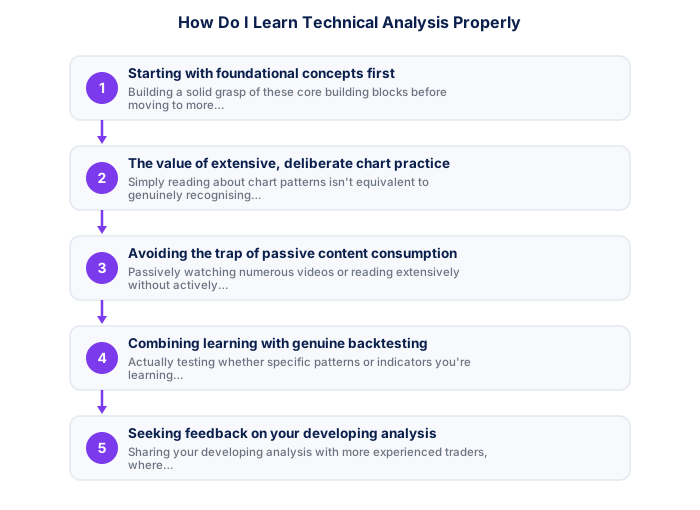
1. Starting with foundational concepts first
Building a solid grasp of core building blocks like support and resistance and trend identification before moving to more complex tools or patterns gives a more stable, genuinely understood foundation for further learning.
It's worth resisting the temptation to jump toward more visually impressive, complex indicators before this foundation feels genuinely solid, the more advanced tools generally build on and interpret the same underlying price action that support and resistance and trend identification already capture, skipping ahead tends to produce a shakier, less intuitive overall understanding.
2. The value of extensive, deliberate chart practice
Simply reading about chart patterns isn't equivalent to genuinely recognising them reliably in real-time, live market conditions. Extensive, deliberate practice actually analysing real charts builds this practical recognition skill considerably more effectively than theory alone.
It's worth setting aside dedicated, regular time specifically for this practice, treating it as seriously as any other skill-building activity, rather than assuming casual, occasional chart-glancing during normal trading will build the same depth of pattern recognition that focused, deliberate practice provides.
- Quantifiable rules remove subjectivity
- Backtestable on historical data
- Works consistently when edge is genuine
- Clear entry/exit criteria reduce hesitation
- Past performance does not guarantee future results
- Risk of overfitting to historical data
- Market regimes change, edges decay
- Requires discipline through drawdown periods
- Price and volume patterns
- Works on any liquid instrument
- Faster to learn basics
- Ignores fundamental context
- Economic and financial data
- Better for longer timeframes
- Deeper knowledge required
- Ignores entry precision
3. Avoiding the trap of passive content consumption
Passively watching numerous videos or reading extensively without actively practising analysis yourself can create a false sense of competence that doesn't translate into genuine, demonstrated practical skill.
It's worth pairing every piece of educational content you consume with immediate, hands-on application, pulling up a chart and identifying the concept you just learned in real, current price action closes the gap between passive familiarity and genuine, applied understanding.
- Written entry/exit rules with zero ambiguity
- Backtested on minimum 3 years of data
- Walk-forward tested on out-of-sample data
- SA-specific events included in test period
- Maximum drawdown within personal tolerance
- 100+ live demo trades with consistent performance
4. Combining learning with genuine backtesting
Actually testing whether specific patterns or indicators you're learning genuinely produce a statistical edge, rather than simply assuming they work because they're commonly taught, develops both technical skill and important critical evaluation ability simultaneously.
It's worth doing this verification specifically for each new concept as you learn it, rather than accumulating a large collection of untested techniques and only backtesting later, testing incrementally as you go helps you build a personal, evidence-based sense of which specific tools genuinely add value for your particular approach.
| Win rate | 1:1 RR | 1.5:1 RR | 2:1 RR |
|---|---|---|---|
| 40% | Losing | Break even | Profitable |
| 50% | Break even | Profitable | Profitable |
| 55% | Profitable | Profitable | Profitable |
| 60% | Profitable | Profitable | Profitable |
5. Seeking feedback on your developing analysis
Sharing your developing analysis with more experienced traders, whether through trading communities or a genuine mentor, where genuinely available and trustworthy, can provide valuable feedback accelerating your learning beyond self-study alone.
It's worth being genuinely open to critical feedback specifically, rather than seeking only validation, feedback that only confirms what you already believe adds little to your development, while honest, even uncomfortable critique from someone with genuine experience tends to accelerate learning considerably more.
6. A realistic timeline for this skill development
Genuine technical analysis proficiency typically develops over months of sustained, deliberate practice rather than quickly through a short course alone, making patience and consistent effort important throughout this process.
The quality of trading education available to South African traders has improved substantially with the growth of FSCA-regulated broker educational content and global online resources. The critical evaluation skill, separating genuinely educational content from thinly disguised marketing for signals, courses, or investment schemes, is as important as the content itself. South African traders should additionally prioritise educational resources that address SA-specific topics including ZAR trading dynamics, SARB policy implications, FSCA regulatory requirements, and SARS tax treatment, since virtually all internationally produced trading education was created without these local dimensions in mind.
The transition from demo to live trading is one of the most psychologically significant steps in a trader's development, and the gap between demo performance and early live performance is a well-documented phenomenon. The primary driver is emotional: real capital at risk changes decision-making in ways that are invisible during demo trading. Common manifestations include premature exit from winning positions to lock in profit, reluctance to enter valid setups due to fear, and difficulty accepting losses that felt mechanical on demo but feel painful with real money. The practical solution is to start live trading with an amount small enough that the monetary amounts do not produce strong emotional reactions while still requiring genuine real-money decision-making. Starting with one to three months of discretionary income is a useful benchmark for calibrating this initial live capital.
Actually testing whether specific concepts work builds genuine skill.
Simply consuming educational content has real limits. Actually testing whether specific technical analysis concepts genuinely work through your own backtesting builds far more durable skill.
A trading strategy that has not been tested against South African market conditions may behave differently than its global performance suggests. USD/ZAR's sensitivity to domestic political events, load shedding, and SARB rate decisions creates volatility patterns that global backtesting databases may not fully capture. Including specific SA-market periods in any strategy evaluation, such as the March 2020 COVID and Moody's downgrade period, the 2024 election run-up, and sustained Stage 6 load shedding intervals, provides a more realistic assessment of how the strategy will perform under conditions that South African traders regularly experience.
Evaluating trading educational content requires applying the same critical standards you would apply to any financial information source. The most valuable resources are those that focus on process, risk management, and psychological frameworks rather than those that primarily promise profits or specific returns. South African traders should additionally prioritise content that addresses SA-specific regulatory, tax, and market context, since most international trading education was produced without South African exchange control, SARS tax treatment, or ZAR-specific market conditions in mind.
★ Why It Matters
A sequencing detail that seems to matter more than people expect: learning to read raw price action on a blank chart before adding any indicators tends to produce a more durable understanding than starting with an indicator-heavy setup, since indicators are just derivatives of the price you haven't learned to read yet.
✕ Common mistakes
- Studying concepts without ever practising on real charts. Practical chart time builds pattern recognition theory alone can't provide.
- Assuming more indicators automatically means better analysis. Excess indicators often create conflicting signals and confusion.
- Skipping backtesting once a pattern seems intuitively reliable. See backtesting as the step that actually validates intuition.
Key Takeaways
- Building genuine technical analysis skill requires combining structured learning with extensive deliberate chart practice, ideally backed by real testing.
- Building genuine technical analysis skill requires combining structured learning of core concepts with extensive, deliberate chart practice, ideally backed by genuine backtesting.
- Starting with foundational concepts first.
- The value of extensive, deliberate chart practice.
- Avoiding the trap of passive content consumption.
Frequently asked follow-up questions
Should I learn multiple technical analysis approaches at once or focus on one?
Many educators suggest focusing deeply on understanding one or two approaches thoroughly first, rather than superficially learning many approaches without genuine depth.
Is it better to learn technical analysis through paid courses or free resources?
Both can give genuine value. The quality and your own active engagement matter more than whether the specific resource is paid or free.
Can demo account practice substitute for genuine backtesting?
These serve somewhat different purposes. Demo accounts build live execution familiarity, while backtesting specifically validates whether your analysis approach has genuine historical statistical merit.
How do I know when I've genuinely learned technical analysis versus just memorised patterns?
Genuine learning typically shows in your ability to correctly identify and reason through patterns in entirely new, unfamiliar charts, rather than simply recognising previously memorised specific examples.
Should I focus on technical analysis exclusively, or also learn fundamental analysis?
This depends on your chosen strategy approach. Some traders combine both, while others focus predominantly on one approach based on their particular style.
