i Short answer
Paper trading manually records hypothetical trades, often in a journal or spreadsheet, without any actual trading platform involvement.
Demo trading uses an actual broker platform with simulated funds in a realistic environment, a step most traders take before eventually moving to live trading.
📋 ON THIS PAGE
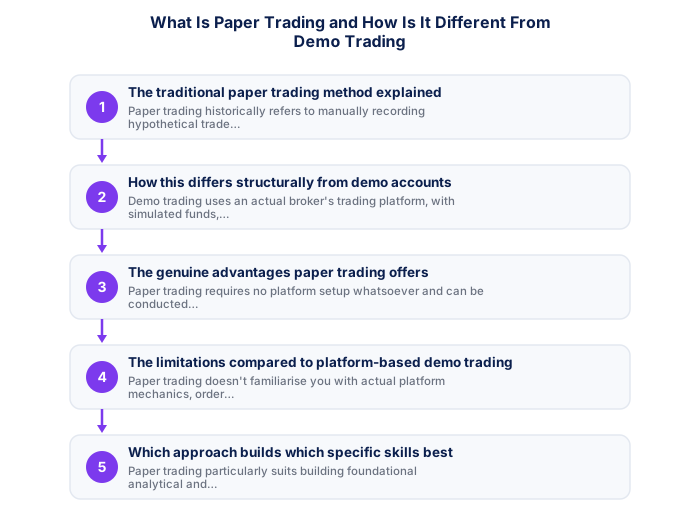
1. The traditional paper trading method explained
Paper trading historically refers to manually recording hypothetical trade decisions, entry price, stop-loss, take-profit, reasoning, in a written journal or simple spreadsheet, then later checking actual market data to determine what would have happened, without any platform actually executing or tracking these decisions automatically.
It's worth appreciating the genuine origin of this term, before electronic trading existed, tracking hypothetical trades literally meant writing them down on paper, the name has persisted even though the practice today often happens in a spreadsheet or notebook app rather than literal paper.
| Feature | Paper Trading | Demo Trading |
|---|---|---|
| Platform used | Manual tracking, spreadsheet or notebook | Actual broker platform |
| Live pricing | No | Yes |
| Builds platform familiarity | No | Yes |
| Flexibility for reflective analysis | Higher | Lower |
2. How this differs structurally from demo accounts
Demo trading, by contrast, uses an actual broker's trading platform with simulated funds, automatically tracking and executing your decisions exactly as a live account would, including live pricing, spread costs, and platform-specific order types and functionality.
It's worth appreciating this fundamental structural difference clearly, a demo account genuinely simulates the platform experience with live pricing, while paper trading is simply your own manual tracking of hypothetical decisions, considerably more basic but also more flexible in certain ways.
- 100+ demo trades completed with consistent rules
- Positive expectancy over full demo sample
- Every demo trade documented in journal
- Written trading plan: entry, exit, position sizing
- FSCA-regulated broker chosen and FSP verified
- Starting capital is genuinely disposable
- Backup connectivity tested
Open a demo
Choose an FSCA-regulated broker. Start with R50,000-R100,000 virtual capital.
Write trading rules
Define entry criteria, stop-loss method, and position sizing in writing.
Trade 2-3 months
Complete at least 50-100 trades across varied market conditions.
Journal everything
Record rationale, emotion, and outcome for every trade.
Evaluate objectively
Move to live only when consistent rule-following meets your benchmark.
3. The genuine advantages paper trading offers
Paper trading requires no platform setup whatsoever and can be conducted using just a notebook or basic spreadsheet, making it genuinely accessible for very early-stage practice before you've even selected or set up a specific broker, supporting initial pattern-recognition practice with minimal barrier to entry.
It's worth using this flexibility deliberately for specific analytical purposes, discussed elsewhere on this site regarding backtesting generally, paper trading's manual nature actually suits certain kinds of deliberate, reflective strategy testing better than a fast-paced, live demo environment might.
4. The limitations compared to platform-based demo trading
Paper trading doesn't familiarise you with actual platform mechanics, order placement workflow, or genuinely realistic spread and execution conditions the way demo trading does. This means paper trading alone leaves an important gap in practical, platform-specific skill development that eventually needs addressing before live trading.
It's worth being honest about this genuine gap, paper trading doesn't build the specific platform familiarity and mechanical execution comfort that demo trading provides, worth using paper trading for strategy validation specifically rather than as a substitute for genuine platform practice.
5. Which approach builds which specific skills best
Paper trading particularly suits building the kind of foundational analytical and pattern-recognition skill that properly learning technical analysis requires, while demo trading particularly suits building platform familiarity, execution confidence, and genuine, if simulated, emotional engagement with live market conditions.
It's worth matching your chosen method to your specific current learning goal, rather than assuming one approach is universally superior, discussed elsewhere on this site regarding structured learning progressions, different stages of your development genuinely benefit from different specific practice methods.
One of the most common mistakes among new traders in South Africa is underestimating the learning period required before live trading becomes appropriate. Most successful retail traders report spending six months to two years on education, demo trading, and small-account live trading before reaching any form of consistency. This investment of time before scaling up capital is not a barrier to entry but a risk management practice that protects capital from being lost during the steepest part of the learning curve.
6. A sensible combined approach using both methods
Many traders benefit from starting with paper trading for very early, low-commitment analytical practice, then transitioning to demo trading once ready to build platform-specific and execution-related skills, before eventually progressing toward live trading once genuine readiness has been demonstrated through this combined practice sequence.
The transition from demo to live trading is one of the most psychologically significant steps in a trader's development, and the gap between demo performance and early live performance is a well-documented phenomenon. The primary driver is emotional: real capital at risk changes decision-making in ways that are invisible during demo trading. Common manifestations include premature exit from winning positions to lock in profit, reluctance to enter valid setups due to fear, and difficulty accepting losses that felt mechanical on demo but feel painful with real money. The practical solution is to start live trading with an amount small enough that the monetary amounts do not produce strong emotional reactions while still requiring genuine real-money decision-making. Starting with one to three months of discretionary income is a useful benchmark for calibrating this initial live capital.
Demo trading uses a platform that simulates execution on live prices.
Paper trading uses any medium to record hypothetical trades manually against real prices, with no platform execution. Demo trading uses a broker's platform that simulates execution, offering platform practice that paper trading doesn't.
★ Why It Matters
Worth doing if you choose paper trading: record your hypothetical entries in real time, not retrospectively at the end of the day. Entries logged after you already know what happened next are subtly, often unconsciously, more favourable than genuine real-time decisions would have been.
✕ Common mistakes
- Assuming paper trading replicates the same experience as demo trading. The absence of an actual platform changes the practical learning involved.
- Not being equally disciplined with paper trading as you would with real money. Casual paper trading produces an unreliable read on actual readiness.
- Treating paper trading results as directly comparable to live trading statistics. The lack of real consequence changes decision-making in ways worth acknowledging.
Can I practise this on a demo first?
Yes, on live prices, but execution is simulated: slippage, rejection and partial fills do not appear. Demo against live covers the gap.
How long should I use a demo before switching to live trading?
Trade on demo for at least two to three months across varied market conditions with consistent rule-following before switching to a live account. The quality and consistency of practice matters more than the total time spent.
Key Takeaways
- Paper trading manually records hypothetical trades without any platform involvement, while demo trading uses an actual broker platform with simulated funds.
- Paper trading manually records hypothetical trades, often in a journal or spreadsheet, without any actual trading platform involvement.
- Demo trading uses an actual broker platform with simulated funds in a realistic environment.
- The traditional paper trading method explained.
- How this differs structurally from demo accounts.
See also: How Do I Evaluate Trading-Related Online Courses With Certificates? and What Is the Value of Paper Trading Competitions?.
Frequently asked follow-up questions
Can paper trading be done digitally rather than on actual paper?
Yes, many traders use a spreadsheet or simple note-taking app rather than literal paper; the term refers to the manual, non-platform-based method rather than requiring physical paper specifically.
Is paper trading less valuable than demo trading?
Not less valuable, but serving a different purpose. Both have genuine roles within a complete learning approach.
Should complete beginners start with paper trading or demo trading?
Either can work as a starting point. Some begin with paper trading for initial, low-commitment practice before moving to the more platform-realistic demo trading.
