i Short answer
The National Treasury manages fiscal policy and government debt issuance, working alongside but distinctly from SARB's monetary policy mandate.
📋 ON THIS PAGE
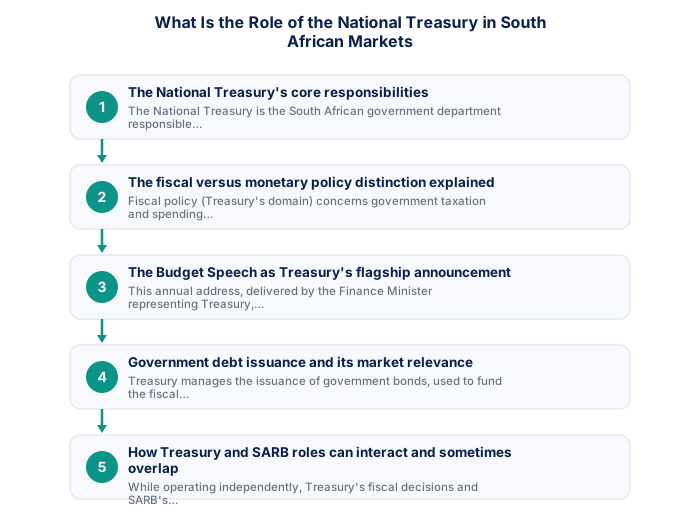
- The National Treasury's core responsibilities
- The fiscal versus monetary policy distinction explained
- The Budget Speech as Treasury's flagship announcement
- Government debt issuance and its market relevance
- How Treasury and SARB roles can interact and sometimes overlap
- Why understanding this distinction helps traders specifically
1. The National Treasury's core responsibilities
The National Treasury is the South African government department responsible for managing public finances, including preparing the annual Budget, managing government debt issuance, and overseeing broader fiscal policy implementation across government departments.
It's worth understanding Treasury as the government's fiscal management arm specifically, discussed alongside the Budget Speech elsewhere on this site, responsible for how government raises and spends money, genuinely distinct from SARB's separate monetary policy role.
See also: EUR/USD: Why Is It the Most Traded Pair?
See also: How Can SA Investors Use Forex to Hedge Rand Risk?
See also: How Does SA Household Debt Affect Traders and JSE?
See also: How Does the Mining Charter Affect JSE Mining Shares?
See also: How Do I Read an Economic Calendar in South African Time?
See also: What Does Pending Order Mean in Trading?
See also: How Does Trading the VIX or Volatility Index Products Wor
2. The fiscal versus monetary policy distinction explained
Fiscal policy (Treasury's domain) concerns government taxation and spending decisions, while monetary policy (SARB's domain) concerns interest rates and money supply management, these represent genuinely separate policy levers, each institution operating independently within its own specific mandate, even though both ultimately affect the broader economy and currency.
It's worth internalising this distinction clearly, since it's genuinely foundational to understanding South African economic policy generally, fiscal policy, government spending and taxation decided by Treasury, and monetary policy, interest rates set by SARB, discussed throughout this site, operate through entirely different mechanisms.
- SARB economic calendar checked for the week
- Next Eskom load shedding schedule reviewed
- GNU stability news reviewed
- Stats SA data releases noted
- Credit agency review dates checked
- US/global events that move EM risk noted
3. The Budget Speech as Treasury's flagship announcement
This annual address, delivered by the Finance Minister representing Treasury, serves as the department's flagship, most closely-watched announcement, presenting the government's fiscal plans and figures directly to Parliament and the broader public.
It's worth treating this specific announcement as your primary window into Treasury's thinking and priorities, discussed in more detail elsewhere on this site regarding the Budget Speech specifically, this single event concentrates most of Treasury's market-relevant communication into one scheduled moment each year.
| Event | Frequency | ZAR impact | Source |
|---|---|---|---|
| SARB MPC | 6x per year | High | resbank.co.za |
| Budget Speech | Annual (February) | Very high | treasury.gov.za |
| Credit reviews | Annual each agency | Very high | Agency sites |
| Stats SA CPI | Monthly | Medium | statssa.gov.za |
| Eskom stage | As needed | Low-medium | eskomsepush.com |
- SA context provides genuine informational edge
- ZAR pairs accessible via FSCA brokers in ZAR accounts
- Rand volatility creates larger intraday ranges
- 6 SARB meetings/year create regular macro setups
- Higher geopolitical risk than G10 pairs
- Load shedding creates unique operational disruptions
- SA rand liquidity thinner than major G10 pairs
- SA-specific news requires constant local monitoring
4. Government debt issuance and its market relevance
Treasury manages the issuance of government bonds, used to fund the fiscal deficit, with investor demand for and pricing of these bonds carrying relevance to broader South African financial market conditions and indirectly to currency sentiment, given the connection between government borrowing costs and broader fiscal sustainability.
It's worth connecting this directly to the bond market discussion elsewhere on this site, Treasury's debt issuance decisions directly shape the South African government bond market that international investors and the Rand's broader fundamentals both depend on.
5. How Treasury and SARB roles can interact and sometimes overlap
While operating independently, Treasury's fiscal decisions and SARB's monetary policy decisions, can interact meaningfully, for example, significant fiscal deficit concerns can sometimes create pressure that interacts with SARB's own separate inflation and interest rate considerations, even though each institution maintains its own distinct, independent decision-making authority within its respective mandate.
It's worth appreciating why coordination between these two genuinely independent institutions matters for overall economic stability, even though their specific tools and mandates remain formally separate, their respective decisions inevitably influence the same broader economic environment.
6. Why understanding this distinction helps traders specifically
Understanding this institutional distinction helps South African traders correctly attribute specific scheduled announcements and policy developments to the appropriate institution and policy domain, supporting more accurate, well-organised fundamental analysis, rather than conflating fiscal and monetary policy developments as though they originated from a single, undifferentiated source.
South Africa's macroeconomic data is closely monitored by international rating agencies and institutional investors whose assessments directly affect the rand and SA bond yields. The most useful analytical habit for ZAR traders is tracking not just the absolute level of each data release but how it compares to market consensus expectations, because it is the surprise component, not the level, that drives the immediate market reaction. The Stats SA release calendar, SARB quarterly bulletin, and National Treasury's monthly statements are the primary official sources for this data before it is summarised in financial media.
The SARB manages monetary policy and the inflation target.
National Treasury manages the government budget and fiscal policy, most visible in the annual Budget Speech. The SARB manages monetary policy and the inflation target independently, setting the repo rate.
★ Why It Matters
Worth distinguishing : Treasury's bond issuance decisions affect government borrowing costs directly, while SARB's repo rate affects broader economy-wide borrowing costs, these two institutions influence markets through genuinely different, complementary channels worth tracking separately.
✕ Common mistakes
- Confusing Treasury's fiscal role with SARB's monetary policy mandate. These are genuinely separate, complementary functions, not interchangeable institutions.
- Assuming bond issuance and interest rate decisions come from the same body. Treasury manages government debt issuance; SARB sets the repo rate independently.
- Treating Treasury announcements and SARB announcements as equally relevant to identical market questions. Each institution's announcements matter for different aspects of market analysis.
- Not distinguishing fiscal policy from monetary policy when assessing Rand impact. These operate through different mechanisms and warrant separate tracking.
Key Takeaways
- The National Treasury manages fiscal policy and government debt issuance, working alongside but distinctly from SARB's separate monetary policy mandate.
- The National Treasury manages fiscal policy and government debt issuance, working alongside but distinctly from SARB's monetary policy mandate.
- The National Treasury's core responsibilities.
- The fiscal versus monetary policy distinction explained.
- The Budget Speech as Treasury's flagship announcement.
See also: How Does NHI Uncertainty Affect JSE Healthcare Stocks?.
Frequently asked follow-up questions
Does the National Treasury set interest rates?
No, this is specifically SARB's mandate. Treasury's role concerns fiscal policy, while SARB maintains independent authority over monetary policy decisions.
Who currently leads the National Treasury?
This is a current leadership position that can change; checking current South African government sources provides the most accurate, up-to-date information on this specific role.
Can Treasury and SARB ever disagree on economic policy direction?
These institutions maintain independent mandates and can have different perspectives reflecting their distinct fiscal and monetary policy responsibilities, though both ultimately aim to support broader South African economic stability.
