i Short answer
South African political developments affecting policy stability, governance quality, and investor confidence can weigh on or support the Rand, alongside more directly economic drivers like SARB policy.
📋 ON THIS PAGE
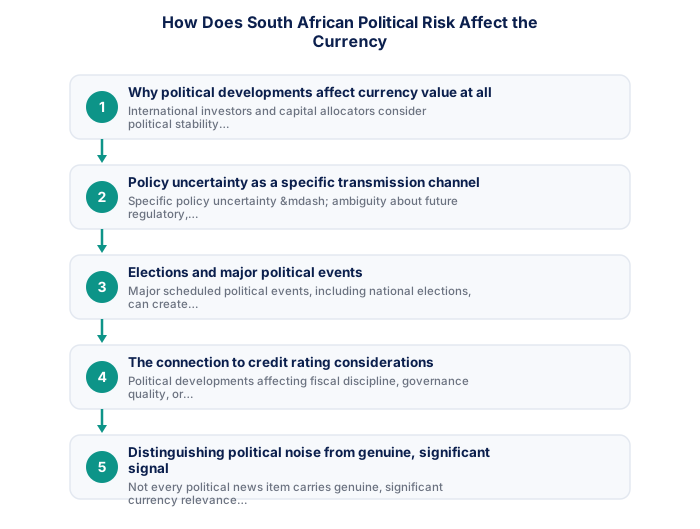
- Why political developments affect currency value at all
- Policy uncertainty as a specific transmission channel
- Elections and major political events specifically
- The connection to credit rating considerations
- Distinguishing political noise from genuine, significant signal
- How traders incorporate this factor practically into analysis
1. Why political developments affect currency value at all
International investors and capital allocators consider political stability and governance quality as part of their broader risk assessment when deciding whether and how much to invest in any specific country's assets, including currency-denominated holdings. Political developments that raise or reduce perceived risk in this broader assessment can correspondingly affect international capital flows and, by extension, currency demand.
It's worth understanding this mechanism as fundamentally about confidence and predictability rather than any specific political ideology, international capital generally favours environments where policy direction feels reasonably stable and predictable, regardless of the particular political character of that stability, worth keeping this distinction in mind when interpreting market reactions.
Moving a stop wider when price approaches it converts a defined risk into an undefined one. This single error causes a disproportionate share of large retail losses.
For related context, see monitoring GNU coalition stability, the GNU requires a specific monitoring framework.
For related context, see South African public sector strikes, mining and public sector strikes are recurring ZAR risk events.
2. Policy uncertainty as a specific transmission channel
Specific policy uncertainty, ambiguity about future regulatory, fiscal, or broader economic policy direction, can weigh on investor confidence independent of any single specific policy's actual content, since investors generally prefer predictability when assessing risk, and genuine uncertainty about future direction itself represents a risk factor, separate from whether any eventually-clarified policy turns out to be favourable or unfavourable.
It's worth distinguishing this specific channel from more dramatic political events, since policy uncertainty can weigh on sentiment gradually and persistently even without any single, obviously newsworthy event occurring, worth watching for this quieter, more sustained pressure alongside more visible political developments.
- D = Drawdown as decimal (e.g. 0.25 = 25%)
- 25% drawdown = needs 33% to recover
- 50% drawdown = needs 100% to recover
- 75% drawdown = needs 300% to recover
3. Elections and major political events specifically
Major scheduled political events, including national elections, can create periods of heightened uncertainty and corresponding currency volatility, particularly if the election outcome carries genuine uncertainty about future policy direction. This connects to the broader principle, applied specifically to significant political developments.
It's worth marking South African election dates on your broader economic calendar well in advance, discussed elsewhere on this site, since these are genuinely predictable, scheduled sources of potential volatility worth planning your risk exposure around rather than being caught unprepared.
- Position size calculated before every entry
- Stop-loss defined from chart structure before entry
- Total open risk below 5% of account at any time
- No adding to losing positions under any circumstances
- Trading paused if monthly drawdown reaches 10%
- Stops never moved further away once position is open
4. The connection to credit rating considerations
Political developments affecting fiscal discipline, governance quality, or policy direction can directly factor into rating agencies' broader assessment, connecting political risk directly to the credit rating and associated currency effects, political and fiscal risk often operate together rather than as entirely separate, unconnected factors.
It's worth reading rating agency commentary specifically around major South African political developments, these reports often explicitly discuss how governance and policy factors are weighing into their assessment, giving you direct access to professional analytical thinking on precisely this connection.
| Drawdown | Recovery needed | At 20%/yr | At 10%/yr |
|---|---|---|---|
| 10% | 11.1% | 7 months | 14 months |
| 25% | 33.3% | 19 months | 38 months |
| 50% | 100.0% | 4+ years | 7+ years |
| 75% | 300.0% | Never at 10%/yr | Never at 10%/yr |
5. Distinguishing political noise from genuine, significant signal
Not every political news item carries genuine, significant currency relevance, distinguishing between routine political commentary or noise and genuinely significant developments with real potential to affect fiscal policy, governance quality, or broader investor confidence requires judgement and ideally cross-referencing against how seriously reputable financial and political analysis sources are treating any specific development.
It's worth developing this judgement gradually through observation rather than expecting to get it right immediately, tracking which specific political stories actually preceded meaningful Rand movement, compared to those that generated coverage but little market reaction, builds a genuinely useful, personal sense of what matters over time.
6. How traders incorporate this factor practically into analysis
South African traders following USD/ZAR specifically benefit from maintaining general awareness of significant domestic political developments through reputable South African news sources, incorporating genuinely significant developments into their broader fundamental analysis alongside the other factors, while avoiding overreacting to routine political noise that's unlikely to carry genuine, lasting currency relevance.
Other cabinet reshuffles generally carry limited market impact.
Most cabinet reshuffles have limited Rand impact. Changes affecting the finance ministry specifically tend to move the currency considerably more than other portfolio changes.
★ Why It Matters
Something worth tracking : cabinet reshuffles affecting the finance minister position tend to move the Rand more sharply than almost any other single political event, markets read this portfolio as a signal about fiscal policy continuity.
✕ Common mistakes
- Reacting to political headlines without checking market expectations first. Widely anticipated developments are often already priced in.
- Assuming political risk affects the Rand independently of fiscal policy. These two dimensions are usually closely connected.
- Not distinguishing between noise and genuinely market-moving political events. Not every political headline carries the same currency relevance.
Key Takeaways
- Political developments affecting policy stability and investor confidence can weigh on or support the Rand, operating alongside more direct economic fundamentals.
- South African political developments affecting policy stability, governance quality, and investor confidence can weigh on or support the Rand, alongside more directly economic drivers like SARB policy.
- Why political developments affect currency value at all.
- Policy uncertainty as a specific transmission channel.
- Elections and major political events specifically.
See also: How Does NHI Uncertainty Affect JSE Healthcare Stocks?.
Frequently asked follow-up questions
Do all political developments affect the Rand equally?
No, significance varies considerably; developments with genuine potential to affect fiscal policy or governance quality typically carry more currency relevance than routine political commentary.
Should I trade specifically around major political events?
This carries elevated risk. Many traders apply additional caution during these specific periods.
How can I stay informed about relevant South African political developments?
Following reputable South African news and financial analysis sources provides ongoing context as part of broader information-gathering practice.
