i Short answer
Mining remains a significant South African export sector, connecting global commodity price trends, particularly precious metals, directly to broader economic activity and Rand sentiment.
📋 ON THIS PAGE
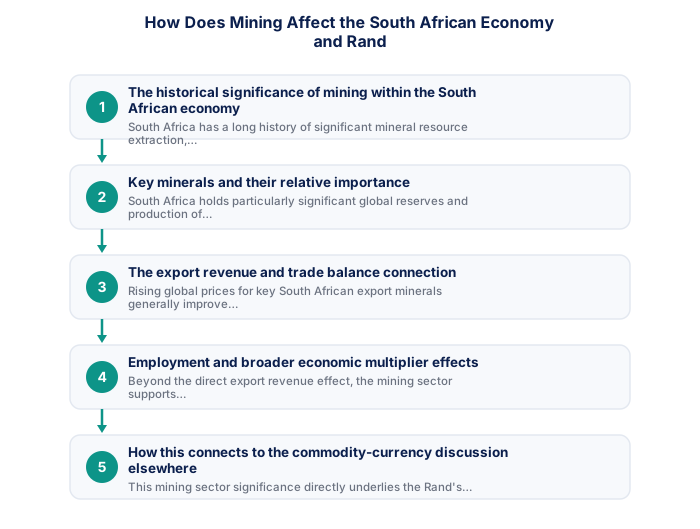
- The historical significance of mining within the South African economy
- Key minerals and their relative importance
- The export revenue and trade balance connection
- Employment and broader economic multiplier effects
- How this connects to the commodity-currency discussion elsewhere
- Tracking mining sector developments as a trader
1. The historical significance of mining within the South African economy
South Africa has a long history of significant mineral resource extraction, historically including major gold mining activity alongside platinum group metals, coal, and various other minerals. While the broader South African economy has diversified considerably over recent decades, mining remains a meaningful contributor to export revenue, employment in specific regions, and overall economic activity.
It's worth checking current data on mining's actual, present-day share of South African GDP rather than relying on its historical reputation alone, since the sector's relative importance to the broader economy has shifted over recent decades as other sectors have grown, worth understanding the current picture rather than an outdated one.
For related context, see the Mining Charter, the Mining Charter directly affects mining company valuations.
2. Key minerals and their relative importance
South Africa holds particularly significant global reserves and production of platinum group metals, alongside meaningful gold and coal production, and various other minerals. Each specific mineral's relative price trends and global demand dynamics can affect different aspects of the broader mining sector's contribution to South African economic activity at any given time.
It's worth building a simple personal reference of which specific minerals matter most for the mining companies and broader economic trends you're actually tracking, rather than treating South African mining as a single, undifferentiated category, since platinum group metals, gold, and coal each respond to somewhat different global demand and pricing dynamics.
- SARB economic calendar checked for the week
- Next Eskom load shedding schedule reviewed
- GNU stability news reviewed
- Stats SA data releases noted
- Credit agency review dates checked
- US/global events that move EM risk noted
3. The export revenue and trade balance connection
Rising global prices for key South African export minerals generally improve the country's trade balance and export revenue, supporting the kind of currency strength's commodity-currency content, while falling commodity prices have the opposite general tendency, all else equal.
It's worth checking South Africa's published trade balance figures periodically alongside global commodity price trends, seeing this connection reflected in actual, official data reinforces the underlying mechanism considerably more concretely than accepting the general principle abstractly.
| Event | Frequency | ZAR impact | Source |
|---|---|---|---|
| SARB MPC | 6x per year | High | resbank.co.za |
| Budget Speech | Annual (February) | Very high | treasury.gov.za |
| Credit reviews | Annual each agency | Very high | Agency sites |
| Stats SA CPI | Monthly | Medium | statssa.gov.za |
| Eskom stage | As needed | Low-medium | eskomsepush.com |
- SA context provides genuine informational edge
- ZAR pairs accessible via FSCA brokers in ZAR accounts
- Rand volatility creates larger intraday ranges
- 6 SARB meetings/year create regular macro setups
- Higher geopolitical risk than G10 pairs
- Load shedding creates unique operational disruptions
- SA rand liquidity thinner than major G10 pairs
- SA-specific news requires constant local monitoring
4. Employment and broader economic multiplier effects
Beyond the direct export revenue effect, the mining sector supports employment and broader economic activity in mining-intensive regions specifically, with associated multiplier effects through supporting industries and local economic activity. Significant shifts in mining sector activity, whether from commodity price changes or sector-specific operational developments, can have effects extending beyond the direct export revenue figures alone.
It's worth appreciating why this broader multiplier effect matters for currency sentiment specifically, beyond the direct export revenue figures, a mining sector downturn affecting regional employment can weigh on broader domestic economic confidence and growth sentiment in ways that compound beyond the trade balance impact alone.
5. How this connects to the commodity-currency discussion elsewhere
This mining sector significance directly underlies the Rand's commodity-currency characteristics, explaining mechanically why gold and broader precious metals price trends, carry the kind of relevance to Rand sentiment that this commodity-currency relationship describes more generally.
6. Tracking mining sector developments as a trader
South African traders following USD/ZAR specifically can incorporate mining sector developments, significant commodity price trends, major operational developments affecting South African mining , or broader policy developments affecting the sector, as one input within the broader fundamental analysis, alongside the other factors.
This connects directly to the SARB's Monetary Policy Committee (MPC), which meets several times a year to set the repo rate, decisions that ripple through borrowing costs, the Rand, and market sentiment well beyond the immediate announcement.
It's worth following both global commodity price trends and South African mining-specific news, labour disputes, operational challenges, regulatory developments, together, since domestic, mining-specific issues can meaningfully affect the sector's actual output and revenue independently of what global commodity prices alone are doing.
China's manufacturing demand connects closely to South African mineral exports, which in turn feeds directly into broader Rand sentiment.
★ Why It Matters
Something worth tracking alongside the Rand if you trade it: Chinese manufacturing data, since China's demand for South African mining exports connects these two seemingly unrelated data points more directly than most traders initially realise.
✕ Common mistakes
- Assuming all mining commodities move together. Different metals respond to different specific demand drivers.
- Not tracking global commodity price trends alongside Rand analysis. These are often more directly connected than purely domestic news.
- Treating mining sector news as having only domestic relevance. Global demand and pricing usually matter more than local headlines alone.
Key Takeaways
- Mining remains a significant South African export sector, connecting commodity price trends, particularly precious metals, directly to broader Rand sentiment.
- Mining remains a significant South African export sector, connecting global commodity price trends, particularly precious metals, directly to broader economic activity and Rand sentiment.
- The historical significance of mining within the South African economy.
- Key minerals and their relative importance.
- The export revenue and trade balance connection.
See also: Why Is August Historically the Rand's Worst Month?.
Frequently asked follow-up questions
Is mining still South Africa's largest economic sector?
The broader economy has diversified considerably; checking current Statistics South Africa sector breakdown data gives the most accurate, current picture of mining's specific relative contribution.
Do mining sector developments affect the JSE as well as the Rand?
Yes, given the JSE's historical sector weighting toward mining and resources, mining sector developments can affect both JSE performance and broader Rand sentiment simultaneously.
Which specific commodity matters most for the Rand?
Gold and platinum group metals are commonly discussed as particularly relevant given South Africa's specific production significance, though overall commodity basket trends matter more broadly than any single mineral in isolation.
